House Sparrow Identification Guide
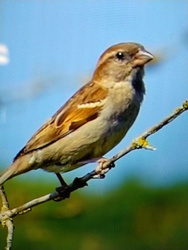
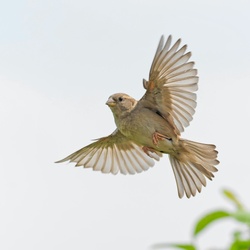
A stocky, adaptable urban songbird with males showing a gray crown, chestnut nape, and black bib, and females identified by their plain buffy-brown, unstreaked face and pale eyebrow stripe.
Read the full House Sparrow encyclopedia entry →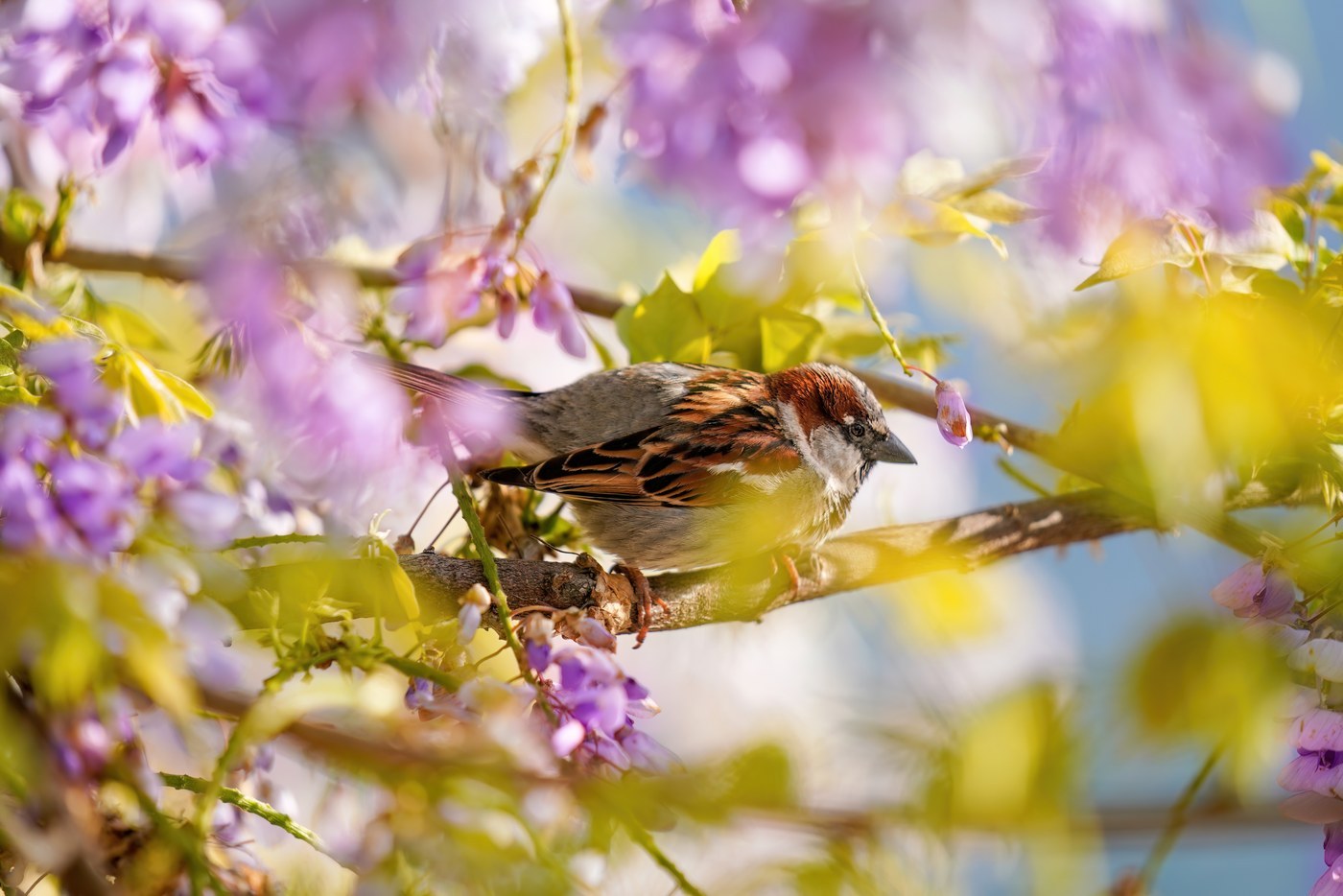
Overview
The House Sparrow (Passer domesticus) is one of the most widespread birds in the world, native to Eurasia and North Africa but introduced and now common on nearly every continent, thriving alongside humans in cities, farms, and towns.
Key Field Marks
- Size & shape: Chunky, big-headed, short-tailed songbird about 5.9-6.7 inches (15-17 cm), with a stout, conical bill.
- Male (breeding): Gray crown, chestnut-brown band running from behind the eye down the nape, black bib/throat patch (larger and blacker in high-status males), white cheeks, and a black bill in breeding season.
- Male (non-breeding): Bib and mask become duller and partly obscured by pale feather fringes; bill turns more horn/yellowish.
- Female/juvenile: Plain, unstreaked buffy-brown face with a distinct pale buffy eyebrow (supercilium) behind the eye, streaked brown back, and dull grayish-brown underparts — notably lacking any black bib.
- Overall structure: Stocky and round-bodied compared to most native New World sparrows, with a thick bill suited to seed cracking.
Separating House Sparrow from Similar Species
Eurasian Tree Sparrow
- Eurasian Tree Sparrow (locally established in parts of the U.S. Midwest) has a solid chestnut-brown crown (not gray) in both sexes and a distinct black cheek spot on an otherwise white face — sexes look alike, unlike House Sparrow's strong sexual dimorphism.
Native New World Sparrows (e.g., Song Sparrow, Chipping Sparrow)
- Most native sparrows have streaked underparts and more slender bodies/bills; female House Sparrow's combination of a plain unstreaked breast, plain face, and pale eyebrow with no central breast spot helps separate it from streaky native sparrows.
Dickcissel (female/non-breeding)
- Superficially similar chunky shape, but Dickcissel has a heavier bluish-gray bill and often a hint of yellow on the breast, plus finer necessarily distinctive back streaking; range and habitat also differ.
Habitat and Range
House Sparrows are closely tied to human development — city centers, farms, suburban yards, barns, and parking lots — and are rarely found far from buildings or agricultural structures. They are native across Europe, the Middle East, and much of Asia and North Africa, and were introduced to North America (New York, 1850s), South America, Australia, and southern Africa, where they are now widespread and often abundant.
Seasonal Occurrence
Year-round residents wherever established; they do not migrate and can be found in the same locations across all seasons.
Behavior
Highly social and often aggressive at feeders and nest sites, House Sparrows will evict native cavity-nesting birds such as bluebirds and Purple Martins from nest boxes. They forage on the ground in flocks, dust-bathe frequently, and readily nest in building crevices, vents, and nest boxes as well as natural cavities.
Voice
A simple, repetitive series of chirping notes — "cheep," "chirrup," or "tschilp" — given by both sexes, often in a monotonous chattering chorus from flocks perched on wires, rooftops, or hedges. There is no complex musical song.
Frequently asked questions
How can I tell a male from a female House Sparrow?
Males show a gray crown, chestnut nape stripe, and black throat bib; females are plain buffy-brown overall with no bib, showing instead a pale eyebrow stripe behind the eye.
Is the House Sparrow related to native American sparrows?
No, House Sparrow belongs to the Old World sparrow family (Passeridae) and is only distantly related to New World sparrows like Song or Chipping Sparrow, which are in a different family.
Where are House Sparrows typically found?
Almost always near human structures — cities, farms, suburban neighborhoods, and agricultural buildings — rather than in wild, undeveloped habitat.
Why do House Sparrows compete with native cavity nesters?
As cavity nesters themselves, House Sparrows aggressively claim nest boxes and cavities, sometimes evicting or even killing native species like Eastern Bluebirds and Purple Martins to take over nest sites.
House Sparrow identified by the community
Recent House Sparrow sightings identified with Bird Identifier.