
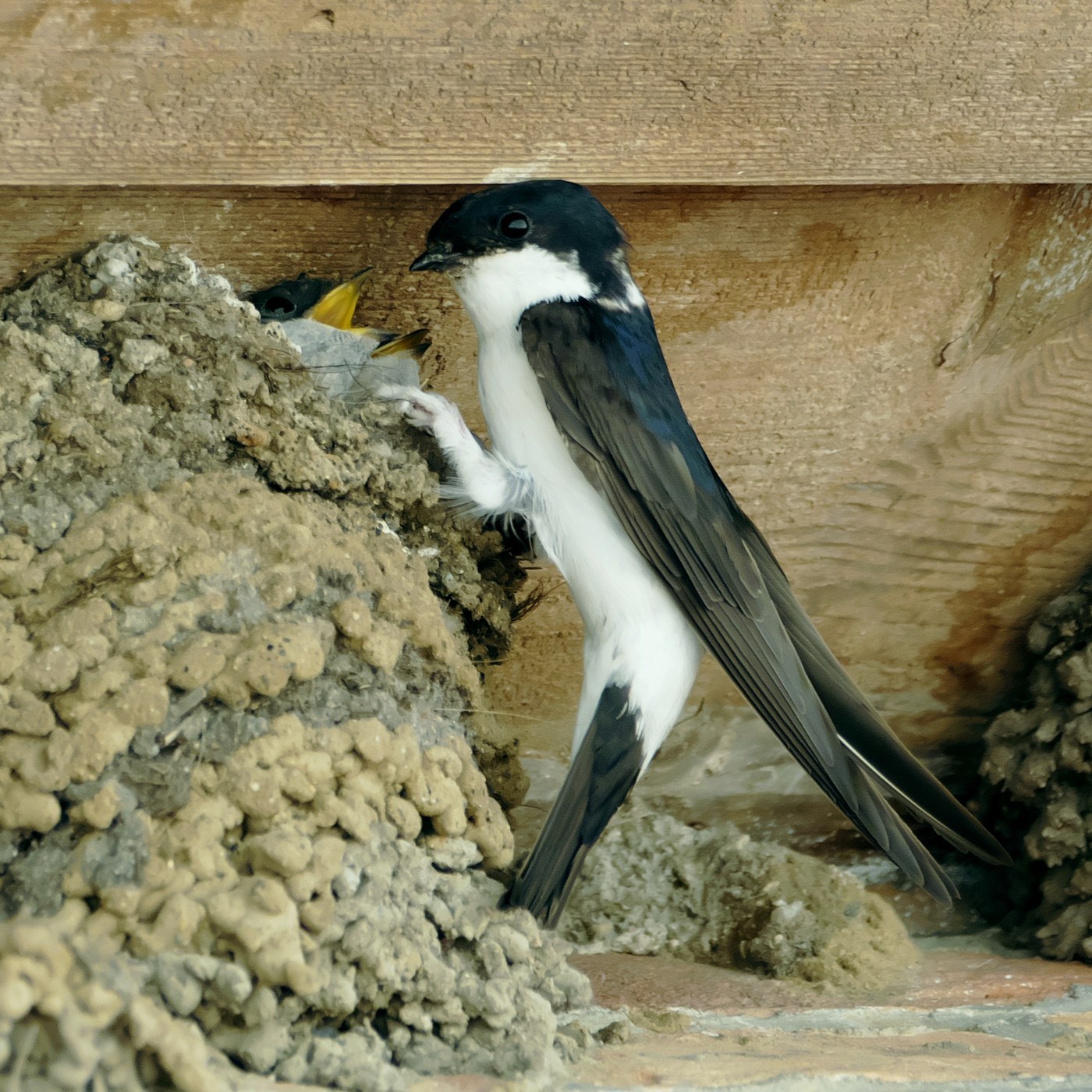
House Martin
Delichon urbicum
A glossy blue-black swallow relative with a clean white rump and underparts, famous for building mud-cup nests under building eaves.
- Size
- 12.5-13.5 cm (5 in) long, 26-29 cm wingspan
- Habitat
- towns, villages, and farmland with buildings or cliffs for nesting
- Type
- songbird
Spotted a bird like this?
Identify any bird from a photo, free.
Overview
The House Martin is a small, agile aerial insectivore closely related to swallows. Adults are glossy blue-black above with crisp white underparts and, most distinctively, a bright white rump that stands out clearly even in fast, distant flight. The tail is short and only shallowly forked, unlike the long streamers of the Barn Swallow.
House Martins are closely tied to human settlements, building distinctive enclosed mud nests with a small entrance hole tucked under the eaves of houses and other buildings.
How to identify it
Key field marks
- Glossy blue-black upperparts with a bold white rump patch
- Clean white underparts, including the throat (no dark breast band or throat patch)
- Short, shallowly forked tail without long streamers
- Flight often higher and more fluttering than swallows, with frequent gliding
Similar species
The Barn Swallow has a deeply forked tail with long streamers, a dark rufous throat, and lacks the white rump. Sand Martin is brown above (not glossy blue-black) with a brown breast band.
Habitat & range
Range
Breeds across Europe, North Africa, and temperate Asia; winters in sub-Saharan Africa and parts of southern Asia.
Habitat
Strongly associated with human habitation, nesting on the outside of buildings in towns and villages, as well as natural cliff faces in some regions; forages over open country, farmland, water, and villages.
Migration
A long-distance migrant, departing breeding grounds in autumn for wintering areas in Africa, returning the following spring, often to the same nest site.
Behavior & voice
Behavior
Highly social, nesting in loose colonies of several to many pairs on suitable buildings, and often foraging and roosting in flocks, sometimes alongside swallows and martins.
Voice
A soft, twittering song and a distinctive dry "chirrp" or "prrit" call given in flight, especially around the nest colony.
Feeding
Catches flying insects on the wing, often foraging higher in the air than Barn Swallows, and gathers mud from puddles and pond edges for nest construction.
Nesting and breeding
Builds an enclosed, cup-shaped nest of mud pellets mixed with saliva, fixed under eaves or overhangs, with a small entrance hole near the top. Lays 4-5 white eggs and often raises two broods, with earlier young sometimes helping feed later broods.
Frequently asked questions
What distinguishes a House Martin from a Barn Swallow?
The House Martin has a white rump and short, only shallowly forked tail with no long streamers, while the Barn Swallow has a deeply forked tail with streamers and a dark, rufous throat.
Where do House Martins build their nests?
They construct enclosed cup nests from mud pellets, typically fixed under the eaves of houses and other buildings.
Do House Martins migrate?
Yes, they are long-distance migrants that winter in sub-Saharan Africa and return to Europe and Asia to breed.
What do House Martins eat?
They feed exclusively on flying insects caught in the air, often foraging at height over villages, farmland, and water.
House Martin guides
In-depth guides for identifying, finding, and understanding House Martin.
Other birds you may enjoy

Black Redstart
13-14.5 cm (5.1-5.7 in) long, 23-26 cm wingspan

Black-throated Sparrow
12-14 cm (4.7-5.5 in) long, about 19-20 cm (7.5-8 in) wingspan

Greater Bird-of-paradise
Body about 43 cm; males with additional flank plumes up to 50 cm and long tail wires

Blue Tit
11-12 cm (4.3-4.7 in) long, 17-20 cm wingspan

Red-billed Quelea
11.5–13 cm long, wingspan about 20–22 cm
White-plumed Antbird
13-14 cm (5-5.5 in) long

Pyrrhuloxia
19-22 cm (7.5-8.7 in) long, 30 cm wingspan

Blue-gray Tanager
16-18 cm (6-7 in) long

Blackburnian Warbler
11-13 cm (4.3-5.1 in) long, 20-22 cm wingspan

Bluethroat
13-14 cm (5.1-5.5 in) long, 20-22 cm wingspan

Eurasian Nuthatch
12-14.5 cm (4.7-5.7 in) long, 22.5-27 cm wingspan

Wood Thrush
19-21 cm (7.5-8.3 in) long, about 33 cm (13 in) wingspan