
House Martin Identification Guide
A small Old World swallow known for its glossy blue-black upperparts, clean white underparts, and the diagnostic white rump patch visible in flight.
Read the full House Martin encyclopedia entry →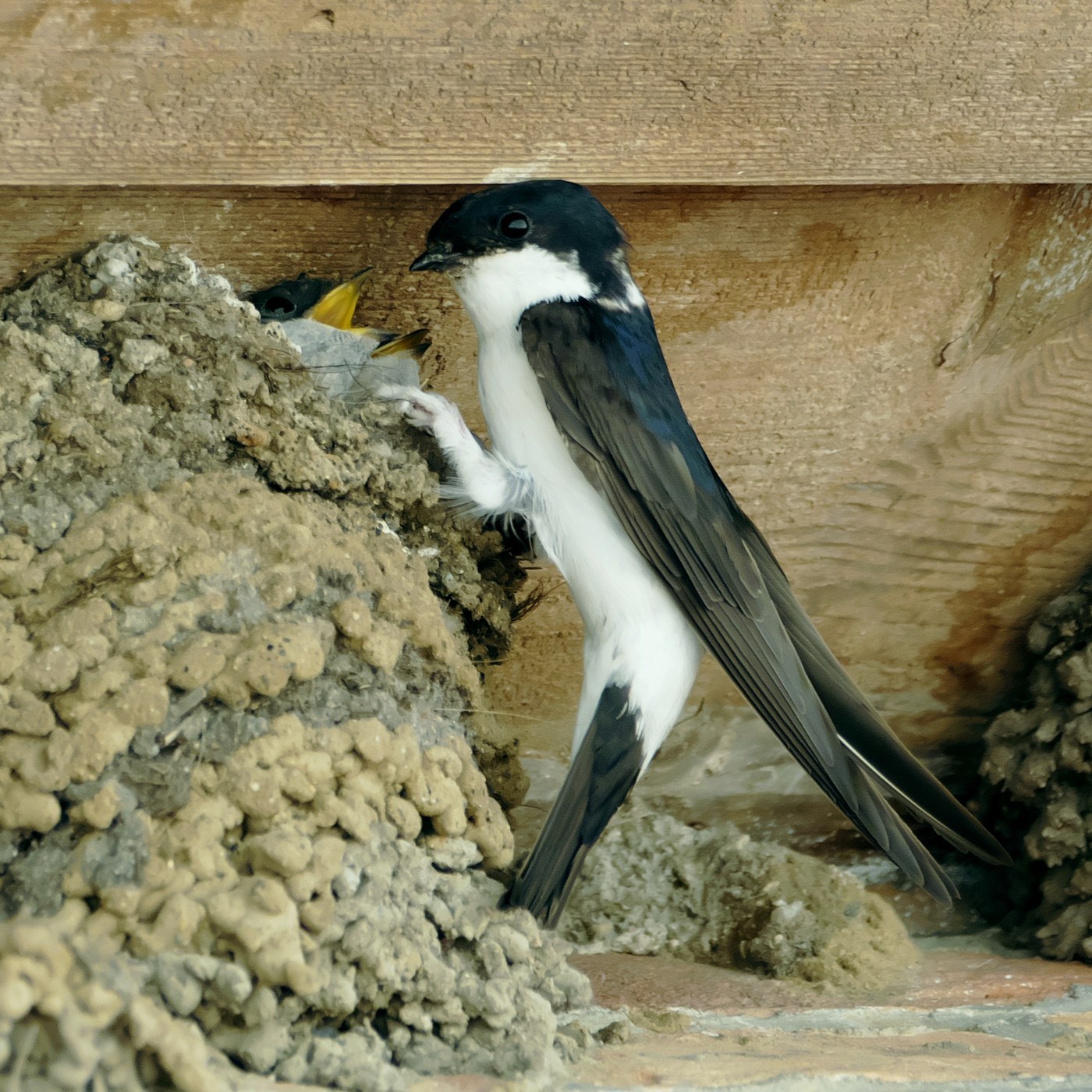
Overview
The (Common) House Martin (Delichon urbicum) is a small aerial-feeding swallow widespread across Europe, Asia, and North Africa, well known for building mud nests under the eaves of buildings — hence the name. It is a long-distance migrant wintering in sub-Saharan Africa and parts of Asia.
Key Field Marks
- Size & shape: Small swallow, about 5.1 inches (13 cm), with a short forked tail (less deeply forked than Barn Swallow) and compact, triangular wings.
- Upperparts: Glossy deep blue-black head, back, and wings.
- Rump: Bold, clean white rump patch — the single best field mark, easily seen as the bird banks and turns in flight.
- Underparts: Entirely clean white below, including the throat, unlike the darker-throated swallows.
- Legs and feet: Feathered white legs and feet, unusual among swallows.
- Tail: Black, shallowly forked, lacking the long streamers of Barn Swallow.
Separating House Martin from Similar Species
Barn Swallow
- Barn Swallow has a deeply forked tail with long thin streamers, a rusty/orange throat and forehead, and lacks the white rump patch entirely.
Sand Martin (Bank Swallow)
- Sand Martin is brown above (not glossy blue-black) with a distinct brown breast band across an otherwise white underside, and no white rump.
Crag Martin / other martins
- Crag Martin is uniformly brownish-gray without a white rump or white underparts, and has a squarer tail with small white tail spots instead.
Habitat and Range
House Martins breed widely across Europe and temperate Asia, nesting colonially in cup-shaped mud nests plastered under eaves, bridges, and cliff overhangs (their original nesting habitat before adapting to buildings). They forage over open country, villages, towns, lakes, and rivers, wherever flying insects are abundant. The species winters in Africa south of the Sahara and in parts of South and Southeast Asia.
Seasonal Occurrence
Summer breeding visitor across its Eurasian range, typically arriving in spring (April-May) and departing by September-October for African or Asian wintering grounds. Passage migrants can appear well outside the breeding range during spring and fall movements.
Behavior
Highly aerial and social, House Martins forage in loose flocks, often high in the air, catching flying insects on the wing. They build enclosed mud nests with a small entrance hole, frequently in tight colonies under building eaves, and readily reuse or repair nests from previous years.
Voice
The song is a soft, twittering warble. The most frequently heard call is a hard, dry "prrit" or "chirrp" given both in flight and around the nest colony.
Frequently asked questions
What is the single best field mark for House Martin?
The bold white rump patch contrasting with glossy blue-black upperparts is diagnostic and visible even at a distance as the bird flies and turns.
How does House Martin differ from Barn Swallow?
House Martin has a white rump, a shorter, shallowly forked tail without streamers, and an all-white throat, while Barn Swallow has no white rump, a deeply forked tail with long streamers, and a rusty throat.
Where do House Martins spend the winter?
Most House Martins winter in sub-Saharan Africa, with some Asian-breeding populations wintering in South and Southeast Asia.
Do House Martins nest on natural cliffs or only buildings?
Originally cliff nesters, House Martins still use natural rock faces in some areas, but the majority of the population now nests on buildings and bridges under eaves and overhangs.