
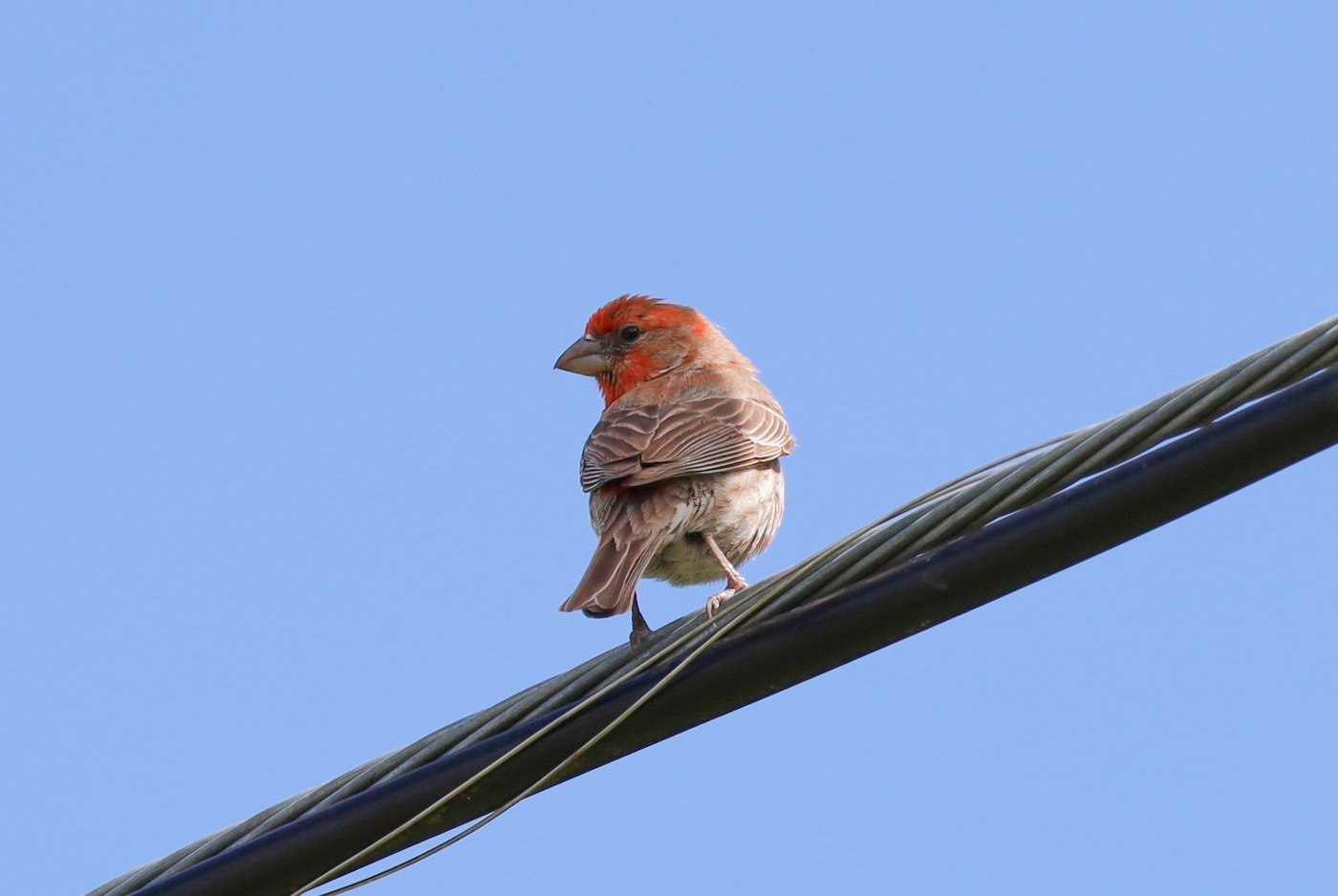
House Finch
Haemorhous mexicanus
A common backyard finch with the male showing rosy red on the head and breast and heavily streaked brown flanks.
- Size
- 12.5-14 cm (5-5.5 in) long, 20-25 cm (8-10 in) wingspan
- Habitat
- urban and suburban areas, farms, deserts, and open woodlands
- Type
- songbird
Spotted a bird like this?
Identify any bird from a photo, free.
Overview
The House Finch is a small, streaky finch that has become one of the most common and familiar birds at feeders across North America. Males have variable amounts of red to orange-red coloring on the forehead, eyebrow, throat, and breast, with the rest of the body brown and heavily streaked, especially on the flanks. Females and immature birds lack any red and are plain grayish-brown with blurry streaking throughout, lacking the bold facial pattern of many similar sparrows.
Originally a bird of the western United States and Mexico, House Finches were introduced to the eastern U.S. in the 1940s (sold illegally as "Hollywood finches") and have since spread to become common across nearly the entire continent.
How to identify it
Key Field Marks
- Male: red to orange-red face, throat, and breast, with brown streaked back and flanks
- Female: plain grayish-brown with diffuse streaking and no strong facial pattern
- Fairly long, slightly curved upper edge to a conical bill
- Squared-off tail tip
Similar Species
- Purple Finch: male has a more raspberry-purple wash covering the head, back, and breast rather than concentrated red, and a more notched tail; female Purple Finch has a bold white eyebrow stripe and dark cheek patch, unlike the plain-faced female House Finch.
- Cassin's Finch (western mountains): male has a more contrasting bright red crown against a paler pink-brown body; ranges overlap in parts of the West.
- Common Redpoll: smaller, with a red cap and black chin, and much whiter overall in winter.
Habitat & range
Habitat
House Finches are highly adaptable and common in urban and suburban neighborhoods, parks, farms, and open or scrubby habitats, as well as deserts and canyons in their native western range.
Range
Native to the western United States and Mexico, House Finches were introduced to New York in the 1940s and have since spread across virtually the entire continental United States and southern Canada.
Migration
Most House Finches are year-round residents and do not undertake long migrations, though some northern and high-elevation populations may shift locally in winter.
Behavior & voice
Behavior
House Finches are social and gregarious, often seen in small flocks at feeders, and they nest readily near human structures, including hanging planters, ledges, and shrubs close to houses.
Voice
The song is a long, bubbly, warbling series of notes, often ending in an upward or downward slurred note; a common call is a sharp "queet."
Feeding
They feed mainly on seeds, buds, and fruit, and are common visitors to feeders offering sunflower seed; unlike many finches they rarely eat insects.
Nesting & Breeding
Females build a cup nest in a wide variety of sites, from tree branches and cactus to building ledges and hanging planters, and typically lay 2-6 pale bluish-white eggs with fine speckling. Pairs may raise multiple broods in a season.
Frequently asked questions
Why do male House Finches vary in how red they are?
The intensity of a male's red coloring depends on pigments (carotenoids) obtained from food during molt, so diet quality directly affects color, which can range from pale yellow-orange to deep red.
How did House Finches spread across the eastern United States?
Illegally captured western House Finches sold as cage birds ("Hollywood finches") were released on Long Island, New York, around 1940, and the population expanded rapidly to cover most of the eastern U.S. within a few decades.
What is House Finch eye disease?
House Finches are commonly affected by a bacterial conjunctivitis (Mycoplasma gallisepticum) that causes swollen, crusty eyes and was first documented spreading through the species in the 1990s; keeping feeders clean helps reduce transmission.
How do you tell House Finch and Purple Finch apart?
Male House Finches show red concentrated on the head and breast with brown streaked flanks, while male Purple Finches have a more raspberry wash extending over the head, back, and breast; females differ mainly by facial pattern, with Purple Finch showing a bold white eyebrow and dark cheek.
Do House Finches migrate?
Most House Finches are non-migratory residents throughout the year, though some northern populations may move short distances in harsh winters.
House Finch guides
In-depth guides for identifying, finding, and understanding House Finch.
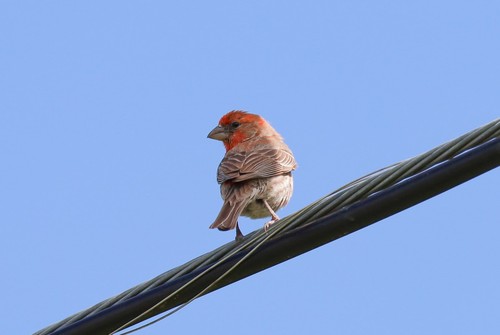
House Finch identified by the community
Real birds identified with Bird Identifier.

Other birds you may enjoy

Black Redstart
13-14.5 cm (5.1-5.7 in) long, 23-26 cm wingspan

Black-throated Sparrow
12-14 cm (4.7-5.5 in) long, about 19-20 cm (7.5-8 in) wingspan

Greater Bird-of-paradise
Body about 43 cm; males with additional flank plumes up to 50 cm and long tail wires

Blue Tit
11-12 cm (4.3-4.7 in) long, 17-20 cm wingspan

Red-billed Quelea
11.5–13 cm long, wingspan about 20–22 cm
White-plumed Antbird
13-14 cm (5-5.5 in) long

Pyrrhuloxia
19-22 cm (7.5-8.7 in) long, 30 cm wingspan

Blue-gray Tanager
16-18 cm (6-7 in) long

Blackburnian Warbler
11-13 cm (4.3-5.1 in) long, 20-22 cm wingspan

Bluethroat
13-14 cm (5.1-5.5 in) long, 20-22 cm wingspan

Eurasian Nuthatch
12-14.5 cm (4.7-5.7 in) long, 22.5-27 cm wingspan

Wood Thrush
19-21 cm (7.5-8.3 in) long, about 33 cm (13 in) wingspan