
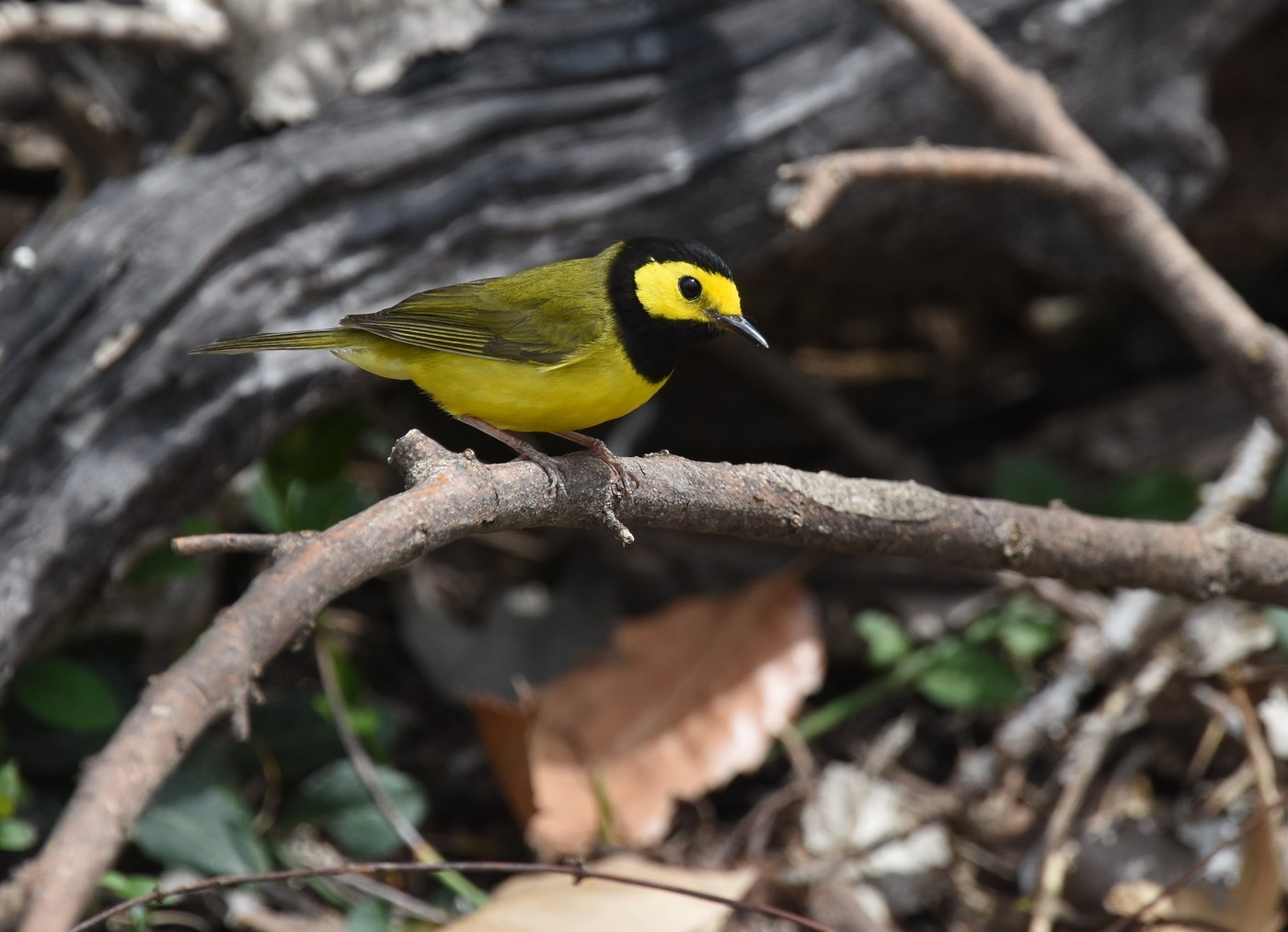
Hooded Warbler
Setophaga citrina
A vivid yellow-faced warbler of eastern forest understory whose males wear a bold black hood, and which flashes white outer tail feathers as it flicks its tail while foraging.
- Size
- 12-14 cm (4.7-5.5 in) long, 17-19 cm wingspan
- Habitat
- mature deciduous forest with a dense shrubby understory
- Type
- songbird
Spotted a bird like this?
Identify any bird from a photo, free.
Overview
The Hooded Warbler is one of the most striking birds of the eastern forest understory. Adult males have a brilliant yellow face set within a solid black hood that covers the crown, throat, and sides of the neck, creating a dramatic, almost masked appearance. Females and immatures are more subdued, typically showing an olive crown and only a partial or absent black hood, though the bright yellow face and underparts remain.
Both sexes share olive-green upperparts and clean yellow underparts, and all ages habitually fan and flick the tail, revealing conspicuous white outer tail feathers that flash as the bird moves through dense cover.
How to identify it
Key field marks
- Bright yellow face surrounded by a black hood (bold and complete in adult males)
- Olive-green upperparts, yellow underparts
- Large white patches in the outer tail feathers, frequently flashed as the tail is flicked open
- Fairly large, dark eye standing out against the yellow face
Similar species
Females lacking a black hood can suggest Wilson's Warbler, but Hooded Warbler is larger, has extensive white in the tail (which Wilson's lacks), and habitually fans its tail. Yellow Warbler also lacks tail spots and has a more uniformly yellow body without the crisp olive back contrast.
Habitat & range
Hooded Warblers breed in mature deciduous and mixed forests across the eastern United States, with a strong preference for stands that have a dense shrub and sapling understory, including forest gaps created by treefalls. They are also found in edges of bottomland forest and can be locally common in mature woodlots with a well-developed understory layer.
They winter primarily in Mexico, Central America, and parts of the Caribbean, using similar understory-rich forest habitat.
Behavior & voice
Behavior and voice
Hooded Warblers forage actively low in dense vegetation and frequently make short flycatching sallies to snatch flying insects, using the flashing white tail feathers to help flush prey from foliage.
The song is a loud, ringing series often rendered as "ta-wit ta-wit ta-wit tee-yo," delivered with a bright, whistled quality that carries well through dense understory.
Nesting
The female builds a compact cup nest low in a shrub or sapling, typically within a few feet of the ground, made of bark strips, leaves, and plant down. Clutches usually contain 3-5 eggs, and the species is a frequent host of Brown-headed Cowbird brood parasitism.
Frequently asked questions
How can you tell a female Hooded Warbler from a male?
Males have a bold, complete black hood surrounding a yellow face, while females typically show an olive crown with little or no black, though some females do show a partial hood.
Why does the Hooded Warbler flick its tail?
It habitually fans and flicks its tail, flashing large white patches in the outer tail feathers, which is thought to help startle and flush insect prey from foliage.
What kind of forest does the Hooded Warbler need?
It prefers mature deciduous or mixed forest with a well-developed shrubby understory, including canopy gaps and edges, rather than open woodland or pure canopy habitat.
What does a Hooded Warbler sound like?
Its song is a loud, bright, ringing phrase often rendered as "ta-wit ta-wit ta-wit tee-yo."
Where do Hooded Warblers spend the winter?
They winter mainly in Mexico, Central America, and parts of the Caribbean, in forest with similar dense understory.
Hooded Warbler guides
In-depth guides for identifying, finding, and understanding Hooded Warbler.
Other birds you may enjoy

Black Redstart
13-14.5 cm (5.1-5.7 in) long, 23-26 cm wingspan

Black-throated Sparrow
12-14 cm (4.7-5.5 in) long, about 19-20 cm (7.5-8 in) wingspan

Greater Bird-of-paradise
Body about 43 cm; males with additional flank plumes up to 50 cm and long tail wires

Blue Tit
11-12 cm (4.3-4.7 in) long, 17-20 cm wingspan

Red-billed Quelea
11.5–13 cm long, wingspan about 20–22 cm
White-plumed Antbird
13-14 cm (5-5.5 in) long

Pyrrhuloxia
19-22 cm (7.5-8.7 in) long, 30 cm wingspan

Blue-gray Tanager
16-18 cm (6-7 in) long

Blackburnian Warbler
11-13 cm (4.3-5.1 in) long, 20-22 cm wingspan

Bluethroat
13-14 cm (5.1-5.5 in) long, 20-22 cm wingspan

Eurasian Nuthatch
12-14.5 cm (4.7-5.7 in) long, 22.5-27 cm wingspan

Wood Thrush
19-21 cm (7.5-8.3 in) long, about 33 cm (13 in) wingspan