
Hooded Warbler Identification Guide
A bright yellow-faced warbler of eastern deciduous forest understory, the male Hooded Warbler is framed by a bold black hood covering the crown and throat, and both sexes flash white tail spots while foraging.
Read the full Hooded Warbler encyclopedia entry →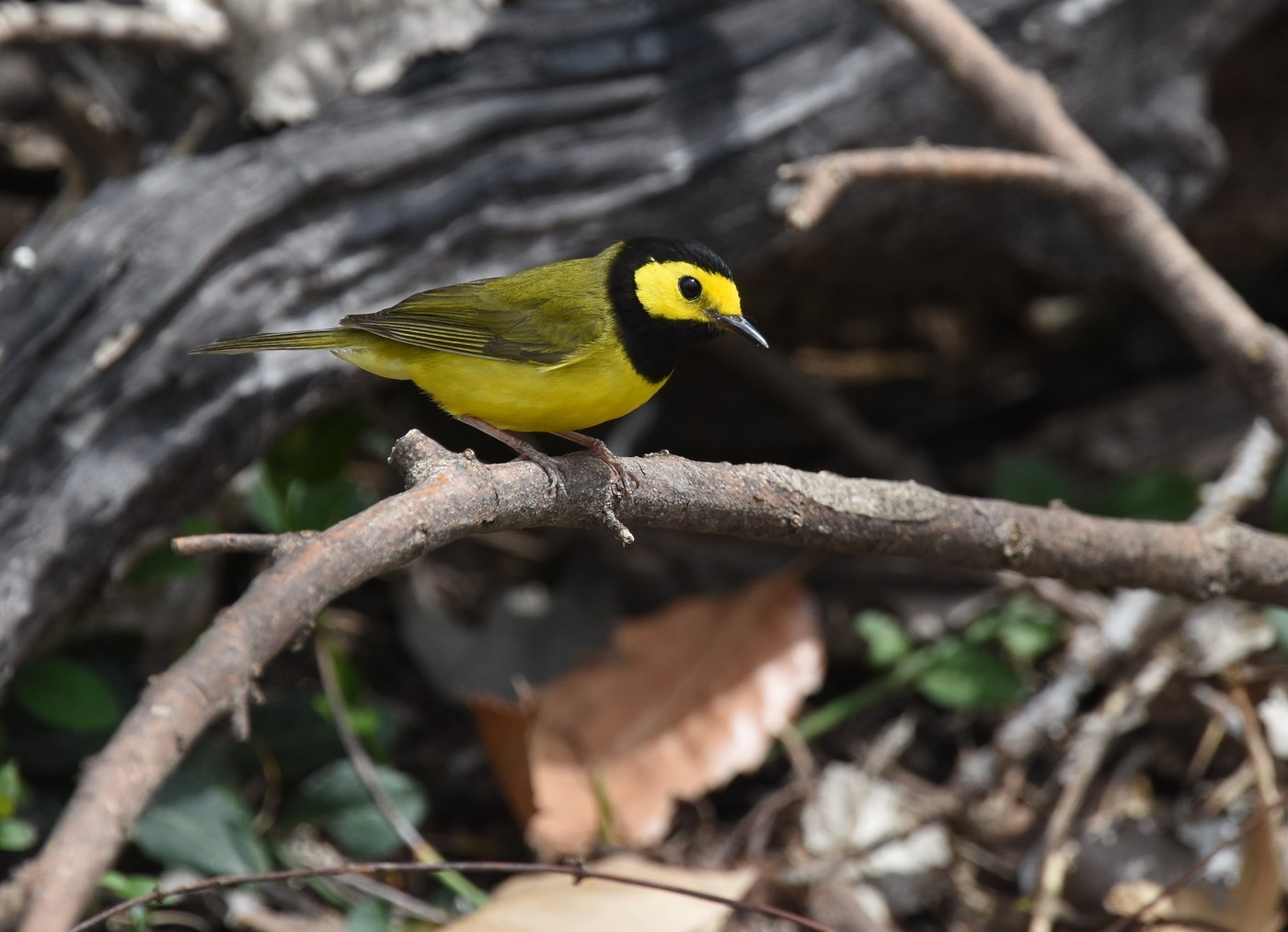
Key Field Marks
- Size & shape: A small warbler, about 13 cm (5 in) long, with a fairly large, dark eye, a relatively long tail often flicked and spread while foraging, and an active, low-foraging habit in dense shrub layers.
- Male plumage: Bright yellow face and underparts framed by a bold black hood covering the crown, nape, and throat, leaving only the yellow face open in the center — a striking, distinctive pattern. The back and wings are plain olive-green, with no wing bars.
- Female/immature plumage: Duller and more variable; many females show an incomplete or largely absent black hood, appearing mostly olive above and yellow below with a plain yellowish face, though some females do show partial dark markings on the crown or throat.
- Tail: Both sexes show large white spots on the outer tail feathers, frequently flashed as the bird fans and flicks its tail while hopping through low vegetation — a key foraging behavior and identification aid.
Separating It From Similar Species
- Wilson's Warbler: Male Wilson's has only a small black cap restricted to the crown, without the black extending down to the throat as a full hood, and lacks the white tail spots of Hooded Warbler.
- Kentucky Warbler: Shows black on the face/sides of the crown and a yellow "spectacles" pattern around the eye, but lacks the solid black hood and white tail spots of Hooded Warbler, and forages more on the ground.
- Female Hooded Warbler vs. other plain yellow-olive warblers: The habit of persistently flicking open a white-spotted tail while foraging low in shrubs is a strong behavioral clue even when the hood is faint or absent.
Where & When to See One
Hooded Warblers breed in the understory of mature deciduous and mixed forests across the eastern United States, favoring areas with dense shrub layers, forest gaps, and edges, from roughly the Midwest and mid-Atlantic south through the Southeast. They are Neotropical migrants, arriving on breeding grounds in spring (April–May) and departing in fall to winter in Mexico, Central America, and the Caribbean. Look for them low in shady, shrubby understory rather than high in the canopy, often near forest edges or gaps with dense saplings.
Voice
A loud, ringing song often rendered as "ta-wit ta-wit ta-wit tee-o" or "weeta weeta weet-tee-o," with an emphatic downslurred final note, delivered frequently from low-to-mid perches. The call note is a sharp, metallic "chip."
Frequently asked questions
What is the key field mark for a male Hooded Warbler?
A bold black hood covering the crown, nape, and throat that frames a bright yellow face, combined with white spots flashed in the outer tail feathers.
How do I identify a female Hooded Warbler, which often lacks the full hood?
Look for an olive-above, yellow-below warbler that persistently flicks and fans a tail showing large white spots while foraging low in dense shrubs — a strong behavioral clue even without a complete hood.
How is Hooded Warbler different from Wilson's Warbler?
Male Wilson's Warbler has only a small black cap on the crown without black extending to the throat, and it lacks the white tail spots shown by Hooded Warbler.
Where should I look for Hooded Warblers?
Search the shady, shrubby understory of mature deciduous forest in the eastern United States during the breeding season, particularly near forest edges and gaps with dense low vegetation.