
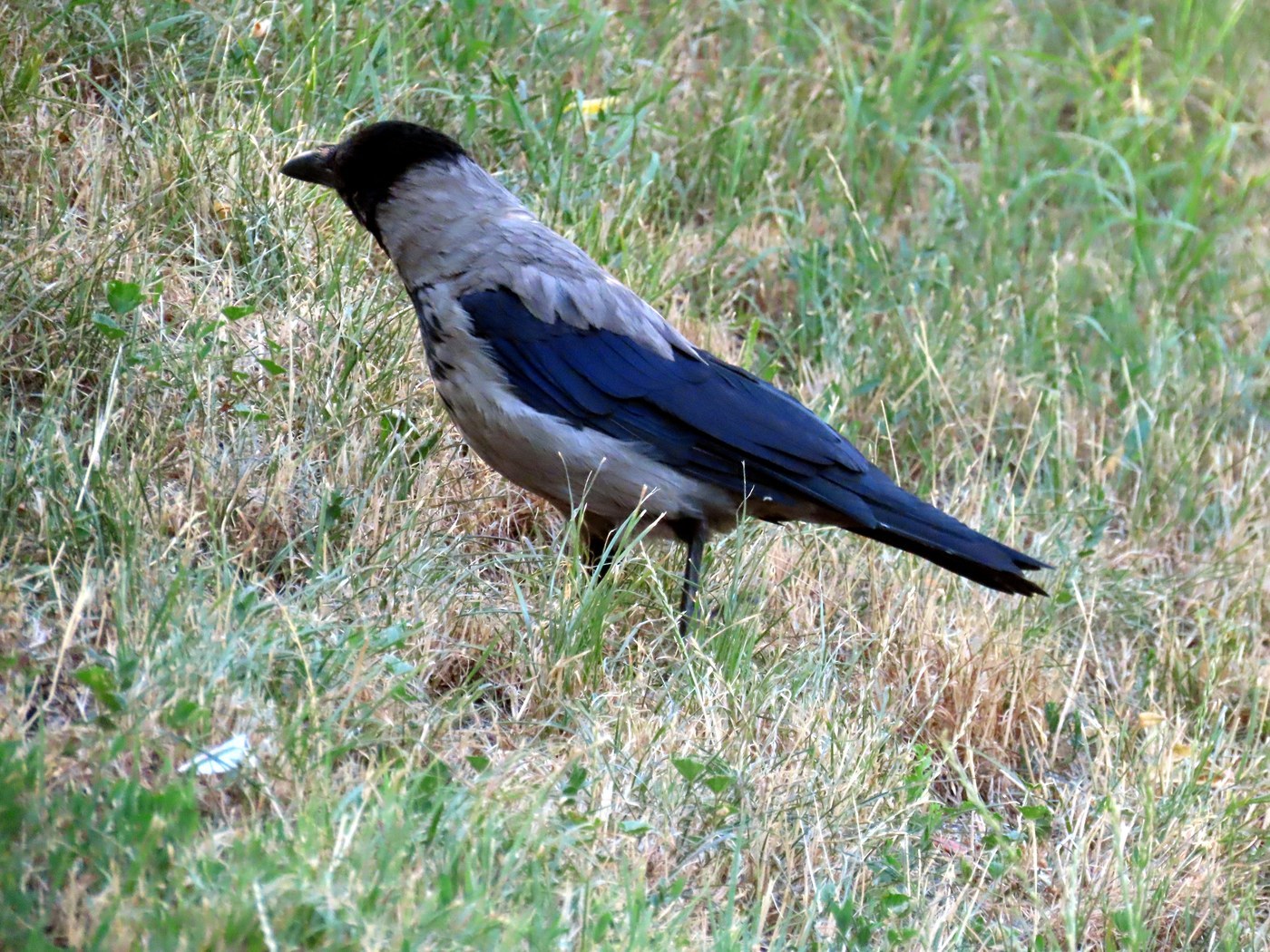
Hooded Crow
Corvus cornix
A pale grey-bodied crow with a contrasting black head, wings and tail, closely related to and interbreeding with the Carrion Crow.
- Size
- 46–51 cm long, wingspan around 98 cm
- Habitat
- Farmland, coasts, and open country across northern, eastern Europe and the Middle East
- Type
- songbird
Spotted a bird like this?
Identify any bird from a photo, free.
Overview
The Hooded Crow is a large corvid closely related to the Carrion Crow, from which it differs strikingly in plumage: the head, throat, wings, and tail are glossy black, while the back, breast, and belly are ash-grey, creating a two-toned, "hooded" appearance.
In size, shape, bill structure, and behavior it closely resembles the Carrion Crow, and the two were formerly treated as a single species. Where their ranges meet, in a band through central Europe, they interbreed and produce intermediate hybrids.
How to identify it
Key field marks
- Grey back, breast, and belly contrasting with black head, throat, wings, and tail
- Straight black bill, similar shape to Carrion Crow
- Same general size and structure as Carrion Crow
Similar species
- Carrion Crow: entirely black; the two species replace one another geographically and hybridize in a contact zone, producing birds with patchy grey-and-black plumage
- Rook: black overall with a bare pale face patch, unlike the Hooded Crow's grey body
Behavior cues
Behavior, voice, and habits are essentially identical to the Carrion Crow — plumage pattern is the reliable distinguishing feature.
Habitat & range
Habitat
Occupies farmland, coastal areas, moorland, and open country, as well as towns in parts of its range.
Range
Found across northern and eastern Europe (including Scotland, Ireland, and Scandinavia), the Balkans, and eastward through the Middle East and parts of Central Asia, where it replaces the Carrion Crow.
Migration
Mostly resident, though northern populations may move south in severe winters; some local dispersal occurs outside the breeding season.
Behavior & voice
Behavior
Like the Carrion Crow, Hooded Crows are typically seen alone, in pairs, or in small family groups, holding territories year-round, though non-breeders may gather in loose flocks.
Voice
Calls are indistinguishable from the Carrion Crow's — a harsh, deliberate "caw-caw-caw."
Feeding
An opportunistic omnivore, taking carrion, invertebrates, grain, eggs, and small animals, and scavenging readily near human activity.
Nesting and breeding
Builds a sturdy stick nest in a tree, on a cliff, or occasionally on a structure. Clutches usually number 3–5 eggs, incubated mainly by the female.
Frequently asked questions
How is a Hooded Crow different from a Carrion Crow?
The Hooded Crow has a grey body with a black head, wings, and tail, while the Carrion Crow is entirely black; they hybridize where their ranges overlap.
Where are Hooded Crows found?
Northern and eastern Europe, the Balkans, the Middle East, and parts of Central Asia.
Do Hooded Crows and Carrion Crows interbreed?
Yes, in the contact zone where their ranges meet they hybridize, producing offspring with intermediate grey-and-black plumage.
What does a Hooded Crow eat?
It is an omnivorous scavenger eating carrion, invertebrates, grain, and small animals.
Hooded Crow guides
In-depth guides for identifying, finding, and understanding Hooded Crow.
Other birds you may enjoy

Black Redstart
13-14.5 cm (5.1-5.7 in) long, 23-26 cm wingspan

Black-throated Sparrow
12-14 cm (4.7-5.5 in) long, about 19-20 cm (7.5-8 in) wingspan

Greater Bird-of-paradise
Body about 43 cm; males with additional flank plumes up to 50 cm and long tail wires

Blue Tit
11-12 cm (4.3-4.7 in) long, 17-20 cm wingspan

Red-billed Quelea
11.5–13 cm long, wingspan about 20–22 cm
White-plumed Antbird
13-14 cm (5-5.5 in) long

Pyrrhuloxia
19-22 cm (7.5-8.7 in) long, 30 cm wingspan

Blue-gray Tanager
16-18 cm (6-7 in) long

Blackburnian Warbler
11-13 cm (4.3-5.1 in) long, 20-22 cm wingspan

Bluethroat
13-14 cm (5.1-5.5 in) long, 20-22 cm wingspan

Eurasian Nuthatch
12-14.5 cm (4.7-5.7 in) long, 22.5-27 cm wingspan

Wood Thrush
19-21 cm (7.5-8.3 in) long, about 33 cm (13 in) wingspan