
Hooded Crow Identification Guide
A gray-bodied crow with a black head, wings, and tail, the Hooded Crow replaces the all-black Carrion Crow across much of northern, eastern, and southern Europe, the Middle East, and parts of Asia.
Read the full Hooded Crow encyclopedia entry →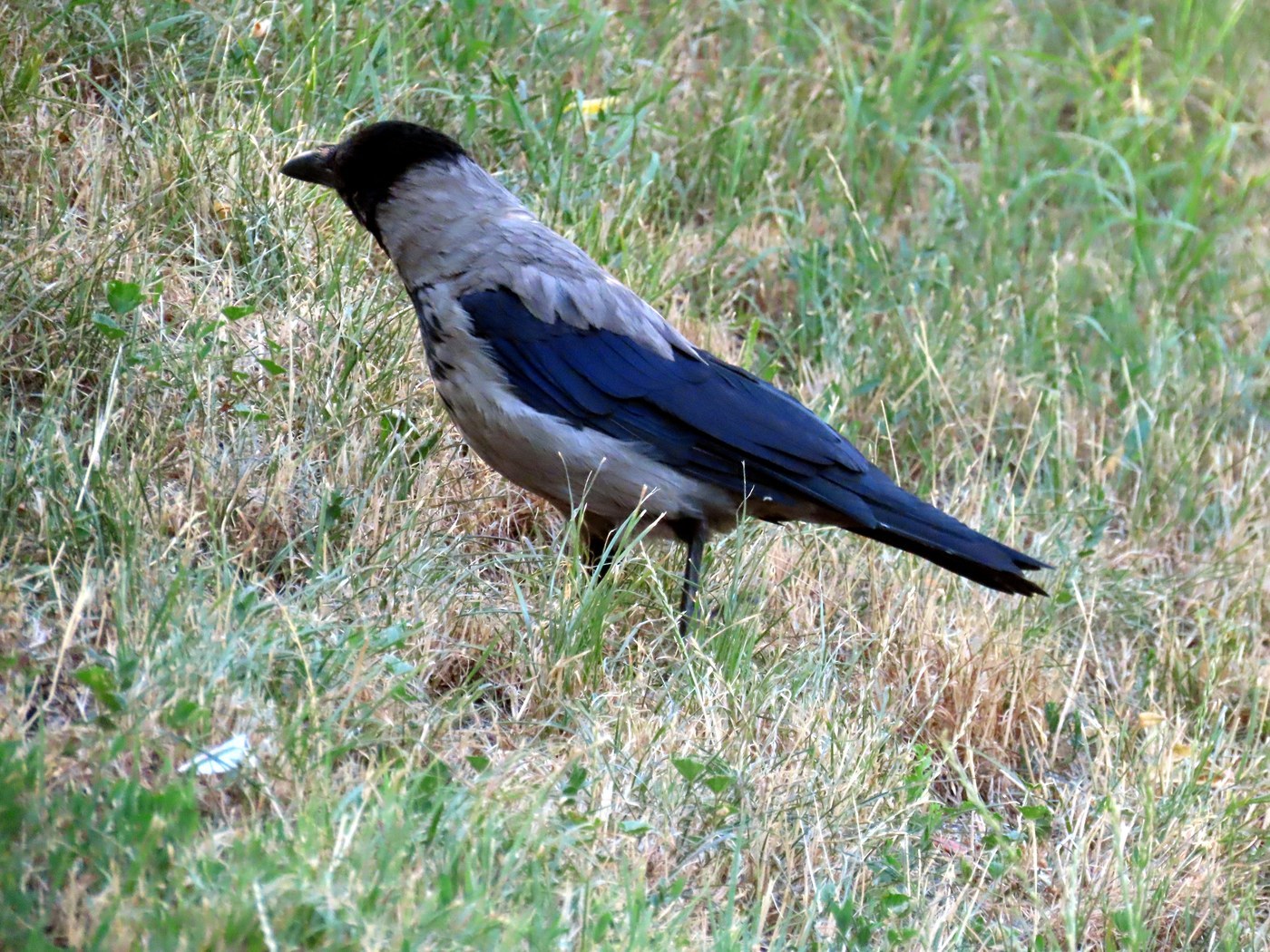
Key Field Marks
- Size & shape: A large corvid, about 45–47 cm (18 in) long, structurally identical to the Carrion Crow — stout black bill, broad wings, and a fairly squared tail typical of "black crow" species.
- Plumage pattern: The defining feature is the two-toned plumage: black head, throat, wings, and tail contrasting with an ash-gray body (back, breast, belly, and mantle).
- Bill and legs: Black, heavy bill and black legs, as in other members of the crow family.
- In flight: The gray body against black head, wingtips, and tail is obvious and diagnostic even at a distance, unlike the uniformly black silhouette of Carrion Crow or Rook.
Separating It From Similar Species
- Carrion Crow: Entirely glossy black with no gray in the plumage; the two species meet and hybridize in a narrow contact zone across parts of Europe (such as Scotland, parts of Germany and Italy), where intermediate birds with patchy gray can occur.
- Rook: All black like Carrion Crow but with a bare, whitish-gray face patch at the base of a more pointed bill and a distinctly peaked, "trousered" look to the leg feathers — easily separated from Hooded Crow's gray-and-black pattern.
- Jackdaw: Much smaller, with a gray nape and pale eye, not to be confused with the larger, gray-bodied Hooded Crow.
Where & When to See One
Hooded Crow is resident and widespread across northern and eastern Europe (Scandinavia, Scotland, Ireland, Russia), the eastern Mediterranean, the Middle East, and parts of Central Asia, generally replacing Carrion Crow to the east and north of a diagonal contact zone running through Europe. It occupies a very wide range of habitats, including farmland, coastlines, moorland, urban areas, and open woodland, and is a highly adaptable omnivorous generalist, much like other crows.
Voice
A harsh, grating "caw" or "kraa," typically given in a series of three or four repeated notes, very similar to the voice of Carrion Crow — the two are essentially indistinguishable by ear, so visual plumage pattern remains the key identification tool.
Frequently asked questions
What is the main difference between a Hooded Crow and a Carrion Crow?
Hooded Crow has a gray body contrasting with a black head, wings, and tail, while Carrion Crow is entirely glossy black.
Do Hooded Crows and Carrion Crows ever look alike?
The two species hybridize in a narrow contact zone in parts of Europe, occasionally producing birds with intermediate or patchy gray-and-black plumage.
Where does the Hooded Crow live?
It is resident across northern and eastern Europe, the Middle East, and parts of Central Asia, generally to the north and east of the Carrion Crow's range.
Can voice help separate Hooded Crow from Carrion Crow?
Not really — their calls are essentially identical harsh 'caw' notes, so plumage pattern is the most reliable way to distinguish them.