
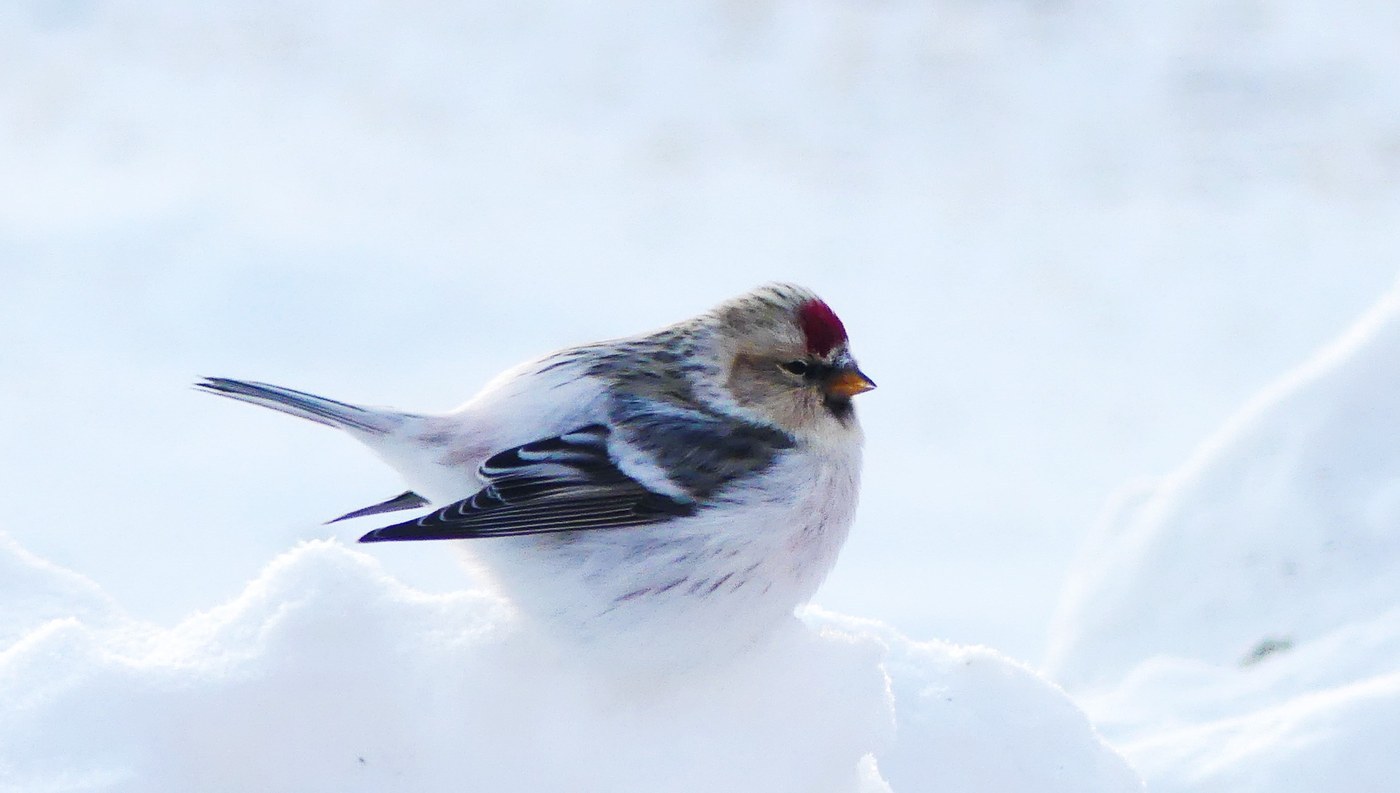
Hoary Redpoll
Acanthis hornemanni
A pale, frosty-looking arctic finch, closely resembling the Common Redpoll but adapted to even colder, higher-latitude habitat.
- Size
- 12-14 cm (4.7-5.5 in) long, 20-22 cm wingspan
- Habitat
- high arctic tundra, open scrub near the northern limit of trees
- Type
- songbird
Spotted a bird like this?
Identify any bird from a photo, free.
Overview
The Hoary Redpoll is the paler, "frostier" counterpart to the Common Redpoll, breeding at even higher latitudes across the high arctic. It shares the same basic pattern — a red cap, black chin, and streaky body — but overall looks whiter and less heavily marked, with a stubbier, smaller bill, an unstreaked or only lightly streaked white rump, and reduced flank streaking. Males show a faint pink wash on the breast; females are essentially unmarked pale gray-white below aside from fine streaking on the sides.
Because plumage variation within Common Redpoll overlaps considerably with Hoary Redpoll, and genetic studies have found the two to be extremely closely related, identification in the field can be genuinely difficult, and some ornithologists consider them different forms of a single variable species.
How to identify it
Key Field Marks
- Overall paler, frostier plumage than Common Redpoll
- Smaller, more conical, "pushed-in" looking bill
- Largely unstreaked white rump (versus streaked in Common Redpoll)
- Reduced streaking on flanks and undertail coverts
- Red cap and small black chin, as in Common Redpoll
Similar Species
- Common Redpoll: darker, more heavily streaked overall, especially on the rump and flanks, with a slightly longer, more pointed bill; separating the two safely often requires close comparison of multiple features.
- Pine Siskin: lacks the red cap and shows yellow edging in wings and tail.
Habitat & range
Habitat
Hoary Redpolls breed in high arctic tundra, often in sparser, more open scrub and rocky terrain than Common Redpolls, near the northern edge of woody vegetation.
Range
The species has a circumpolar high-arctic distribution, breeding in the northernmost parts of Canada, Alaska, Greenland, and Eurasia.
Migration
Hoary Redpolls make irregular, irruptive movements southward in winter, generally in smaller numbers than Common Redpolls and often mixed within larger Common Redpoll flocks, reaching southern Canada and the northern United States in invasion years.
Behavior & voice
Behavior
Hoary Redpolls behave much like Common Redpolls, foraging actively and often gregariously, frequently joining mixed flocks with their more numerous relative during winter irruptions.
Voice
Calls and song are very similar to the Common Redpoll's dry rattles and buzzy trills, making voice an unreliable way to separate the two species.
Feeding
Diet centers on small seeds of birch, willow, and tundra forbs, with insects taken during the brief summer breeding season.
Nesting
Nests are built low in scrub or on sheltered ground, lined with feathers and plant down for insulation against arctic cold. Clutches typically number 4-7 eggs.
Frequently asked questions
Is the Hoary Redpoll really a separate species from the Common Redpoll?
They are currently classified as separate species, but genetic studies show them to be very closely related with overlapping plumage variation, and some researchers argue they represent one variable species.
How do I identify a Hoary Redpoll in a flock of Common Redpolls?
Look for an overall paler, frostier bird with a smaller stubby bill, an unstreaked white rump, and minimal flank streaking, and expect to see it as the exception among mostly Common Redpolls.
Where does the Hoary Redpoll breed?
It nests in high arctic tundra habitats farther north than Common Redpoll, across the northernmost reaches of Canada, Alaska, Greenland, and Eurasia.
Does the Hoary Redpoll visit backyard feeders?
Occasionally, especially during larger irruption winters when it may appear mixed in with flocks of Common Redpolls at feeders offering small seeds.
What does a Hoary Redpoll eat?
Mainly small seeds from birch, willow, and other tundra plants, supplemented with insects during the short arctic summer.
Hoary Redpoll guides
In-depth guides for identifying, finding, and understanding Hoary Redpoll.
Other birds you may enjoy
Black Redstart
13-14.5 cm (5.1-5.7 in) long, 23-26 cm wingspan
Black-throated Sparrow
12-14 cm (4.7-5.5 in) long, about 19-20 cm (7.5-8 in) wingspan
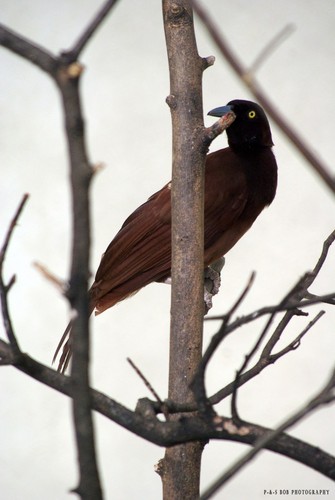
Greater Bird-of-paradise
Body about 43 cm; males with additional flank plumes up to 50 cm and long tail wires
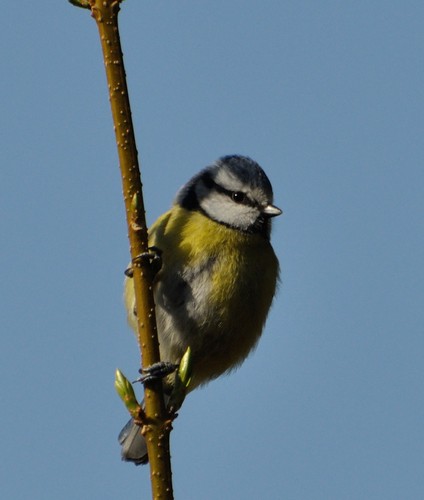
Blue Tit
11-12 cm (4.3-4.7 in) long, 17-20 cm wingspan
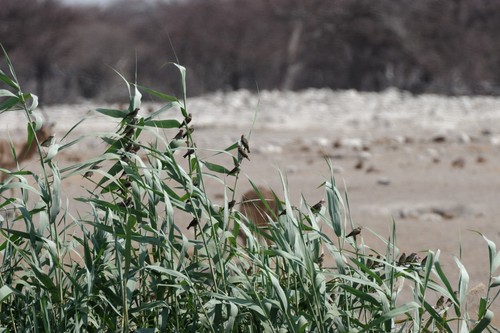
Red-billed Quelea
11.5–13 cm long, wingspan about 20–22 cm
White-plumed Antbird
13-14 cm (5-5.5 in) long
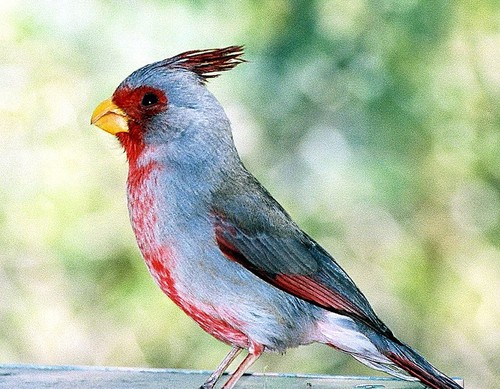
Pyrrhuloxia
19-22 cm (7.5-8.7 in) long, 30 cm wingspan
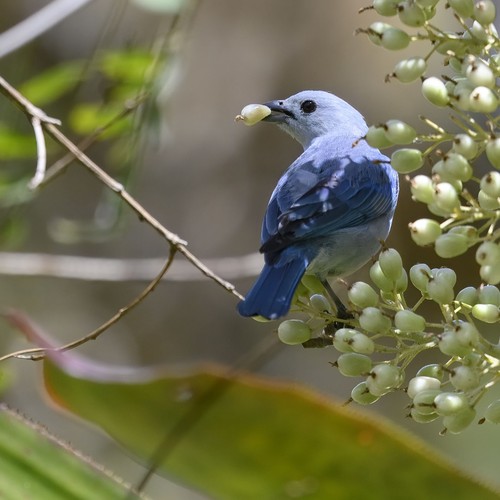
Blue-gray Tanager
16-18 cm (6-7 in) long
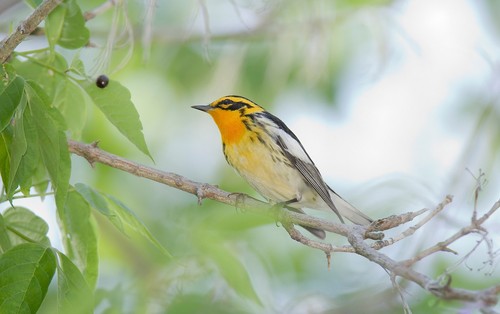
Blackburnian Warbler
11-13 cm (4.3-5.1 in) long, 20-22 cm wingspan
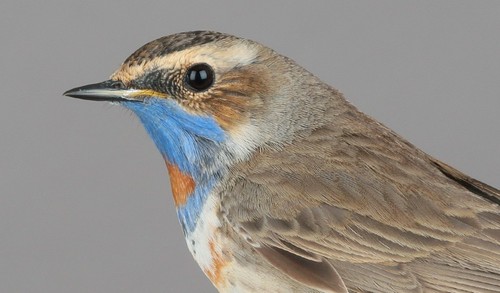
Bluethroat
13-14 cm (5.1-5.5 in) long, 20-22 cm wingspan
Eurasian Nuthatch
12-14.5 cm (4.7-5.7 in) long, 22.5-27 cm wingspan
Wood Thrush
19-21 cm (7.5-8.3 in) long, about 33 cm (13 in) wingspan