
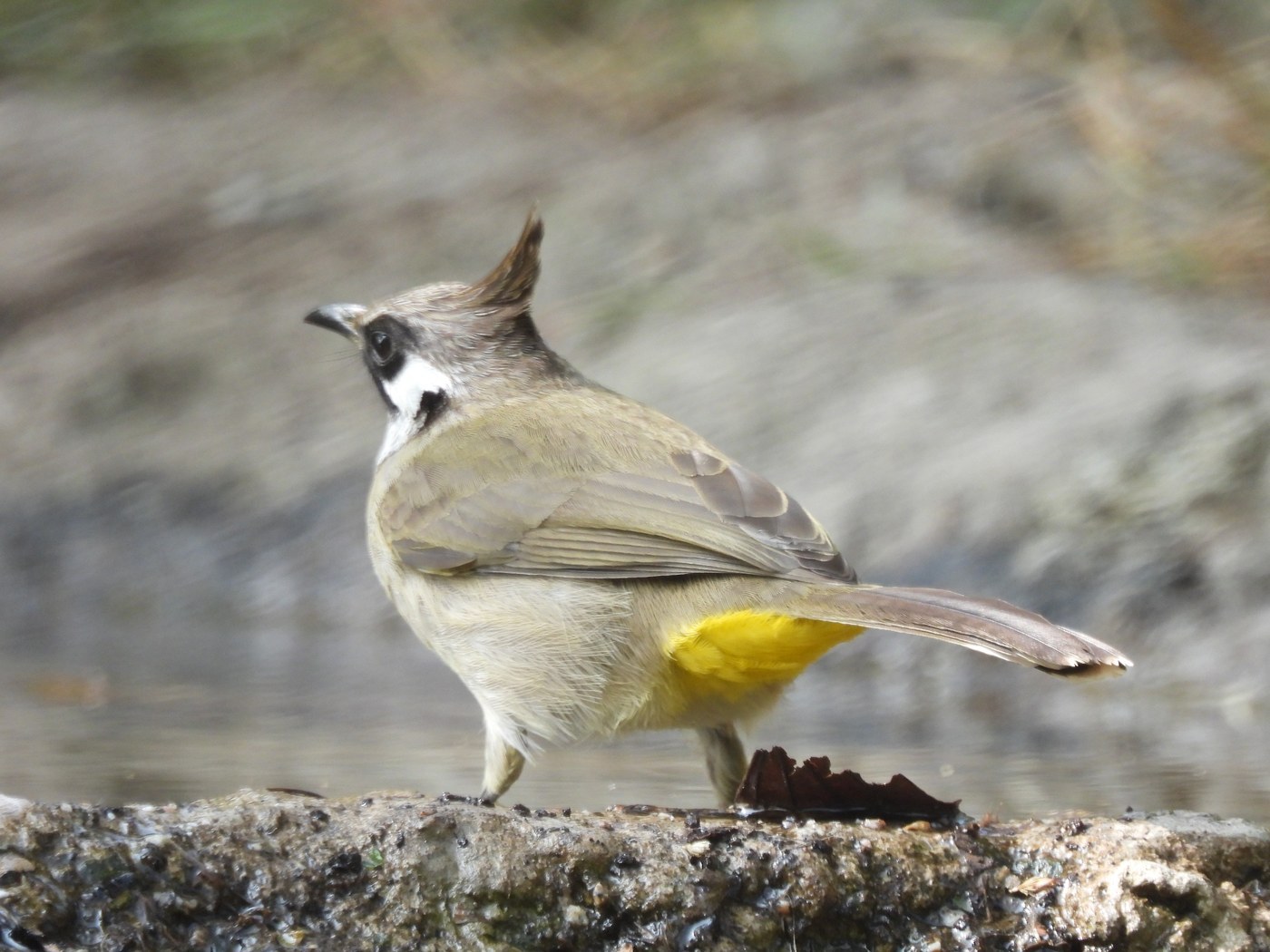
Himalayan Bulbul
Pycnonotus leucogenys
A crested bulbul of Himalayan foothill gardens and scrub, with a black head, a white cheek patch, and a bright yellow vent.
- Size
- 18-20 cm (7-8 in) long, 26-30 cm wingspan
- Habitat
- foothill scrub, gardens, and open woodland of the Himalayas
- Type
- songbird
Spotted a bird like this?
Identify any bird from a photo, free.
Overview
The Himalayan Bulbul, also widely known as the White-cheeked Bulbul, is a lively, crested songbird typical of gardens and scrub in the foothills and lower valleys of the Himalayas. It has a black crested head, brownish upperparts, and pale underparts with light streaking on the breast, but its most notable feature is the neat white patch on the cheek, set against the black head.
The undertail coverts (vent) are a bright lemon-yellow, providing a splash of color as the bird flicks its tail while perched. It is a common, confiding bird around towns and villages within its range.
How to identify it
Key field marks
- Black crested head with a neat white cheek patch
- Brownish-grey upperparts, pale underparts with light breast streaking
- Bright yellow undertail coverts (vent)
- Often seen perched with tail raised, in pairs or small groups
Similar species
The White-eared Bulbul lacks a prominent crest and shows a larger white ear patch covering more of the head. The Red-vented Bulbul lacks the white cheek patch and has a red (not yellow) vent.
Habitat & range
Range
Found along the Himalayan foothills from north-eastern Afghanistan and Pakistan east through northern India and Nepal.
Habitat
Common in gardens, orchards, scrub, and open woodland in hill valleys and foothills, typically at low to middle elevations.
Migration
Mostly resident, with some populations making short altitudinal movements to lower elevations in winter.
Behavior & voice
Behavior
Active and sociable, often seen in pairs or small flocks, frequently perching in the open with its crest raised and tail flicked upward.
Voice
A cheerful, bubbly, chattering song similar to other bulbuls, along with sharp contact calls.
Feeding
Feeds mainly on fruit, berries, and nectar, supplemented with insects, and is a regular visitor to gardens with fruiting shrubs.
Nesting and breeding
Builds a cup nest of twigs and grass in a bush or small tree, typically at low to moderate heights. Lays 2-3 eggs, with both parents helping to raise the chicks.
Frequently asked questions
Is the Himalayan Bulbul the same as the White-cheeked Bulbul?
Yes, Himalayan Bulbul and White-cheeked Bulbul are alternate common names for the same species, Pycnonotus leucogenys.
Where does the Himalayan Bulbul live?
It is found along the Himalayan foothills from north-eastern Afghanistan and Pakistan east through northern India and Nepal.
How do you tell a Himalayan Bulbul from a White-eared Bulbul?
The Himalayan Bulbul has a prominent black crest and a smaller white cheek patch, while the White-eared Bulbul lacks a crest and shows a larger white ear patch.
What altitude does the Himalayan Bulbul prefer?
It typically occurs at low to middle elevations in the Himalayan foothills, with some populations moving to lower elevations in winter.
Himalayan Bulbul guides
In-depth guides for identifying, finding, and understanding Himalayan Bulbul.
Other birds you may enjoy

Black Redstart
13-14.5 cm (5.1-5.7 in) long, 23-26 cm wingspan

Black-throated Sparrow
12-14 cm (4.7-5.5 in) long, about 19-20 cm (7.5-8 in) wingspan

Greater Bird-of-paradise
Body about 43 cm; males with additional flank plumes up to 50 cm and long tail wires

Blue Tit
11-12 cm (4.3-4.7 in) long, 17-20 cm wingspan

Red-billed Quelea
11.5–13 cm long, wingspan about 20–22 cm
White-plumed Antbird
13-14 cm (5-5.5 in) long

Pyrrhuloxia
19-22 cm (7.5-8.7 in) long, 30 cm wingspan

Blue-gray Tanager
16-18 cm (6-7 in) long

Blackburnian Warbler
11-13 cm (4.3-5.1 in) long, 20-22 cm wingspan

Bluethroat
13-14 cm (5.1-5.5 in) long, 20-22 cm wingspan

Eurasian Nuthatch
12-14.5 cm (4.7-5.7 in) long, 22.5-27 cm wingspan

Wood Thrush
19-21 cm (7.5-8.3 in) long, about 33 cm (13 in) wingspan