
Hepatic Tanager
Piranga flava
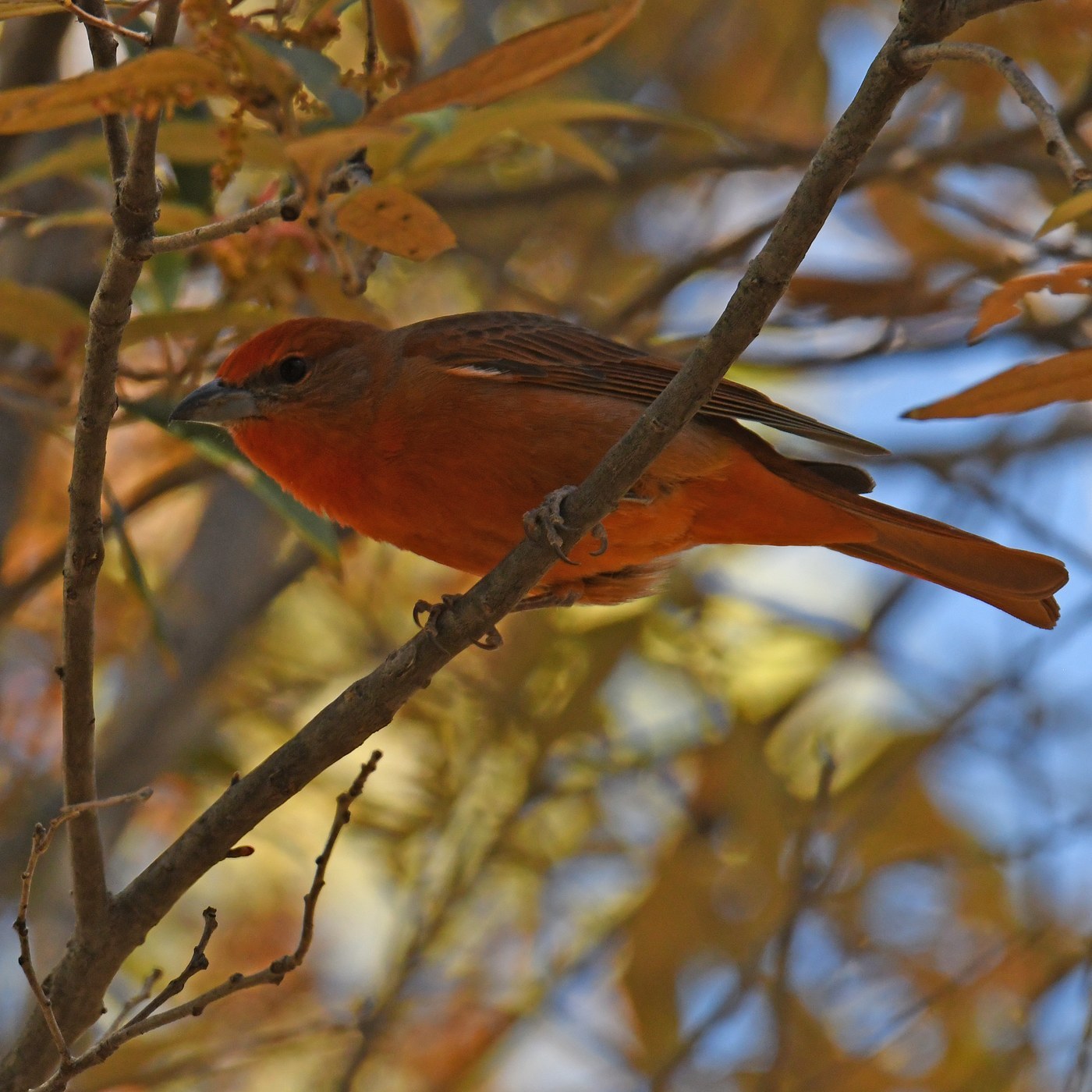
A dusky, brick-red tanager of southwestern mountain pine-oak forests, named for a rich red color reminiscent of liver tissue, with a distinctive dark gray cheek patch.
- Size
- 18-20 cm (7-8 in) long, 28-30 cm wingspan
- Habitat
- open pine-oak woodlands in mountains of the southwestern borderlands
- Type
- songbird
Spotted a bird like this?
Identify any bird from a photo, free.
Overview
The Hepatic Tanager is a somewhat subdued, brick-red tanager of montane pine-oak woodlands along the U.S.-Mexico borderlands, named for a liver-red ("hepatic") color quality to its plumage rather than the brighter scarlet of some relatives. Adult males are a dull to moderately deep red overall, with a distinctive dusky gray patch on the cheek (auricular area) and a dark, grayish bill, both useful features for separating it from the similar Summer Tanager. Females and immature birds are olive-yellow with a similar gray cheek patch and grayish bill.
Less familiar to most North American birders than the Summer or Scarlet Tanager because of its limited, localized U.S. range, the Hepatic Tanager reaches the United States only in mountainous pine-oak habitat of the Southwest, with its main range extending south through Mexico and Central America into South America.
How to identify it
Key Field Marks
- Adult male: brick-red to dull red overall, dusky gray cheek patch, dark grayish bill
- Female/immature: olive-yellow overall, gray cheek patch, grayish bill
- Bill notably darker and heavier-looking than the pale bills of Summer or Scarlet Tanager
- No black on the wings
Similar Species
- Summer Tanager lacks the dark gray cheek patch and has a paler, more uniformly pale bill; overall color tends to be a brighter, cleaner red.
- Scarlet Tanager male has contrasting black wings and tail, absent in Hepatic Tanager.
- Female Hepatic Tanagers are best distinguished from female Summer Tanagers by the dark cheek patch and darker bill.
Habitat & range
Habitat
Favors open, mature pine-oak woodlands in mountains, typically at middle to higher elevations, often with a fairly open canopy and grassy understory.
Range
In the U.S., breeds locally in mountain ranges of Arizona, New Mexico, and far west Texas. More broadly distributed from Mexico south through Central America into South America, making it the most widespread tanager in the Americas by overall range.
Migration
U.S. breeding populations are migratory, moving into Mexico for winter, while populations farther south are largely resident.
Behavior & voice
Behavior
Hepatic Tanagers forage deliberately in the mid- to upper canopy of open pine-oak woodland, often moving more slowly and less conspicuously than other tanagers.
Voice
The song is a burry, robin-like series similar to other Piranga tanagers, generally considered slower and less varied; the call is a soft, low "chuck" note.
Feeding
Feeds on insects gleaned from foliage and caught in flight, supplemented with fruit, particularly outside the breeding season.
Nesting & Breeding
The female builds a shallow cup nest of twigs and plant material, usually placed on a horizontal branch of a pine or oak. She incubates 3-4 eggs alone.
Frequently asked questions
Why is it called the Hepatic Tanager?
The name refers to the male's dull, brick-red plumage color, which was likened to the color of liver tissue (hepatic means relating to the liver) by early ornithologists.
How do you tell a Hepatic Tanager from a Summer Tanager?
Hepatic Tanagers show a distinctive dusky gray cheek patch and a darker, grayish bill, while Summer Tanagers lack the cheek patch and have a paler, more uniformly light bill.
Where can you find a Hepatic Tanager in the United States?
It occurs in the U.S. only locally in mountain pine-oak woodlands of Arizona, New Mexico, and far west Texas, with its broader range extending through Mexico, Central America, and into South America.
What habitat does the Hepatic Tanager prefer?
It favors open, mature pine-oak woodland at middle to higher mountain elevations, generally with a relatively open canopy.
Hepatic Tanager guides
In-depth guides for identifying, finding, and understanding Hepatic Tanager.
Other birds you may enjoy

Black Redstart
13-14.5 cm (5.1-5.7 in) long, 23-26 cm wingspan

Black-throated Sparrow
12-14 cm (4.7-5.5 in) long, about 19-20 cm (7.5-8 in) wingspan

Greater Bird-of-paradise
Body about 43 cm; males with additional flank plumes up to 50 cm and long tail wires

Blue Tit
11-12 cm (4.3-4.7 in) long, 17-20 cm wingspan

Red-billed Quelea
11.5–13 cm long, wingspan about 20–22 cm
White-plumed Antbird
13-14 cm (5-5.5 in) long

Pyrrhuloxia
19-22 cm (7.5-8.7 in) long, 30 cm wingspan

Blue-gray Tanager
16-18 cm (6-7 in) long

Blackburnian Warbler
11-13 cm (4.3-5.1 in) long, 20-22 cm wingspan

Bluethroat
13-14 cm (5.1-5.5 in) long, 20-22 cm wingspan

Eurasian Nuthatch
12-14.5 cm (4.7-5.7 in) long, 22.5-27 cm wingspan

Wood Thrush
19-21 cm (7.5-8.3 in) long, about 33 cm (13 in) wingspan