
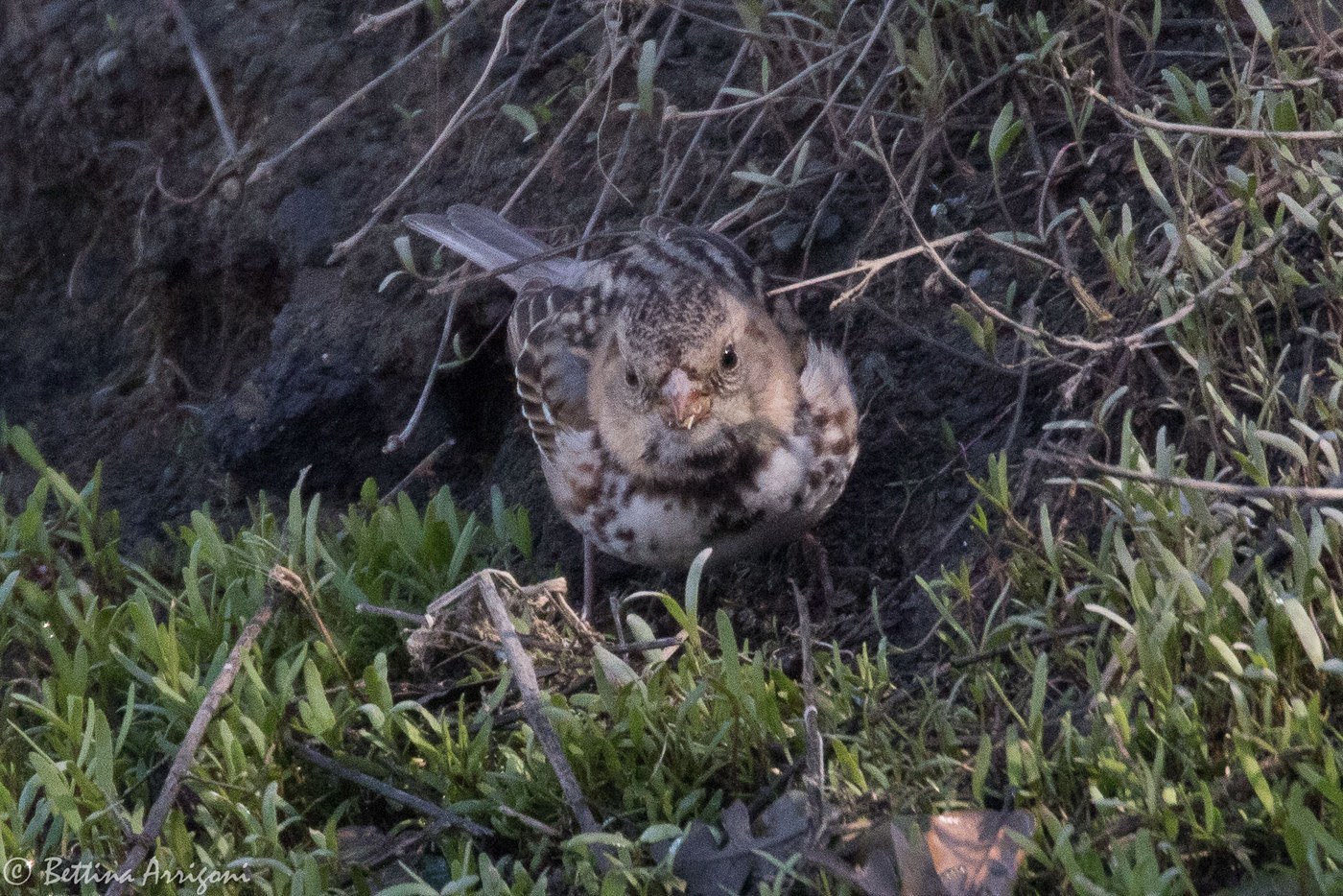
Harris's Sparrow
Zonotrichia querula
North America's largest sparrow, with a black hood and bib framing a pink bill, breeding only in Canada and wintering on the Great Plains.
- Size
- 18-20 cm (7.1-7.9 in) long, 25-28 cm wingspan
- Habitat
- breeds in stunted taiga/tundra transition zone of northern Canada; winters in brushy fields and woodland edges of the south-central Great Plains
- Type
- songbird
Spotted a bird like this?
Identify any bird from a photo, free.
Overview
Harris's Sparrow is the largest sparrow species in North America, a bulky, handsome bird with a bold black hood and bib covering the crown, face, and throat of breeding adults, sharply set off against a bright pink bill and a plain gray face and nape. The extent of black is variable, being most extensive in older breeding-plumage adults and reduced to a patchier, less complete pattern in immature and non-breeding birds.
The body below the bib is white with variable dark streaking or spotting along the flanks, and the back is streaked brown, giving an overall bold, striking appearance among sparrows.
How to identify it
Key field marks
- Black hood and bib (variable extent) contrasting with a bright pink bill
- Plain gray face and nape framing the black crown/throat
- Large size, noticeably bigger than most other sparrows
- White underparts with variable dark spotting on the flanks
Similar species
- White-crowned Sparrow and White-throated Sparrow both lack the extensive black hood and bib and are smaller-bodied overall.
- No other North American sparrow combines a black hood, pink bill, and this large a body size.
Habitat & range
Harris's Sparrow has an unusually restricted breeding range for a North American songbird, nesting only in the low shrub tundra and stunted spruce transition zone of north-central Canada, a habitat type sometimes called taiga-tundra ecotone, making it the only songbird species that breeds exclusively in Canada.
In winter, the species migrates to a fairly narrow band of the south-central Great Plains, chiefly Kansas, Oklahoma, Nebraska, and neighboring states, where it favors brushy fields, woodland edges, and hedgerows, often in mixed flocks with other sparrows.
Behavior & voice
Harris's Sparrows forage on the ground, often in flocks with other sparrow species during winter, scratching through leaf litter and low vegetation for seeds and insects, and tend to dominate other sparrows at feeding areas due to their larger size.
The song is a series of clear, mournful whistled notes, often on one or two pitches, somewhat similar in quality to the White-throated Sparrow's song but generally simpler; calls include a sharp "chink" note. Diet is seeds and insects, with more insects taken during the breeding season. Nests are built on the ground in low tundra shrub, with typical clutches of three to five eggs; because the breeding range is so remote, the nesting biology of this species was not documented until relatively late compared to most North American birds.
Frequently asked questions
How do you identify a Harris's Sparrow?
Look for North America's largest sparrow, with a black hood and bib (extent varies by age), a bright pink bill, a plain gray face, and white underparts with variable flank spotting.
Where does the Harris's Sparrow breed?
It breeds only in a narrow band of low shrub tundra and stunted spruce transition habitat in north-central Canada, making it the only bird species that breeds exclusively within Canada.
Where do Harris's Sparrows spend the winter?
Mainly on the south-central Great Plains, including Kansas, Oklahoma, and Nebraska, in brushy fields and woodland edges.
What does a Harris's Sparrow sound like?
A series of clear, mournful whistled notes on one or two pitches, along with a sharp 'chink' call.
Is the Harris's Sparrow the largest sparrow in North America?
Yes, it is generally considered the largest native sparrow species found in North America.
Harris's Sparrow guides
In-depth guides for identifying, finding, and understanding Harris's Sparrow.
Other birds you may enjoy

Black Redstart
13-14.5 cm (5.1-5.7 in) long, 23-26 cm wingspan

Black-throated Sparrow
12-14 cm (4.7-5.5 in) long, about 19-20 cm (7.5-8 in) wingspan

Greater Bird-of-paradise
Body about 43 cm; males with additional flank plumes up to 50 cm and long tail wires

Blue Tit
11-12 cm (4.3-4.7 in) long, 17-20 cm wingspan

Red-billed Quelea
11.5–13 cm long, wingspan about 20–22 cm
White-plumed Antbird
13-14 cm (5-5.5 in) long

Pyrrhuloxia
19-22 cm (7.5-8.7 in) long, 30 cm wingspan

Blue-gray Tanager
16-18 cm (6-7 in) long

Blackburnian Warbler
11-13 cm (4.3-5.1 in) long, 20-22 cm wingspan

Bluethroat
13-14 cm (5.1-5.5 in) long, 20-22 cm wingspan

Eurasian Nuthatch
12-14.5 cm (4.7-5.7 in) long, 22.5-27 cm wingspan

Wood Thrush
19-21 cm (7.5-8.3 in) long, about 33 cm (13 in) wingspan