
Harris's Sparrow Identification Guide
North America's largest sparrow, easily known by its black crown, face, and bib set off against a pink bill and gray cheeks.
Read the full Harris's Sparrow encyclopedia entry →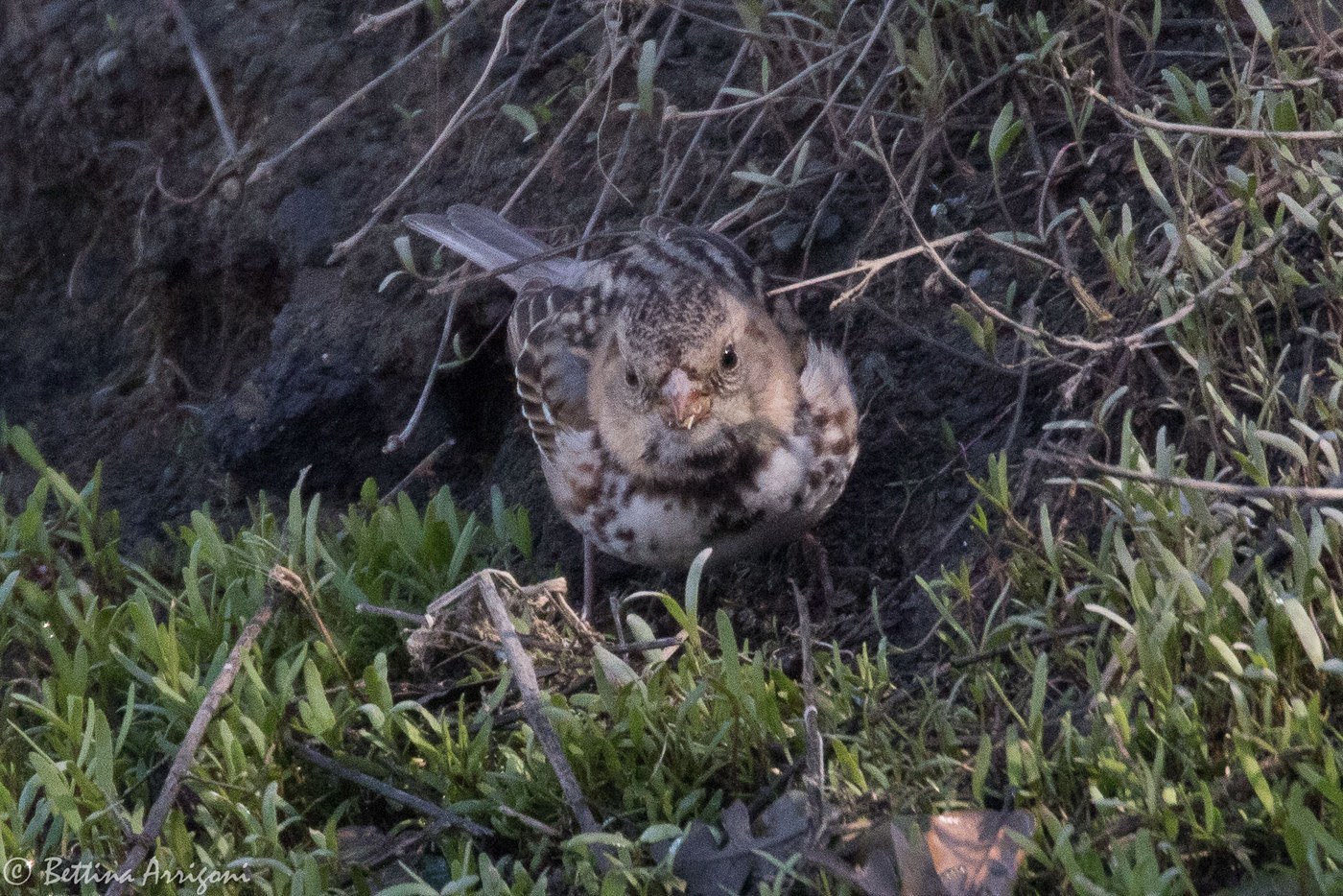
Key Field Marks
- Size & shape: The largest native sparrow in North America — bulky, long-tailed, with a big rounded head and a heavy conical bill.
- Plumage (breeding adult): Solid black crown, black face, and black bib contrasting sharply with clean gray cheeks and nape; back is streaked brown; underparts whitish with streaked flanks.
- Plumage (winter/immature): Black reduced to mottled patches on crown and throat rather than solid black; still shows the gray cheek and pink bill pattern.
- Bill: Distinctive bright pink-to-pale bill, a strong contrast against the dark face — visible at a good distance.
- Behavior: Often forages on the ground in brushy cover or under feeders, scratching through leaf litter; frequently joins mixed flocks with White-crowned and White-throated Sparrows in winter.
Similar Species
- White-crowned Sparrow: Smaller, has a striped black-and-white crown rather than a solid black hood, and lacks the black bib.
- House Sparrow (male): Much smaller, has a gray crown with chestnut nape, and lacks the pink bill and gray cheek patch.
- American Tree Sparrow: Smaller, has a rusty crown (not black), a bicolored bill, and a dark central breast spot instead of a bib.
Range, Habitat & Season
Breeds only in the low arctic and subarctic tundra-forest transition zone of north-central Canada (a very restricted breeding range, largely around Hudson Bay). Winters in the south-central Great Plains, from Nebraska and Kansas south through Oklahoma and Texas, favoring brushy thickets, hedgerows, weedy fields, and backyard feeders with dense cover nearby. Migrates through the Great Plains states in spring and fall.
Voice
A clear, plaintive, minor-key whistled song of one to three long notes, "oh… dear… me," slightly quavering; call is a sharp, metallic "chink" or "weenk" often given from cover.
Frequently asked questions
What is the easiest way to identify a Harris's Sparrow?
Look for its large size, solid black crown and bib contrasting with gray cheeks, and a bright pink bill — no other North American sparrow shows this combination.
Where does Harris's Sparrow breed?
It breeds in a narrow band of stunted spruce and tundra habitat in north-central Canada near Hudson Bay, one of the most restricted breeding ranges of any North American songbird.
How can I tell a winter Harris's Sparrow from a White-crowned Sparrow?
Winter Harris's Sparrows still show blotchy black on the throat/face and a pink bill, while White-crowned Sparrows have a striped gray-and-black crown and a plain gray face without a bib.
Where do Harris's Sparrows spend the winter?
They winter mainly on the Great Plains, from Nebraska and Kansas south through Oklahoma into central Texas, often visiting feeders with brushy cover.