
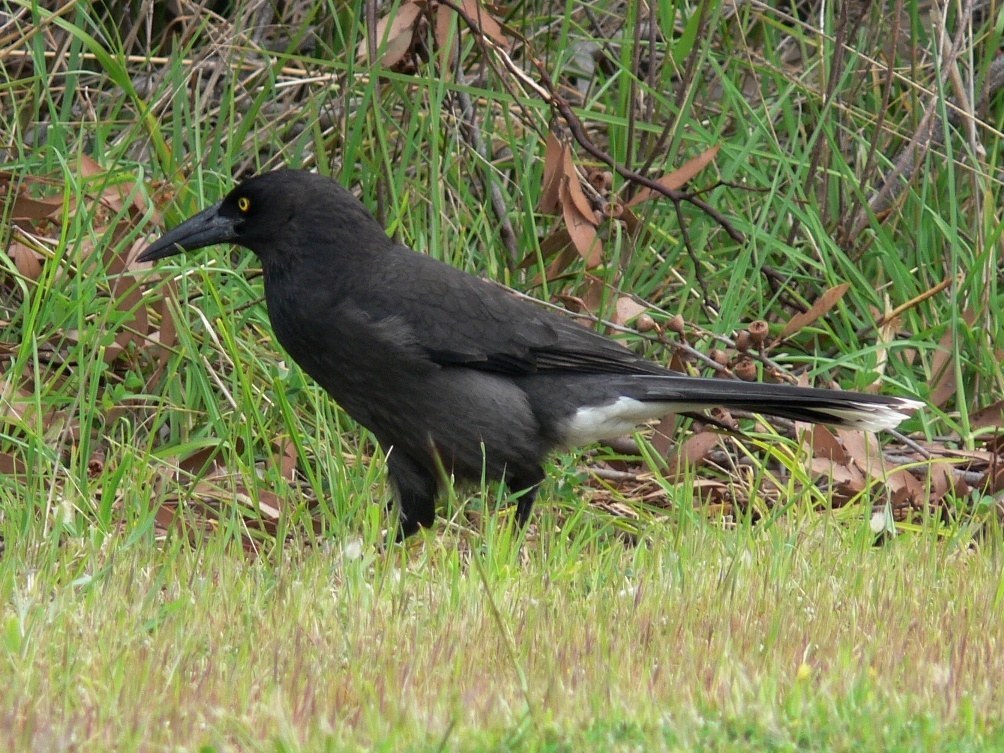
Grey Currawong
Strepera versicolor
A large, grey-toned currawong of southern Australia's forests and woodlands, with a yellow eye and white wing and tail markings.
- Size
- 45-51 cm (18-20 in) long
- Habitat
- forests, woodlands, and mallee scrub across southern Australia
- Type
- songbird
Spotted a bird like this?
Identify any bird from a photo, free.
Overview
The Grey Currawong is a large songbird similar in build to the Pied Currawong but generally showing more grey tones through the body plumage rather than solid black, with the exact depth of grey varying noticeably between the several recognized subspecies across its range, from quite dark, almost blackish forms to paler, more uniformly grey birds. Like its relative, it has a bright yellow eye, a stout black bill, and white patches in the wing and at the tip of the tail.
One well-known subspecies found in parts of South Australia is often nicknamed the "clinking currawong" for its distinctive metallic call.
How to identify it
Key field marks
- Grey-toned body plumage, varying by subspecies from dark grey to blackish
- Bright yellow eye
- White patches in the wings and at the tail tip
- Heavy, black, slightly hooked bill
Similar species
- Pied Currawong: more solidly black plumage overall, less grey tone through the body.
- Australian Raven: entirely black with a pale eye rather than yellow, and no white wing/tail markings.
Habitat & range
Habitat
Grey Currawongs occupy eucalypt forest, woodland, and mallee scrub, generally favoring drier habitats than the Pied Currawong across parts of their range.
Range
The species is found across southern Australia, including southwestern Western Australia, South Australia, Victoria, Tasmania, and parts of southern New South Wales, with several regional subspecies.
Migration
Mostly sedentary, though some local and altitudinal movement can occur, with birds sometimes moving to lower areas in harsh winter conditions.
Behavior & voice
Behavior
Grey Currawongs forage both in trees and on the ground, often alone, in pairs, or in small groups, and are generally somewhat less gregarious than the Pied Currawong outside the breeding season.
Voice
Calls include a range of ringing and metallic notes; one subspecies is known for a distinctive clinking call that has earned it the nickname "clinking currawong."
Feeding
Diet is omnivorous, including insects and other invertebrates, fruits, small vertebrates, and occasionally the eggs and nestlings of other birds.
Nesting and breeding
Nests are large stick platforms built in trees. Clutches typically contain two to four pale eggs with darker markings, incubated mainly by the female, with the male assisting in provisioning.
Frequently asked questions
How do you tell a Grey Currawong from a Pied Currawong?
The Grey Currawong shows more grey tones through the body plumage, while the Pied Currawong is essentially solid black apart from white wing and tail markings.
What is a 'clinking currawong'?
It is a nickname for a South Australian subspecies of the Grey Currawong, named for its distinctive metallic, clinking call.
Where do Grey Currawongs live?
They are found across southern Australia, including Tasmania, in forests, woodlands, and mallee scrub.
What do Grey Currawongs eat?
A varied omnivorous diet including insects, fruits, small vertebrates, and occasionally eggs or nestlings of other birds.
Grey Currawong guides
In-depth guides for identifying, finding, and understanding Grey Currawong.
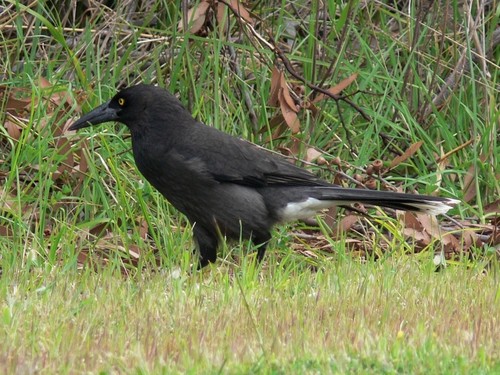
Other birds you may enjoy

Black Redstart
13-14.5 cm (5.1-5.7 in) long, 23-26 cm wingspan

Black-throated Sparrow
12-14 cm (4.7-5.5 in) long, about 19-20 cm (7.5-8 in) wingspan

Greater Bird-of-paradise
Body about 43 cm; males with additional flank plumes up to 50 cm and long tail wires

Blue Tit
11-12 cm (4.3-4.7 in) long, 17-20 cm wingspan

Red-billed Quelea
11.5–13 cm long, wingspan about 20–22 cm
White-plumed Antbird
13-14 cm (5-5.5 in) long

Pyrrhuloxia
19-22 cm (7.5-8.7 in) long, 30 cm wingspan

Blue-gray Tanager
16-18 cm (6-7 in) long

Blackburnian Warbler
11-13 cm (4.3-5.1 in) long, 20-22 cm wingspan

Bluethroat
13-14 cm (5.1-5.5 in) long, 20-22 cm wingspan

Eurasian Nuthatch
12-14.5 cm (4.7-5.7 in) long, 22.5-27 cm wingspan

Wood Thrush
19-21 cm (7.5-8.3 in) long, about 33 cm (13 in) wingspan