
Grey Currawong Identification Guide
A large, slate-grey Australian songbird with a heavy hooked bill, yellow eye, and bold white wing and tail patches best located by its ringing, bell-like calls.
Read the full Grey Currawong encyclopedia entry →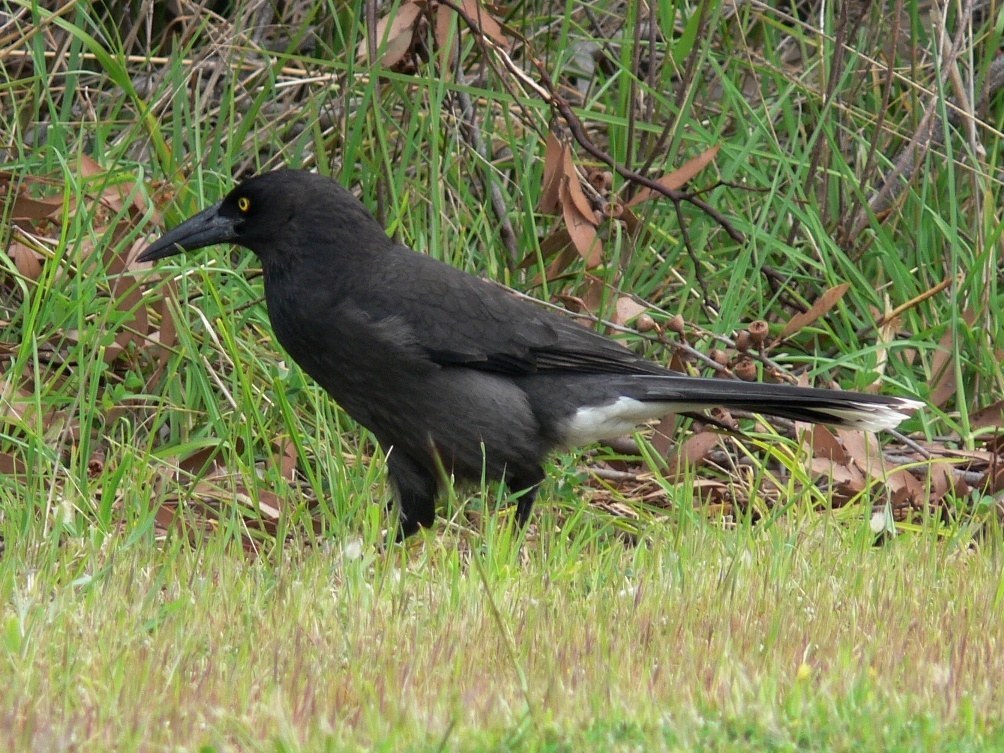
Key Field Marks
- Size & shape: A large, crow-like passerine around 48-56 cm (19-22 in) long, with a heavy build, long tail, and a stout, slightly hooked bill.
- Plumage: Overall dark slate-grey to sooty grey-brown body, variable by subspecies from pale ashy grey to almost blackish.
- Wing & tail pattern: Bold white patches at the base of the primaries and white tips to the tail feathers, conspicuous in flight and when the tail is fanned.
- Undertail coverts: White, contrasting with the darker body, visible when the bird perches with tail raised or in flight from below.
- Eye & bill: Pale yellow to cream iris standing out against the dark face; black, heavy, slightly downcurved bill used for probing bark and turning over litter.
- Behavior: Forages on the ground and in trees for large insects, small vertebrates, and fruit; often perches high and upright on bare branches or wires, and moves with slow, deliberate hops.
Similar Species
- Pied Currawong: Blacker overall with more extensive white in the wing, rump, and undertail, and a different, more strident call; ranges overlap broadly in southeastern Australia.
- Australian Raven / crows: All-black with a shaggier throat hackle, lack the white wing/tail patches and pale eye of the currawong, and have a harsher, more nasal call.
- Grey Butcherbird: Much smaller, with a black-and-white head pattern and hooked bill, but far smaller body size and different voice separate it easily.
Where & When to See It
- Range: Southern Australia, including southwestern Western Australia, South Australia, Victoria, Tasmania, and parts of New South Wales, with several recognized subspecies varying in plumage tone.
- Habitat: Eucalypt forest and woodland, mallee, coastal scrub, and increasingly parks and rural gardens, especially in cooler, wetter regions and at higher elevations.
- Season: Resident year-round in most of its range; some populations make local altitudinal movements in winter, descending from highlands to lower woodlands.
Voice
- A distinctive, far-carrying, ringing or clanging call, often described as a metallic "clink-clink" or bell-like "kar-week," quite different from the more complex, ringing wolf-whistle calls of the Pied Currawong.
Quick Tips for Confident ID
- Compare overall grey tone versus the blacker Pied Currawong when both occur together.
- Check for the pale yellow eye and white tail tip/wing patch combination.
- Learn the metallic, clanging call, which is often the first clue to its presence in forest habitat.
Frequently asked questions
How do you tell a Grey Currawong from a Pied Currawong?
Grey Currawongs are duller slate-grey overall with less extensive white patterning, while Pied Currawongs are glossy black with larger white wing, rump, and undertail patches, and the two also differ clearly in call.
What does a Grey Currawong eat?
It is an omnivore taking large insects, spiders, small reptiles, nestlings, and fruit, foraging both on the ground and by probing bark and epiphytes in trees.
Is the Grey Currawong found across all of Australia?
No, it is restricted to southern Australia including the southwest, South Australia, Victoria, Tasmania, and parts of New South Wales; it is absent from the tropical north.
What is the easiest way to detect a Grey Currawong in the field?
Its loud, metallic, bell-like or clanging call often gives away its presence in forest before the bird itself is seen perched high in the canopy.