
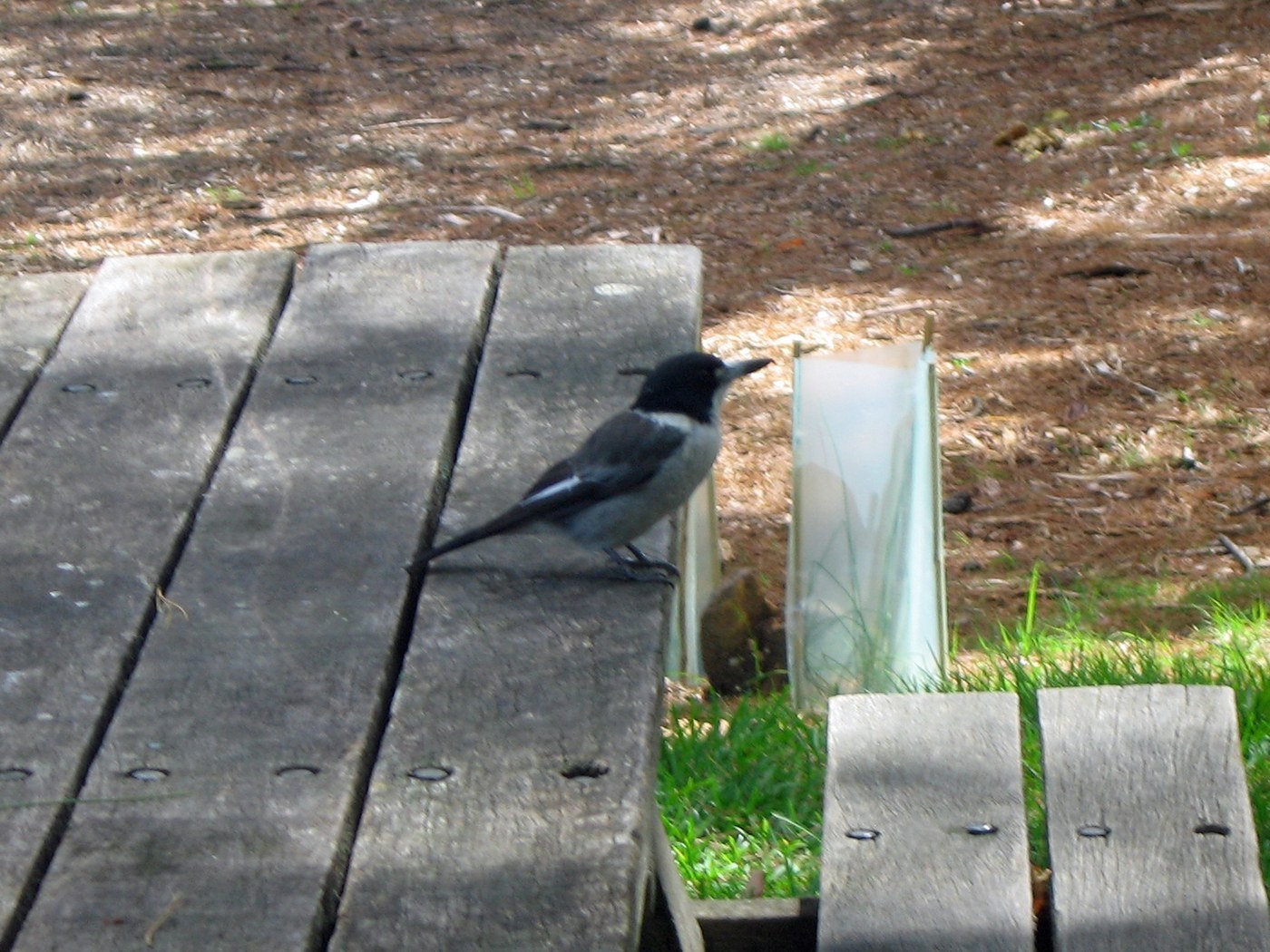
Grey Butcherbird
Cracticus torquatus
A grey-backed relative of the Pied Butcherbird with a black mask and white underparts, known for its musical, flute-like calls.
- Size
- 26-30 cm (10-12 in) long
- Habitat
- woodlands, scrub, farmland, and gardens across southern and eastern Australia
- Type
- songbird
Spotted a bird like this?
Identify any bird from a photo, free.
Overview
The Grey Butcherbird shares the family's hooked bill and largely carnivorous habits, but is distinguished by its grey back and wings rather than solid black, paired with a black mask that runs from the bill through the eye without covering the full head. The underparts are clean white, with a white wing bar visible on the folded wing.
Like its relatives, it has a beautiful, musical voice, and it is a familiar visitor to gardens across much of southern and eastern Australia, sometimes bold enough to approach outdoor dining areas in search of scraps.
How to identify it
Key field marks
- Grey back and wings (not solid black)
- Black mask through the eye, not covering the full head
- White underparts and white wing bar
- Heavy, hooked grey-black bill
Similar species
- Pied Butcherbird: solid black hood over the entire head and throat rather than a partial mask, and a black (not grey) back.
- Grey Currawong and Pied Currawong: much larger, with different bill shape and yellow (not dark) eyes.
- Magpie-lark: smaller, slimmer bill, different black-and-white pattern.
Habitat & range
Habitat
Grey Butcherbirds occupy open woodland, scrub, farmland with scattered trees, and gardens, needing open areas for hunting and cover for nesting.
Range
The species is found across southern Australia, from southwestern Western Australia through South Australia, Victoria, New South Wales, southern Queensland, and Tasmania.
Migration
Sedentary, with pairs or family groups holding permanent territories year-round.
Behavior & voice
Behavior
Grey Butcherbirds hunt from perches, swooping to the ground to take prey, which may be wedged into bark or a branch fork to be torn apart, similar to other butcherbirds. They can become quite tame around houses and picnic areas.
Voice
The song is a series of rich, clear, melodious whistles and warbles, often given from a prominent perch, and considered among the more accomplished songs of Australian birds.
Feeding
Diet is largely carnivorous, comprising large insects, small reptiles, small birds and mammals, and carrion, along with occasional fruit.
Nesting and breeding
Nests are loosely built stick bowls placed in tree forks. Clutches typically contain three to five pale eggs with darker markings, incubated mainly by the female, with the male helping to feed her and later the chicks.
Frequently asked questions
How do you tell a Grey Butcherbird from a Pied Butcherbird?
The Grey Butcherbird has a grey back and only a partial black eye mask, while the Pied Butcherbird has a solid black hood covering the entire head and throat.
What does a Grey Butcherbird eat?
It is largely carnivorous, eating large insects, small reptiles, small birds and mammals, and carrion, occasionally supplemented with fruit.
Are Grey Butcherbirds good singers?
Yes, they have a rich, melodious, whistling song and are considered accomplished songbirds despite their predatory diet.
Where do Grey Butcherbirds live?
They are found across southern Australia, including Tasmania, in open woodland, scrub, farmland, and gardens.
Grey Butcherbird guides
In-depth guides for identifying, finding, and understanding Grey Butcherbird.
Other birds you may enjoy

Black Redstart
13-14.5 cm (5.1-5.7 in) long, 23-26 cm wingspan

Black-throated Sparrow
12-14 cm (4.7-5.5 in) long, about 19-20 cm (7.5-8 in) wingspan

Greater Bird-of-paradise
Body about 43 cm; males with additional flank plumes up to 50 cm and long tail wires

Blue Tit
11-12 cm (4.3-4.7 in) long, 17-20 cm wingspan

Red-billed Quelea
11.5–13 cm long, wingspan about 20–22 cm
White-plumed Antbird
13-14 cm (5-5.5 in) long

Pyrrhuloxia
19-22 cm (7.5-8.7 in) long, 30 cm wingspan

Blue-gray Tanager
16-18 cm (6-7 in) long

Blackburnian Warbler
11-13 cm (4.3-5.1 in) long, 20-22 cm wingspan

Bluethroat
13-14 cm (5.1-5.5 in) long, 20-22 cm wingspan

Eurasian Nuthatch
12-14.5 cm (4.7-5.7 in) long, 22.5-27 cm wingspan

Wood Thrush
19-21 cm (7.5-8.3 in) long, about 33 cm (13 in) wingspan