
Grey Butcherbird Identification Guide
A bold, hook-billed Australian songbird with slate-gray upperparts, a black hood, and a rich, melodious song, often seen impaling prey on thorns or fence barbs.
Read the full Grey Butcherbird encyclopedia entry →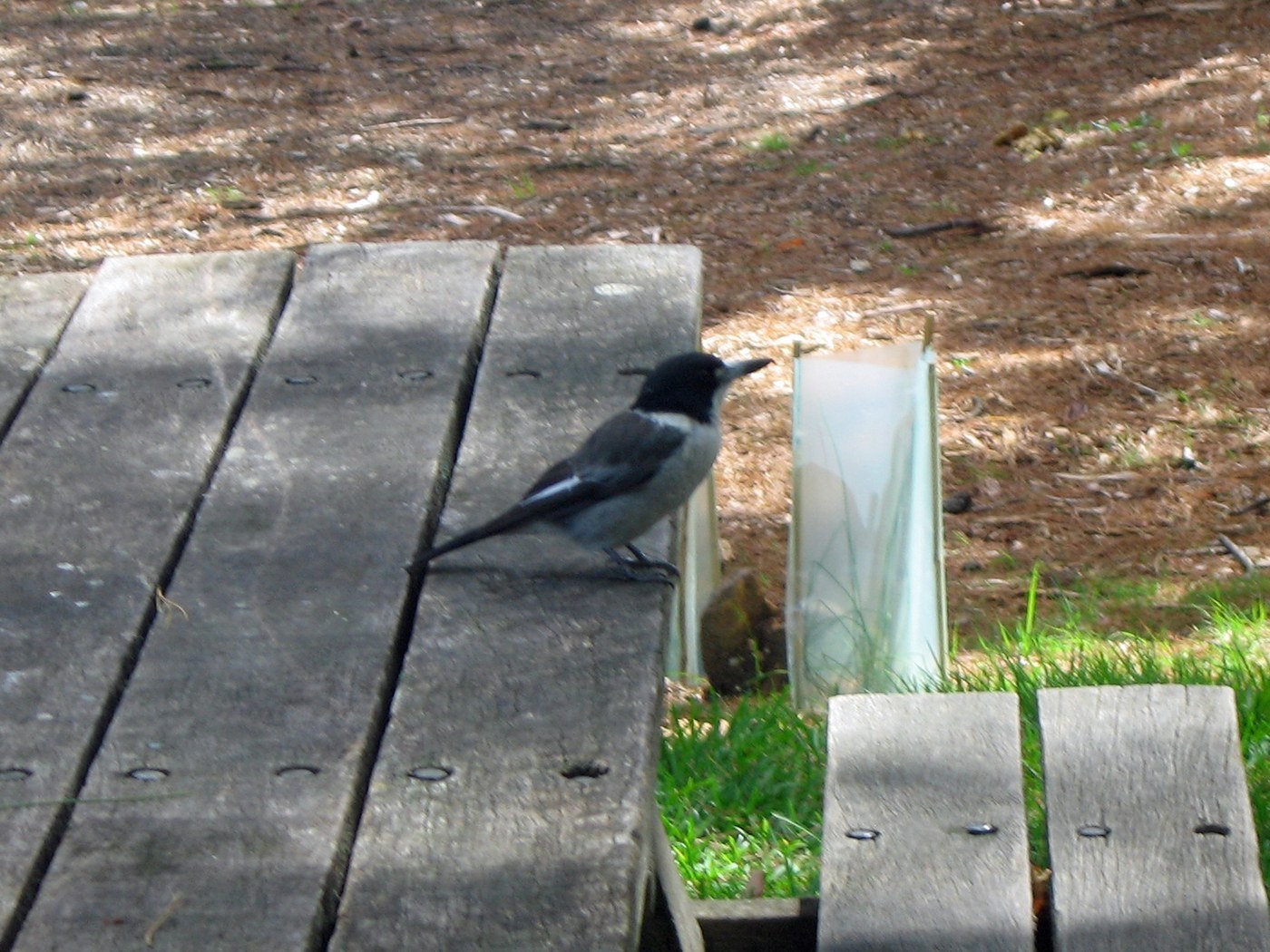
Key Field Marks
- Size and shape: A medium-sized, stocky songbird around 10–12 inches long, with a large head, a heavy, strongly hooked bill well suited to its predatory habits, and a fairly long tail.
- Plumage: Blue-gray upperparts and pale gray-to-white underparts, with a black hood covering the crown, face, and throat, separated from the gray back by a thin white collar; a bold white patch is visible on the wing and rump in flight.
- Bill and legs: Heavy, pale gray bill strongly hooked at the tip, an important tool for gripping and tearing prey; dark gray legs.
- Behavior: A bold, often confiding predator that watches from an open perch before dropping onto insects, small reptiles, or even small birds; frequently caches or impales prey on thorns, forked branches, or barbed wire, a habit that gives the butcherbird group its name.
Separating It From Similar Species
- Pied Butcherbird: Shows a fully black head, neck, and upper breast forming a complete black hood extending further down, plus more extensive black on the back and a mostly black tail, versus the gray back and more restricted black hood of Grey Butcherbird.
- Australian Magpie: Larger and bulkier, with a longer, straighter (less strongly hooked) bill and a more extensive black-and-white pattern lacking the clean gray back of Grey Butcherbird.
- Grey Currawong: Larger still, with red eyes, a longer tail, and white patches at the base of the tail and wing that differ in pattern and extent from the butcherbird's markings.
- The thin white collar separating the black hood from the gray back is a useful close-range mark distinguishing Grey Butcherbird from its darker relatives.
Where and When to See It
- Habitat: Open woodland, forest edge, parks, gardens, and farmland with scattered trees, including well-vegetated urban and suburban areas.
- Range: Widespread across much of Australia, generally absent from the most arid interior, and also found on Tasmania.
- Season: A non-migratory resident throughout its range, present and territorial year-round.
Voice and Song Cues
- Renowned for a rich, melodious, fluted song, often delivered in a duet or chorus between pairs, considered one of the more musical songs among Australian birds.
- Also gives a variety of harsher scolding and alarm calls, especially near the nest, quite different in tone from the flutelike main song.
Frequently asked questions
How is the Grey Butcherbird different from the Pied Butcherbird?
Grey Butcherbird has a gray back and a black hood restricted mainly to the head and throat, separated by a thin white collar, while Pied Butcherbird has a more extensive black hood and more black on the back and tail.
Why is it called a butcherbird?
It has a habit of impaling captured prey, such as insects, small reptiles, or small birds, on thorns or barbed wire, a caching behavior that resembles a butcher's hook and gives the group its name.
What does the Grey Butcherbird eat?
It is a predatory songbird that feeds on large insects, small reptiles, and occasionally small birds or nestlings, hunting from an open perch.
Is the Grey Butcherbird's song considered attractive?
Yes, it is known for a rich, fluted, musical song, often sung as a duet between paired birds, and is considered one of the more pleasant-sounding calls among Australian birds.
Where should I look for a Grey Butcherbird?
Check open woodland, parks, and gardens with scattered trees across most of Australia and Tasmania, where it often perches conspicuously in the open.