
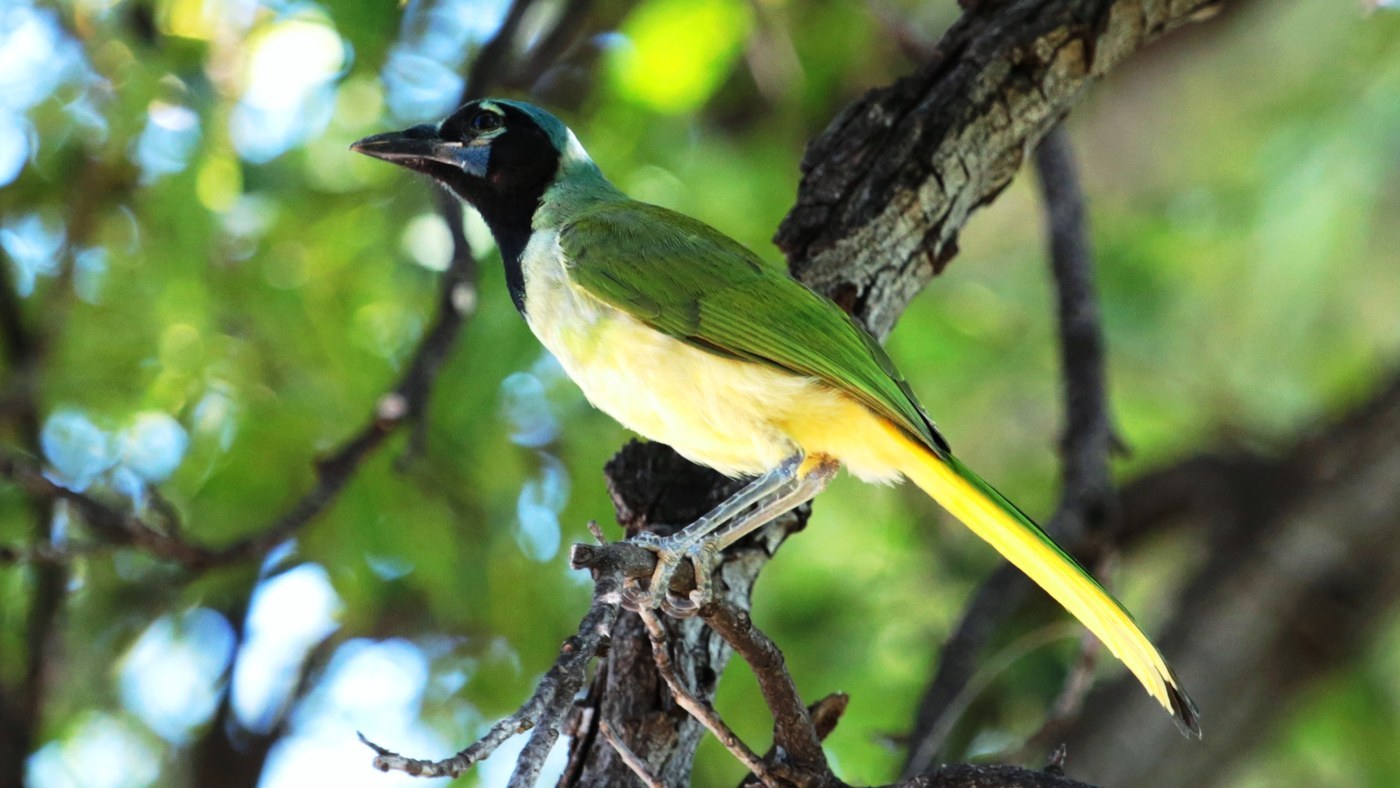
Green Jay
Cyanocorax luxuosus
A dazzlingly colored jay of south Texas brushlands with a green back, sky-blue head markings, and lemon-yellow outer tail feathers.
- Size
- 25-29 cm (10-11.5 in) long, 33-38 cm wingspan
- Habitat
- dense thorny woodlands, brushlands, and riparian thickets of the Lower Rio Grande Valley and Mexico
- Type
- songbird
Spotted a bird like this?
Identify any bird from a photo, free.
Overview
The Green Jay is one of North America's most colorful songbirds, combining lime-green upperparts and a pale green breast with a striking blue-and-black head pattern and bright yellow outer tail feathers. In the United States it is found only in the dense brushlands of the Lower Rio Grande Valley of south Texas, where it represents the northern edge of a range that extends south through Mexico and Central America into parts of South America.
Highly social, Green Jays travel in small family groups year-round and are notably intelligent, sometimes using twigs as tools to pry insects from bark. Their bold coloring and noisy, gregarious habits make them a favorite target for birders visiting the Rio Grande Valley.
How to identify it
Key Field Marks
- Bright green back, wings, and tail contrasting with a pale grayish-green breast and belly
- Black bib and face mask surrounding a violet-blue crown and nape
- Bright yellow outer tail feathers, conspicuous in flight
- Stout black bill and dark eyes
Similar Species
- No other jay in its U.S. range shares this combination of green body and blue-and-black head; it is unmistakable where it occurs.
- Compare with the Green Jay's Central and South American relatives (formerly considered the same species), which show subtle regional differences in head pattern not relevant to Texas birders.
Habitat & range
Green Jays inhabit dense, thorny subtropical woodland, mesquite brushland, and riparian thickets. In the United States this habitat is restricted to the Lower Rio Grande Valley of extreme south Texas, where remaining native brush patches and wildlife refuges support resident populations. The species' broader range extends through eastern Mexico, Central America, and into the Andean foothills of northern South America, with more colorful, differently patterned forms further south.
Green Jays are non-migratory, living year-round in small territories defended by cooperative family groups.
Behavior & voice
Voice
Highly vocal, with a varied repertoire of harsh rattles, clanging notes, and a repeated cleep-cleep-cleep; often first detected by its noisy chatter before being seen.
Feeding
Forages in the understory and canopy for insects, spiders, and seeds, and readily eats fruit; known to wedge acorns and other food items into bark crevices to hold them while extracting the contents, and occasionally uses small sticks as tools to probe for insects.
Nesting
Builds a bulky cup nest of twigs low in dense shrubs or trees; breeds cooperatively in some populations, with young from previous broods sometimes helping feed later nestlings.
Frequently asked questions
Where can I see a Green Jay in the United States?
The only place to reliably find Green Jays in the U.S. is the Lower Rio Grande Valley of south Texas, particularly at wildlife refuges and parks with native thorn-scrub habitat.
What makes the Green Jay's coloring unique?
It combines a bright green body with a violet-blue crown, black facial mask, and lemon-yellow outer tail feathers, an unusual color combination among North American songbirds.
Are Green Jays social birds?
Yes, they live in small family groups year-round and are noisy and gregarious, often mobbing predators together.
Do Green Jays migrate?
No, they are non-migratory residents that stay on territory throughout the year.
Green Jay guides
In-depth guides for identifying, finding, and understanding Green Jay.
Other birds you may enjoy

Black Redstart
13-14.5 cm (5.1-5.7 in) long, 23-26 cm wingspan

Black-throated Sparrow
12-14 cm (4.7-5.5 in) long, about 19-20 cm (7.5-8 in) wingspan

Greater Bird-of-paradise
Body about 43 cm; males with additional flank plumes up to 50 cm and long tail wires

Blue Tit
11-12 cm (4.3-4.7 in) long, 17-20 cm wingspan

Red-billed Quelea
11.5–13 cm long, wingspan about 20–22 cm
White-plumed Antbird
13-14 cm (5-5.5 in) long

Pyrrhuloxia
19-22 cm (7.5-8.7 in) long, 30 cm wingspan

Blue-gray Tanager
16-18 cm (6-7 in) long

Blackburnian Warbler
11-13 cm (4.3-5.1 in) long, 20-22 cm wingspan

Bluethroat
13-14 cm (5.1-5.5 in) long, 20-22 cm wingspan

Eurasian Nuthatch
12-14.5 cm (4.7-5.7 in) long, 22.5-27 cm wingspan

Wood Thrush
19-21 cm (7.5-8.3 in) long, about 33 cm (13 in) wingspan