
Green Jay Identification Guide
A vividly colored, noisy jay of South Texas and Latin American woodlands, combining a bright yellow-green body with a blue-and-black patterned head.
Read the full Green Jay encyclopedia entry →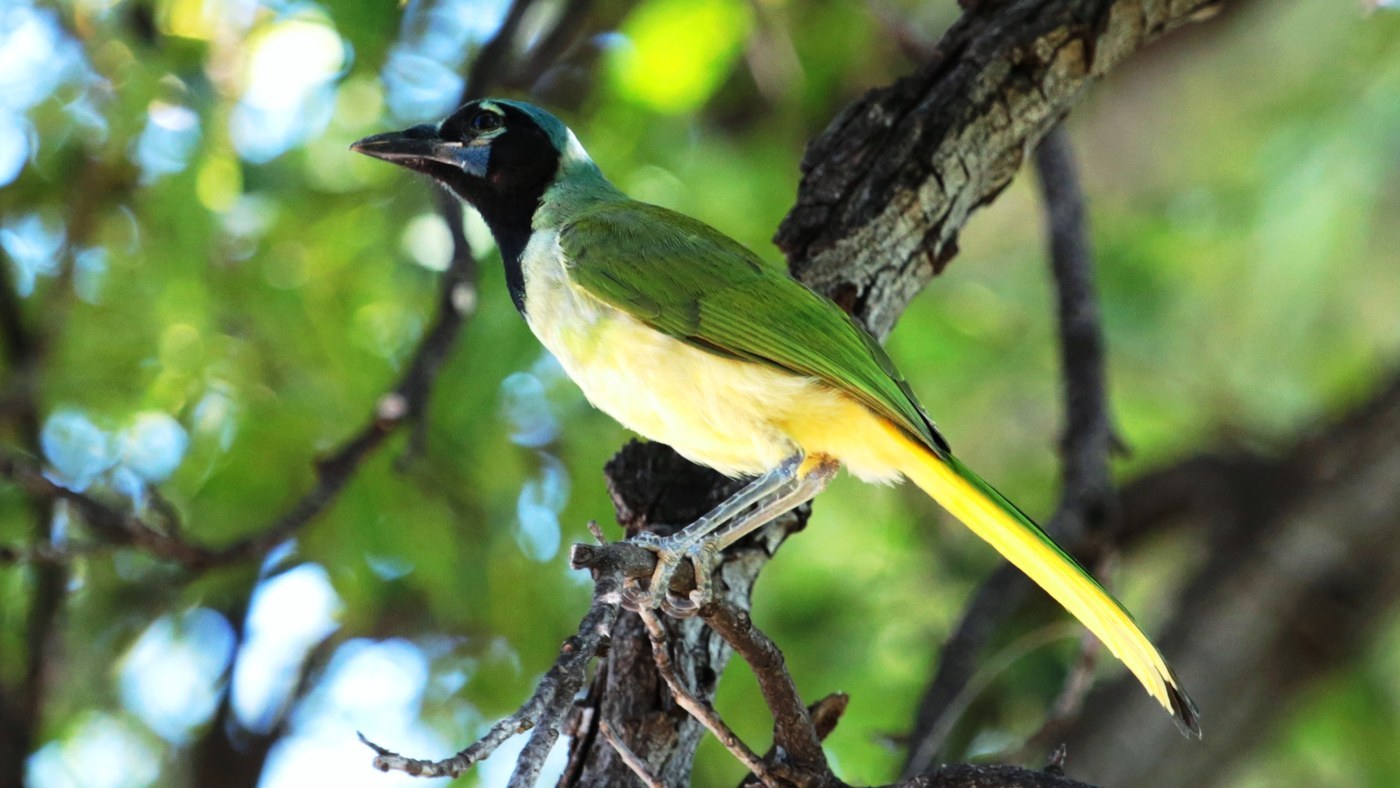
Key Field Marks
- Size and shape: A medium-sized jay, about 10–11 inches long, with a fairly long tail and a stout, slightly hooked bill typical of corvids.
- Plumage: Bright yellow-green body and wings contrast with a striking head pattern of pale blue crown and nape, a black bib and eye mask, and blue cheek patches; the outer tail feathers are bright yellow, especially conspicuous in flight or when the tail is fanned.
- Bill and legs: Black bill; dark gray legs.
- Behavior: Highly social, usually traveling in small, noisy family groups; forages both in trees and on the ground, hopping and flicking its tail; bold and often comes readily to feeders in its range.
Separating It From Similar Species
- Green Jay vs. other jays in range: In South Texas, no other jay shares its combination of green body, blue-and-black head, and yellow outer tail feathers, making it essentially unmistakable within its U.S. range.
- Elsewhere in Mexico and Central/South America, some regional jay species can show green plumage, but the specific blue crown, black bib, and yellow tail-corner pattern of the Green Jay remain diagnostic.
- Juveniles are duller and grayer on the head pattern but still show the core green body and yellow tail markings.
Where and When to See It
- Habitat: Dense thorn scrub, riparian woodland, and forest edge; readily found in wooded parks, ranch brushland, and residential areas with mature trees and feeders in South Texas.
- Range: In the U.S., restricted to the Lower Rio Grande Valley of South Texas; more broadly distributed from Mexico south through Central America and into parts of northern South America.
- Season: A non-migratory, year-round resident throughout its range.
Voice and Song Cues
- Vocal and varied, giving a harsh, rattling "cheh-cheh-cheh" and a range of clanking, metallic, and scolding calls typical of jays.
- Family groups often call back and forth constantly while foraging, making them easy to locate by ear even in dense brush.
Frequently asked questions
Where in the United States can I see a Green Jay?
The species is found in the U.S. only in the Lower Rio Grande Valley of South Texas, where it is a common resident at brushy parks, refuges, and backyard feeders.
What is the most distinctive field mark of the Green Jay?
The combination of a bright yellow-green body, pale blue crown, black facial bib, and bright yellow outer tail feathers makes it unmistakable wherever it occurs.
Do Green Jays travel alone or in groups?
They are highly social and are almost always seen in small, noisy family groups rather than alone.
Are juvenile Green Jays colored differently from adults?
Yes, juveniles have a duller, grayer head pattern with less contrast than adults, though they retain the green body and yellow tail-corner pattern.
What habitat should I search for Green Jays?
Look in dense thorn scrub, wooded riparian corridors, and shaded parks or gardens with mature trees, especially where feeders are present.