
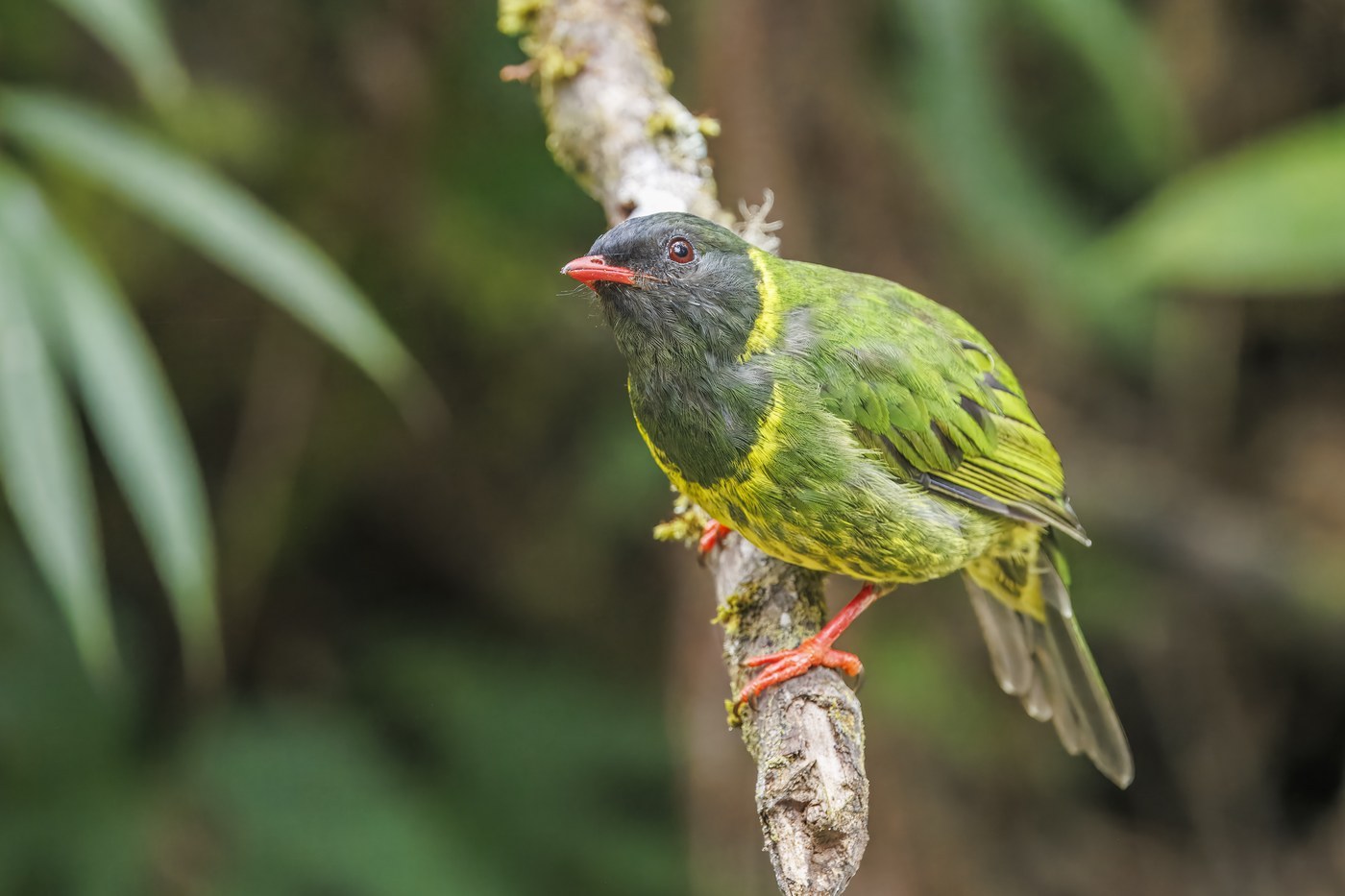
Green-and-black Fruiteater
Pipreola riefferii
A chunky, short-tailed cotinga of Andean cloud forest, with males boldly patterned in bright green and jet black.
- Size
- 17-18 cm (6.5-7 in) long
- Habitat
- humid montane cloud forest and forest edge in the Andes, mostly 1,500-3,200 m elevation
- Type
- songbird
Spotted a bird like this?
Identify any bird from a photo, free.
Overview
The Green-and-black Fruiteater is a plump, short-tailed cotinga of the Andean cloud forest belt. Males are striking, with a glossy black hood, throat, and upper breast sharply set off against bright grass-green upperparts, a green lower breast and flanks, and a yellow belly patch bordered by fine yellow scaling, plus a small red eye-ring and reddish bill base.
Females lack the black hood, being uniform green above with fine yellow scalloping below, closely resembling several related fruiteater species. Both sexes share the family's characteristic stocky, big-headed, short-tailed build.
As a member of the cotinga family, the fruiteater spends much of its time sitting quietly and inconspicuously in the mid-story or canopy, revealing itself mainly through its distinctive call and its habit of plucking fruit while perched or in brief sallying flights.
How to identify it
Key field marks
- Male: glossy black head, throat, and upper breast against bright green upperparts
- Yellow belly patch with fine yellow scaling on the lower underparts
- Short tail and stocky, big-headed cotinga shape
- Female: plain green above, yellow-scalloped below, lacking the black hood
Similar species
Several congeneric fruiteaters overlap in Andean cloud forest, including the Barred Fruiteater and Red-banded Fruiteater; males are distinguished chiefly by the pattern and extent of black on the head/breast and the color of belly markings, while females are best separated by elevation, range, and voice. Golden-breasted Fruiteater lacks the black hood entirely.
Habitat & range
Habitat
This species inhabits humid montane cloud forest, forest edge, and adjacent secondary growth, favoring the mid-story and canopy where fruiting shrubs and epiphyte-laden branches are abundant.
Range
It occurs along the Andes from western Venezuela through Colombia and Ecuador to central Peru and Bolivia, typically between about 1,500 and 3,200 meters elevation.
Migration
The Green-and-black Fruiteater is largely sedentary, though some local elevational movement may occur in response to fruit availability.
Behavior & voice
Behavior
Fruiteaters are quiet, unobtrusive birds that perch upright and motionless for long periods, making them easy to overlook despite the male's bright pattern. They typically forage alone or in pairs, occasionally joining mixed-species canopy flocks.
Voice
The call is a distinctive, far-carrying, somewhat froglike or nasal note, often a short repeated 'currr' or buzzy trill given from a concealed perch.
Feeding
It feeds mainly on small fruits and berries plucked directly from a perch or taken in a brief hovering sally, and it also gleans insects from foliage.
Nesting and breeding
As with most cotingas, nesting details are poorly documented; the female is believed to build a small cup nest and incubate alone, with little or no involvement from the male, typical of the family's polygynous or promiscuous mating system.
Frequently asked questions
What does a male Green-and-black Fruiteater look like?
It has a glossy black head, throat, and upper breast contrasting with bright green upperparts and a yellow, scaled lower belly.
Where does the Green-and-black Fruiteater live?
It lives in humid Andean cloud forest from Venezuela to Bolivia, mostly between 1,500 and 3,200 meters elevation.
What does the Green-and-black Fruiteater eat?
It eats mostly small fruits and berries, along with some insects.
How can you tell a female fruiteater from a male?
Females lack the male's black hood, appearing plain green above with yellow scalloping below.
Green-and-black Fruiteater guides
In-depth guides for identifying, finding, and understanding Green-and-black Fruiteater.
Other birds you may enjoy

Black Redstart
13-14.5 cm (5.1-5.7 in) long, 23-26 cm wingspan

Black-throated Sparrow
12-14 cm (4.7-5.5 in) long, about 19-20 cm (7.5-8 in) wingspan

Greater Bird-of-paradise
Body about 43 cm; males with additional flank plumes up to 50 cm and long tail wires

Blue Tit
11-12 cm (4.3-4.7 in) long, 17-20 cm wingspan

Red-billed Quelea
11.5–13 cm long, wingspan about 20–22 cm
White-plumed Antbird
13-14 cm (5-5.5 in) long

Pyrrhuloxia
19-22 cm (7.5-8.7 in) long, 30 cm wingspan

Blue-gray Tanager
16-18 cm (6-7 in) long

Blackburnian Warbler
11-13 cm (4.3-5.1 in) long, 20-22 cm wingspan

Bluethroat
13-14 cm (5.1-5.5 in) long, 20-22 cm wingspan

Eurasian Nuthatch
12-14.5 cm (4.7-5.7 in) long, 22.5-27 cm wingspan

Wood Thrush
19-21 cm (7.5-8.3 in) long, about 33 cm (13 in) wingspan