
Green-and-black Fruiteater Identification Guide
A chunky, colorful cotinga of Andean cloud forests, the Green-and-black Fruiteater shows bright green upperparts, a black head-and-throat hood in males, and a stout, slightly hooked bill suited to its fruit-heavy diet.
Read the full Green-and-black Fruiteater encyclopedia entry →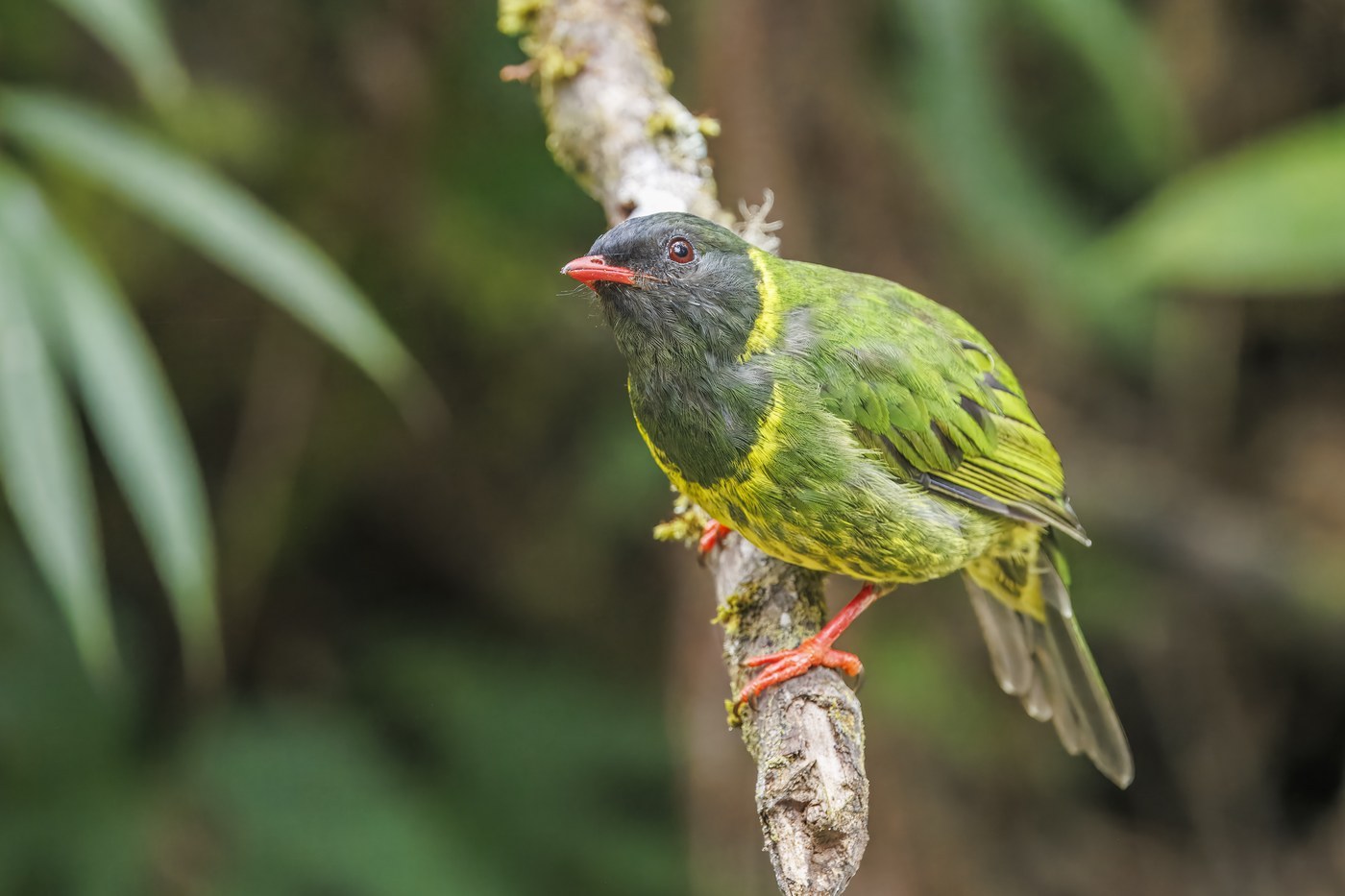
Key Field Marks
- Size & shape: A plump, short-tailed, medium-small cotinga (about 7–7.5 inches / 18–19 cm) with a large rounded head and a short, stout, slightly hooked bill — a compact, front-heavy silhouette typical of fruiteaters.
- Male plumage: Bright grass-green upperparts and breast band contrast with a solid black hood covering the head, throat, and upper breast; belly is yellow, often with green flecking on the flanks; wings show green edging on dark flight feathers.
- Female plumage: Duller and lacks the black hood — mostly green above with a yellowish-green or grayish head and pale yellow belly, subtler and harder to identify without the male's bold pattern nearby.
- Bill: Short, thick-based, and slightly downcurved at the tip — an adaptation for taking fruit.
- Behavior: Quiet, often perches motionless for long periods in the mid- to upper-story, sallying out to pluck fruit; usually solitary or in pairs, sometimes joining mixed-species fruiting-tree gatherings.
Separating It From Similar Species
- Other Andean fruiteaters (e.g., Barred Fruiteater, Golden-breasted Fruiteater, Scaled Fruiteater) can overlap in range but differ clearly in pattern: Barred Fruiteater shows fine barring below rather than a solid black hood; Golden-breasted has an orange-yellow breast; Scaled Fruiteater shows a scaly-patterned underside. Male Green-and-black Fruiteater's clean two-tone green/black-and-yellow pattern is distinctive once seen well.
- Female fruiteaters are the trickiest to separate between species and are best identified by range, elevation, and any accompanying male.
- Its stocky shape and habit of sitting still separate it from more active tanagers or greenlets that share the green coloration but have slimmer bodies and thinner bills.
Where & When to See It
- Habitat: Humid montane cloud forest and forest edge, typically in the subtropical to lower temperate zone.
- Range: Andes of Venezuela, Colombia, Ecuador, Peru, and Bolivia, generally at elevations of roughly 1,500–3,000 m (5,000–10,000 ft).
- Season: Resident year-round within its elevational range; some local altitudinal movement may occur outside the breeding season in response to fruit availability, but there is no long-distance migration.
Voice
- Generally quiet; gives soft, thin, high-pitched whistled or squeaky notes, not loud or far-carrying, making it easier to find by watching fruiting trees than by voice alone.
Frequently asked questions
What is the most distinctive feature of a male Green-and-black Fruiteater?
A solid black hood covering the head, throat, and upper breast, sharply set off against bright green upperparts and a yellow belly.
How do you identify a female Green-and-black Fruiteater?
Females lack the black hood and are mostly green with a yellowish-green head and pale yellow belly; they are best confirmed by range, elevation, and the presence of a nearby male.
Where in the Andes is the Green-and-black Fruiteater found?
In humid montane cloud forest from Venezuela south through Colombia, Ecuador, Peru, and Bolivia, generally between about 1,500 and 3,000 meters elevation.
Is the Green-and-black Fruiteater easy to find by call?
Not especially — its voice is soft, thin, and not far-carrying, so scanning fruiting trees in the mid-to-upper canopy is often more productive than listening for it.