
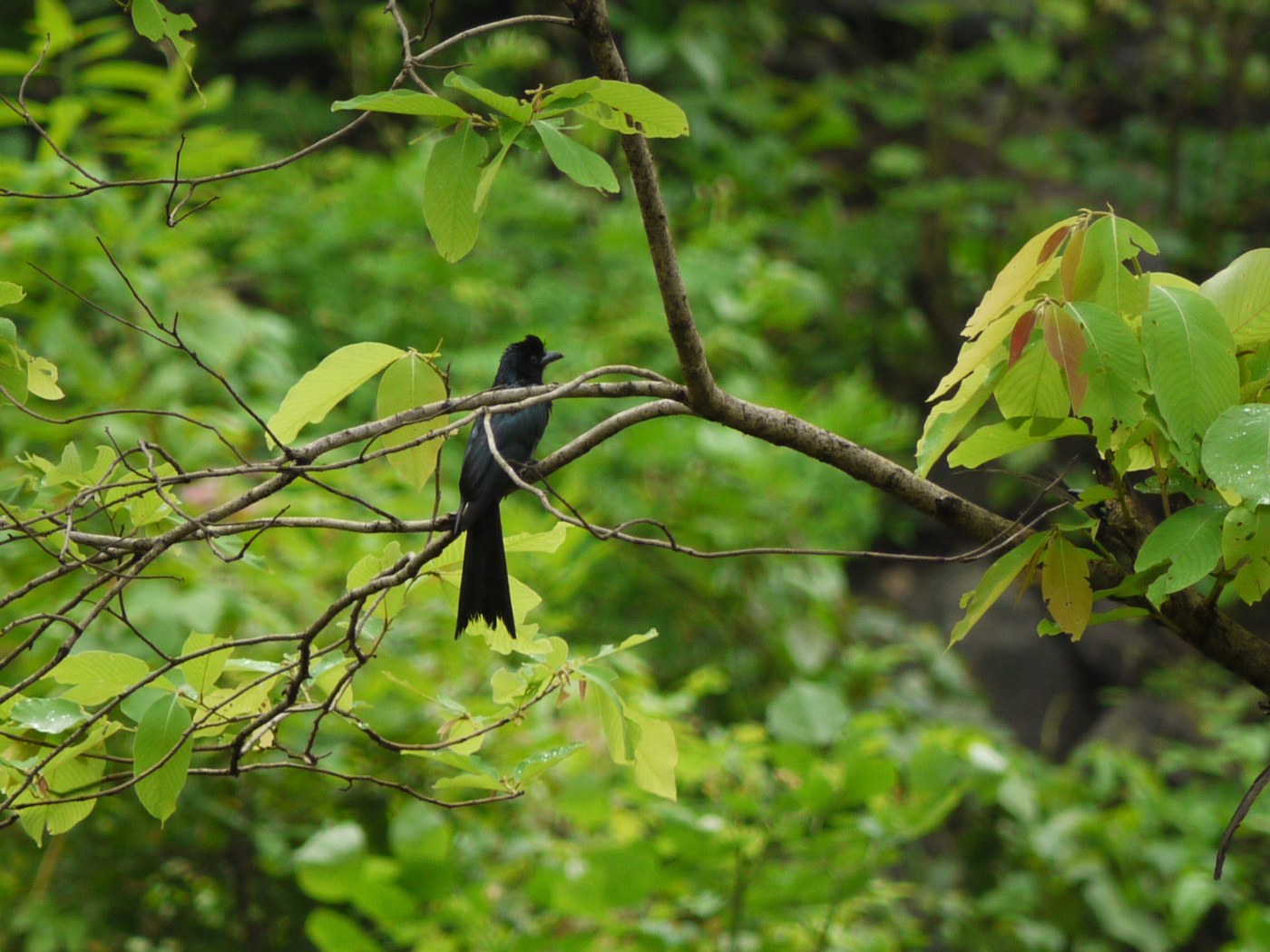
Greater Racket-tailed Drongo
Dicrurus paradiseus
A glossy black forest drongo with a spiky forehead crest and two extraordinary wire-like tail streamers ending in rackets.
- Size
- 30 cm (12 in) body length, plus tail streamers extending total length to 60 cm (24 in) or more
- Habitat
- dense forest, forest edge, and well-wooded gardens across South and Southeast Asia
- Type
- songbird
Spotted a bird like this?
Identify any bird from a photo, free.
Overview
The Greater Racket-tailed Drongo is one of the most spectacular and vocally gifted birds of Asian forests. It is entirely glossy black with a blue-green sheen, a distinctive tuft of forward-curling feathers on the forehead, and — in adults — a pair of extremely long, bare-shafted outer tail feathers that end in twisted, spatula-shaped "rackets," giving the bird an almost otherworldly silhouette in flight.
This drongo is also renowned as one of the finest avian mimics in Asia, capable of reproducing the calls of numerous other bird species, as well as those of squirrels and even man-made sounds, often as part of its own varied song.
How to identify it
Key field marks
- Glossy black body with a green-blue sheen
- Prominent crest of curled feathers rising from the forehead
- Two long wire-like outer tail streamers ending in twisted paddle-shaped rackets (may be missing if molting)
- Larger and bulkier than other drongos, with a heavier bill
Similar species
The Black Drongo is smaller, lacks the forehead crest, and has an ordinary forked tail without rackets. The Lesser Racket-tailed Drongo (in areas where both occur) is smaller with shorter, twisted rackets and a different crest shape.
Habitat & range
This species is found from the Indian subcontinent through Sri Lanka, the Himalayan foothills, and across much of Southeast Asia into Indonesia. It is a bird of dense broadleaf forest, forest edge, and well-wooded plantations or gardens, generally avoiding very open country.
Most populations are resident, though some altitudinal movement occurs in hill regions.
Behavior & voice
Voice
An extraordinarily varied vocalist, producing metallic whistles, harsh scolds, and an extensive repertoire of mimicked calls from other birds, which it often weaves into its own song, sometimes to lure other species into mobbing behavior or to warn of predators.
Feeding
It hunts mainly large flying insects by sallying from a perch, often joining mixed-species foraging flocks and benefiting from insects flushed by other birds and troops of monkeys; it occasionally takes small lizards or visits flowering trees for nectar.
Nesting and breeding
The nest is a shallow, flimsy cup of twigs and tendrils slung between a horizontal fork high in the forest canopy. Pairs are territorial and vigorously defend their nest against crows, raptors, and other intruders.
Frequently asked questions
What are the 'rackets' on this drongo's tail?
They are two elongated, bare-shafted outer tail feathers that twist near the tip into a flattened, spoon-shaped web, trailing behind the bird in flight.
Why is the Greater Racket-tailed Drongo famous among birdwatchers?
It is renowned both for its striking racket tail and forehead crest and for being an exceptional mimic of other birds' calls.
Does this drongo always have its tail rackets?
No, the streamers can be lost or shortened during molt or through wear, so individuals are sometimes seen with a shorter or normal-looking forked tail.
Where does the Greater Racket-tailed Drongo live?
It inhabits dense forest and forest edge from India and Sri Lanka across the Himalayan foothills and Southeast Asia to parts of Indonesia.
Greater Racket-tailed Drongo guides
In-depth guides for identifying, finding, and understanding Greater Racket-tailed Drongo.
Other birds you may enjoy

Black Redstart
13-14.5 cm (5.1-5.7 in) long, 23-26 cm wingspan

Black-throated Sparrow
12-14 cm (4.7-5.5 in) long, about 19-20 cm (7.5-8 in) wingspan

Greater Bird-of-paradise
Body about 43 cm; males with additional flank plumes up to 50 cm and long tail wires

Blue Tit
11-12 cm (4.3-4.7 in) long, 17-20 cm wingspan

Red-billed Quelea
11.5–13 cm long, wingspan about 20–22 cm
White-plumed Antbird
13-14 cm (5-5.5 in) long

Pyrrhuloxia
19-22 cm (7.5-8.7 in) long, 30 cm wingspan

Blue-gray Tanager
16-18 cm (6-7 in) long

Blackburnian Warbler
11-13 cm (4.3-5.1 in) long, 20-22 cm wingspan

Bluethroat
13-14 cm (5.1-5.5 in) long, 20-22 cm wingspan

Eurasian Nuthatch
12-14.5 cm (4.7-5.7 in) long, 22.5-27 cm wingspan

Wood Thrush
19-21 cm (7.5-8.3 in) long, about 33 cm (13 in) wingspan