
Greater Racket-tailed Drongo Identification Guide
A glossy black Asian forest bird instantly recognizable by its long tail streamers ending in twisted, spatula-shaped rackets and its uncanny ability to mimic other birds.
Read the full Greater Racket-tailed Drongo encyclopedia entry →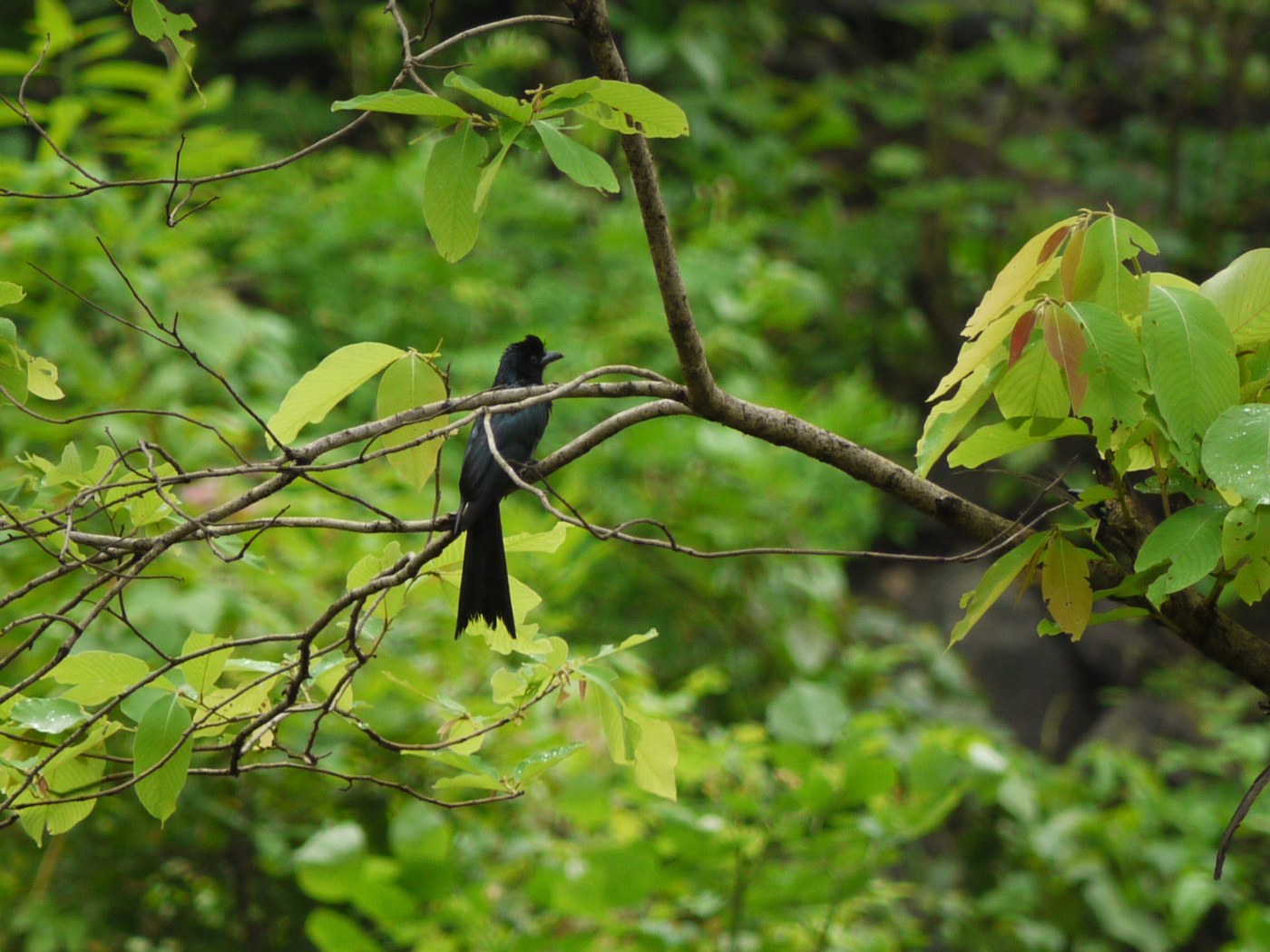
Key Field Marks
- Size & shape: A large drongo with a deeply forked tail base extending into two extremely long, bare-shafted streamers that end in twisted, paddle-like "rackets" — the species' signature feature.
- Plumage: Entirely glossy black with a strong blue-green sheen in good light.
- Head: A prominent forward-curling crest at the base of the bill, though the size and shape of the crest vary noticeably between subspecies across its range.
- Eyes: Deep red, visible at close range.
- Behavior: Highly active and aggressive, often seen sallying for insects from an exposed perch, and frequently joins and even leads mixed-species foraging flocks in forest understory and canopy.
Separating It From Similar Species
- Lesser Racket-tailed Drongo: Smaller overall, with a less pronounced crest and shorter racket streamers; occupies a more restricted range (parts of the Greater Sundas) compared to the widespread greater racket-tailed drongo.
- Black Drongo: Lacks racket-tipped tail streamers entirely, having a shorter, simply forked tail, and favors more open country rather than forest interior.
- Spangled Drongo (Australasia): Typically shows a shorter, less exaggerated tail without true twisted rackets, and occurs in a different geographic region.
- The combination of a crested head and unmistakable wire-thin tail streamers ending in twisted rackets rules out virtually all confusion once seen clearly, though juveniles and molting birds can temporarily lack fully developed rackets.
Where and When to See One
- Range: Widespread across the Indian subcontinent, Southeast Asia, and parts of southern China, with numerous recognized subspecies varying in crest and tail details.
- Habitat: Broadleaf forest, forest edge, bamboo groves, and plantations; often found from lowlands into hill forest.
- Season: Largely resident throughout its range, with some local altitudinal movements in hillier areas.
Voice Cues
- One of the most accomplished avian mimics, routinely imitating the calls of other bird species, and sometimes even other animals, within its territory.
- Its own calls include a variety of loud, metallic whistles, sharp clicks, and harsh scolding notes, often given while leading mixed-species flocks — listen for a mix of "typical" drongo calls interspersed with unexpected mimicked sounds as a strong identification clue.
Frequently asked questions
What is the easiest way to identify a greater racket-tailed drongo?
Look for an all-black bird with a curling crest and two long, wire-like tail streamers ending in twisted, spoon-shaped rackets — a combination unique among most Asian forest birds.
How do you tell greater and lesser racket-tailed drongo apart?
Greater racket-tailed drongo is larger with a more prominent crest and longer racket streamers, while lesser racket-tailed drongo is smaller with a subtler crest and occupies a more limited range.
Why do greater racket-tailed drongos mimic other birds?
They are highly skilled vocal mimics, likely using imitated calls to deter rivals, attract mates, or manipulate other species while foraging in mixed flocks, though the exact function is still studied.
Does every greater racket-tailed drongo have full tail rackets?
No, juveniles and birds in active molt may temporarily lack fully developed racket tips, so structure alone (crest, overall shape) is still useful even without complete streamers.
What habitat is best for finding greater racket-tailed drongos?
Broadleaf forest, forest edges, and bamboo stands from lowlands into hill forest across South and Southeast Asia, often near mixed-species foraging flocks.