
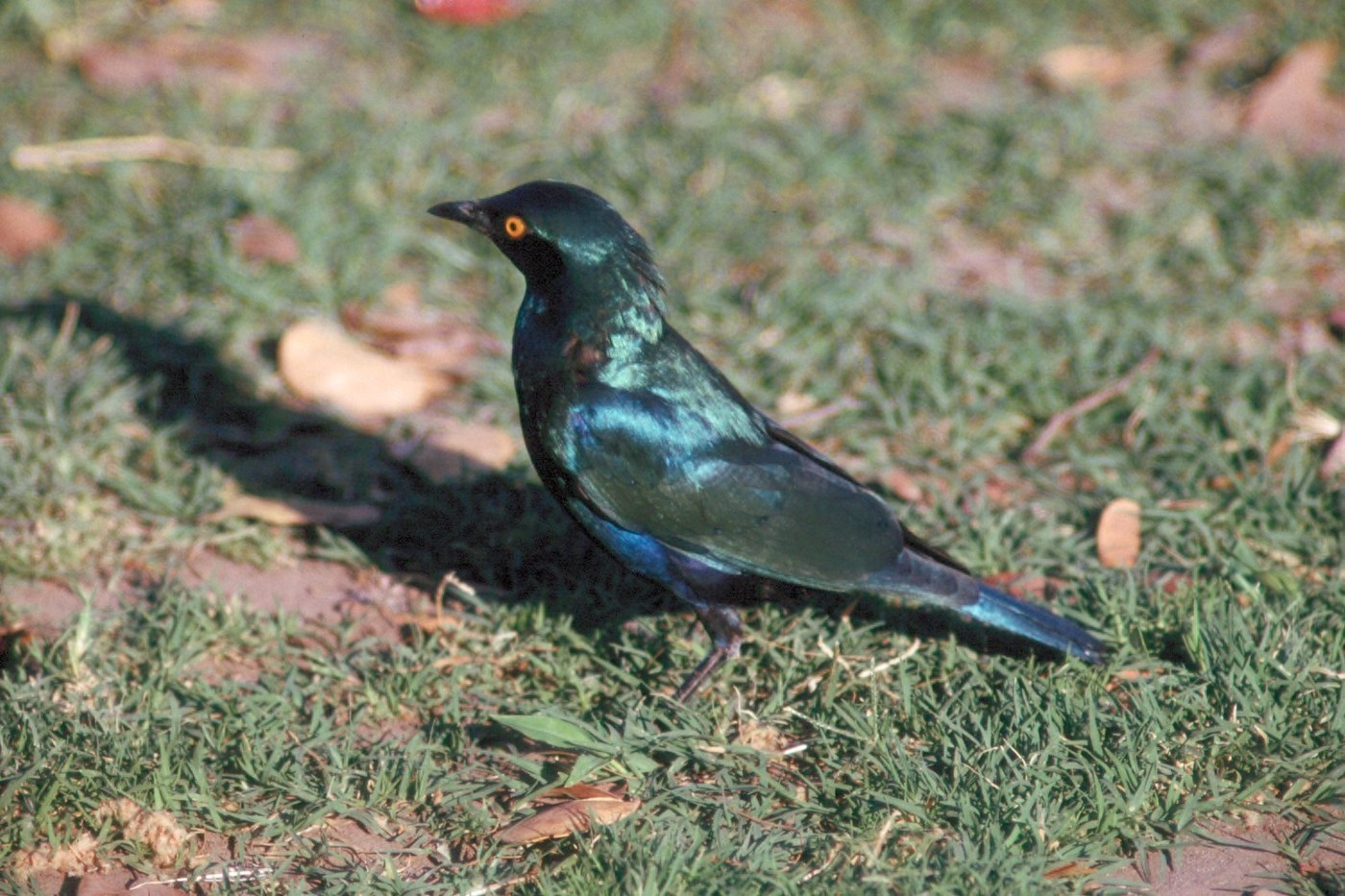
Greater Blue-eared Starling
Lamprotornis chalybaeus
A widespread African starling with glossy blue-green plumage and a violet-blue ear patch, often confused with the closely related Lesser Blue-eared Starling.
- Size
- About 22 cm long
- Habitat
- Woodland, savanna and gardens across sub-Saharan Africa
- Type
- songbird
Spotted a bird like this?
Identify any bird from a photo, free.
Overview
The Greater Blue-eared Starling is a common and widespread glossy starling found across much of sub-Saharan Africa, frequenting woodland, savanna, and gardens. Its brilliant, shifting iridescent plumage is characteristic of the glossy starling group.
Appearance
Adults are richly iridescent, with a metallic green head and back shading into deep blue-violet on the wings and belly, and a distinctive dark violet-blue patch on the ear coverts that gives the species its name. The eye is orange to yellow-orange, and the bill and legs are black. Juveniles are duller and browner, lacking the full adult iridescence.
How to identify it
Key field marks
- Medium-large glossy starling with strongly iridescent green, blue, and violet plumage
- Distinct dark blue-violet ear patch
- Orange to yellow eye
- Deep blue-violet belly and undertail area, appearing darker than the back
Similar species
The Greater Blue-eared Starling is very similar to the smaller Lesser Blue-eared Starling, which has a duller, less extensive ear patch, a darker eye, and a body that appears more uniformly green with less contrast between back and belly; range and direct size comparison, where both occur, along with the more richly violet belly of the Greater, help separate the two. It can also resemble other glossy starlings such as the Rüppell's Starling, best distinguished by the specific ear patch color and eye color.
Habitat & range
Habitat
This species occupies a broad range of wooded and semi-open habitats, including savanna woodland, forest edge, farmland, and gardens.
Range
It is widespread across sub-Saharan Africa, occurring from Senegal and the Sahel belt across to Ethiopia and Somalia, and south through East and southern Africa to South Africa.
Migration
Mostly resident, with some populations showing local nomadic movements linked to rainfall and food supply.
Behavior & voice
Behavior
Greater Blue-eared Starlings are gregarious, often seen in small to large flocks foraging on the ground or in trees, sometimes mixing with other starling species.
Voice
Calls include harsh, grating chatters, whistles, and squeaky notes typical of glossy starlings, often given in a chorus by flock members.
Feeding
The diet includes a wide range of insects such as grasshoppers, termites, and beetles, along with fruit and berries, with birds foraging both on the ground and in the canopy.
Nesting
Nests are built in natural tree cavities or old woodpecker and barbet holes, lined with grass, feathers, and other soft material. Both sexes may help raise the brood, and some populations show cooperative breeding behavior.
Frequently asked questions
How do you tell a Greater Blue-eared Starling from a Lesser Blue-eared Starling?
The Greater Blue-eared Starling is larger, has a more extensive and richly colored ear patch, an orange eye, and a more strongly contrasting violet-blue belly compared to the duller, darker-eyed Lesser Blue-eared Starling.
Where is the Greater Blue-eared Starling found?
It occurs widely across sub-Saharan Africa, from the Sahel belt to East and southern Africa, in woodland, savanna, and gardens.
What does the Greater Blue-eared Starling eat?
It eats a variety of insects such as grasshoppers, termites, and beetles, as well as fruit and berries.
Why does the Greater Blue-eared Starling look different colors in different light?
Its feathers have iridescent structural coloring, so the green, blue, and violet tones shift depending on the angle of light.
Greater Blue-eared Starling guides
In-depth guides for identifying, finding, and understanding Greater Blue-eared Starling.
Other birds you may enjoy

Black Redstart
13-14.5 cm (5.1-5.7 in) long, 23-26 cm wingspan

Black-throated Sparrow
12-14 cm (4.7-5.5 in) long, about 19-20 cm (7.5-8 in) wingspan

Greater Bird-of-paradise
Body about 43 cm; males with additional flank plumes up to 50 cm and long tail wires

Blue Tit
11-12 cm (4.3-4.7 in) long, 17-20 cm wingspan

Red-billed Quelea
11.5–13 cm long, wingspan about 20–22 cm
White-plumed Antbird
13-14 cm (5-5.5 in) long

Pyrrhuloxia
19-22 cm (7.5-8.7 in) long, 30 cm wingspan

Blue-gray Tanager
16-18 cm (6-7 in) long

Blackburnian Warbler
11-13 cm (4.3-5.1 in) long, 20-22 cm wingspan

Bluethroat
13-14 cm (5.1-5.5 in) long, 20-22 cm wingspan

Eurasian Nuthatch
12-14.5 cm (4.7-5.7 in) long, 22.5-27 cm wingspan

Wood Thrush
19-21 cm (7.5-8.3 in) long, about 33 cm (13 in) wingspan