
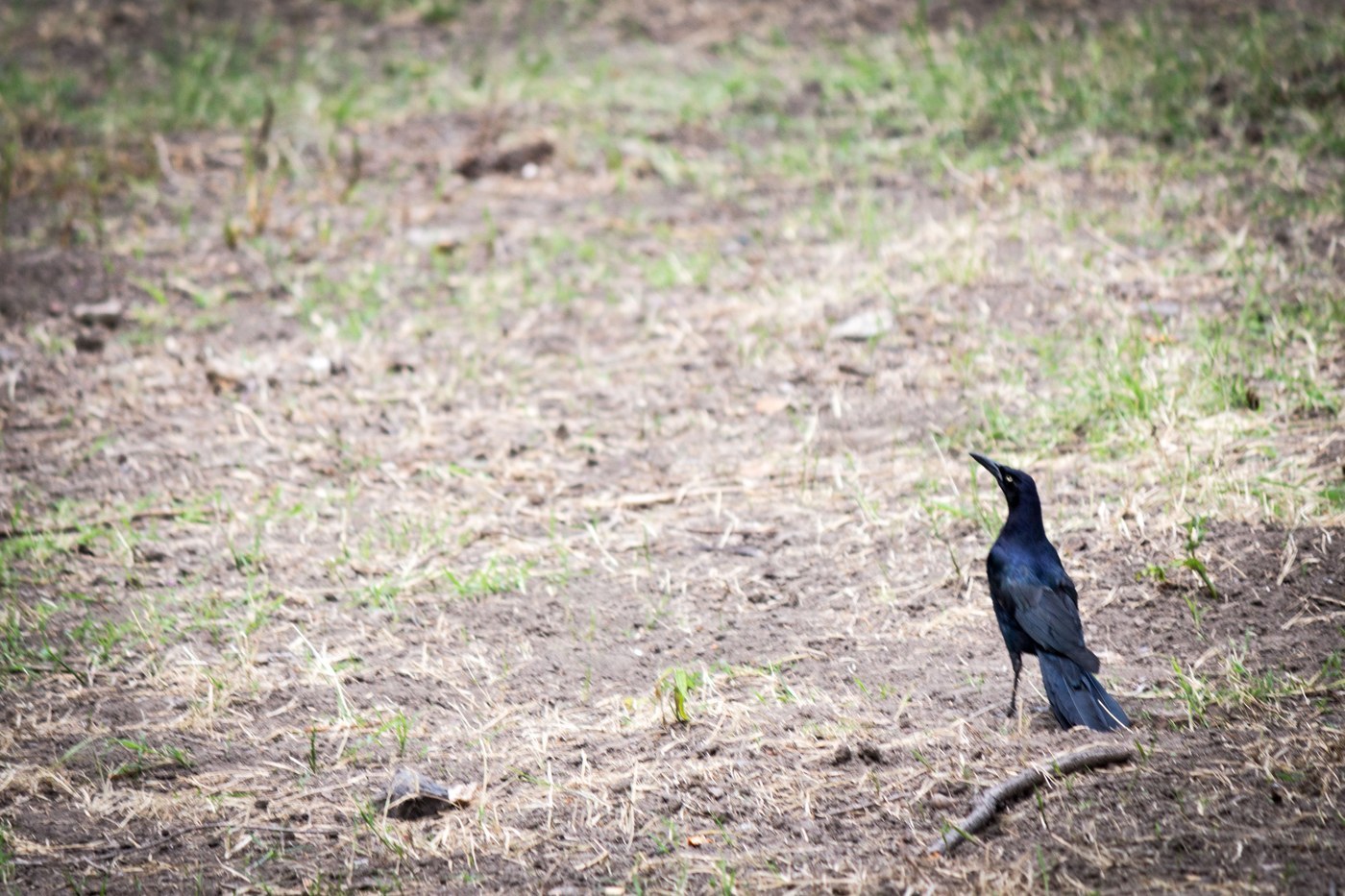
Great-tailed Grackle
Quiscalus mexicanus
A large, glossy, long-tailed blackbird with a loud, varied voice that has rapidly expanded across urban and agricultural North America.
- Size
- 38-46 cm (15-18 in) long, males noticeably larger than females; 43-58 cm wingspan
- Habitat
- urban areas, parking lots, agricultural fields, marshes, and open country near water
- Type
- songbird
Spotted a bird like this?
Identify any bird from a photo, free.
Overview
The Great-tailed Grackle is a large, lanky member of the blackbird family known for its iridescent plumage and enormously long, keel-shaped tail. Males are glossy black with purple-blue iridescence on the head and back, bright yellow eyes, and a tail that can equal or exceed half their total body length, often held in a deep V-shape or folded like a keel in flight. Females are much smaller and duller, with brown upperparts, a pale buffy throat and breast, and a proportionately shorter tail. This striking size difference between the sexes is one of the most pronounced of any North American songbird.
Highly social and conspicuous, Great-tailed Grackles gather in large, noisy flocks, especially outside the breeding season, and have become a familiar sight in parking lots, city parks, and fast-food restaurant lots across the southern and central United States.
How to identify it
Key Field Marks
- Very long, wedge-shaped tail, often folded into a deep V or keel shape, especially in males
- Males: glossy black overall with purple-blue iridescence, bright pale-yellow eyes
- Females: smaller, brown above, buffy below, with a shorter tail and dark eyes
- Large, heavy, slightly downcurved bill
- Long legs and an upright, strutting walk
Similar Species
- Boat-tailed Grackle is nearly identical but restricted to coastal areas of the southeastern and Gulf Coast states, with limited range overlap; female Boat-taileds tend to have darker brown underparts than female Great-taileds.
- Common Grackle is noticeably smaller with a shorter tail and bronze or purple (not purple-blue) iridescence.
- Female Brown-headed Cowbirds are much smaller and lack the long tail.
Habitat & range
Habitat
Great-tailed Grackles favor open and semi-open habitats close to water or human development, including marshes, agricultural fields, golf courses, city parks, and parking lots. They roost communally in large numbers in trees, reedbeds, or urban plantings.
Range
Native to the southwestern and south-central United States, Mexico, and Central America, the species has dramatically expanded its range northward and eastward over the past century, now breeding as far north as the northern Great Plains and Pacific Northwest.
Migration
Most populations are resident or make only short-distance movements, though northern populations may shift southward in winter to concentrate around reliable food and roost sites.
Behavior & voice
Behavior
Gregarious and bold, Great-tailed Grackles forage on the ground in flocks, walking with a confident, strutting gait. Males perform elaborate courtship displays, fluffing their feathers, spreading their tails, and calling loudly while several males compete for a harem of females.
Voice
Their vocal repertoire is extraordinarily varied and loud, including harsh rattles, whistles, clacks, and shrill ascending notes, often delivered from an exposed perch.
Feeding
Omnivorous and opportunistic, they eat insects, seeds, grain, small frogs, lizards, nestlings and eggs of other birds, and readily scavenge human food scraps.
Nesting & Breeding
The species is polygynous, with dominant males mating with multiple females. Females build a bulky cup nest of grass and mud, typically in a tree, shrub, or reedbed, often in loose colonies, and incubate 2-4 eggs alone.
Frequently asked questions
Why do Great-tailed Grackles have such long tails?
The long, keel-shaped tail is used in courtship displays and dominance signaling; males with longer, more impressive tails tend to attract more mates.
How can I tell a male from a female Great-tailed Grackle?
Males are much larger, glossy black with a very long tail, while females are smaller, brown, and have a shorter tail, making the species one of the most sexually dimorphic songbirds in North America.
What is the difference between a Great-tailed Grackle and a Common Grackle?
Great-tailed Grackles are larger with a much longer tail and purple-blue iridescence, while Common Grackles are smaller with a shorter tail and bronze or purple sheen.
Why are Great-tailed Grackles so loud?
They use a wide variety of loud whistles, rattles, and clacks for communication within large flocks and to establish territory and mating status.
Where do Great-tailed Grackles live?
They are common across the southern and central United States, Mexico, and Central America, favoring open habitats near water and human development, and their range continues to expand northward.
Great-tailed Grackle guides
In-depth guides for identifying, finding, and understanding Great-tailed Grackle.
Other birds you may enjoy
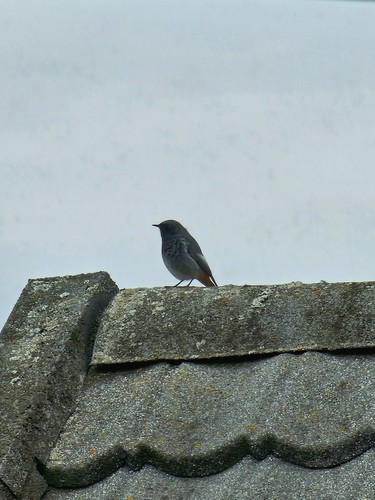
Black Redstart
13-14.5 cm (5.1-5.7 in) long, 23-26 cm wingspan
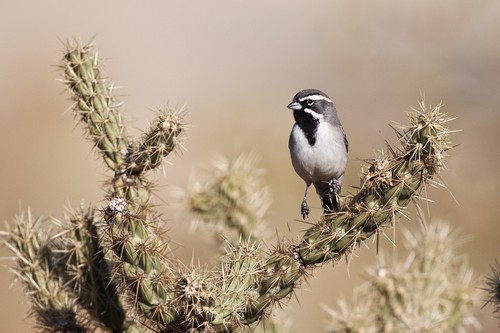
Black-throated Sparrow
12-14 cm (4.7-5.5 in) long, about 19-20 cm (7.5-8 in) wingspan
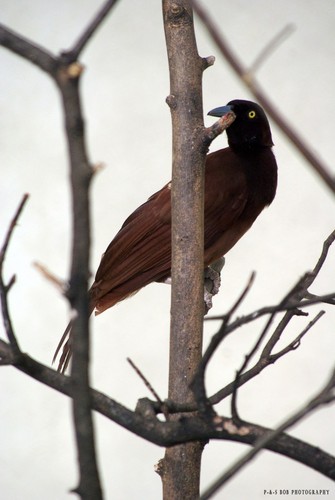
Greater Bird-of-paradise
Body about 43 cm; males with additional flank plumes up to 50 cm and long tail wires
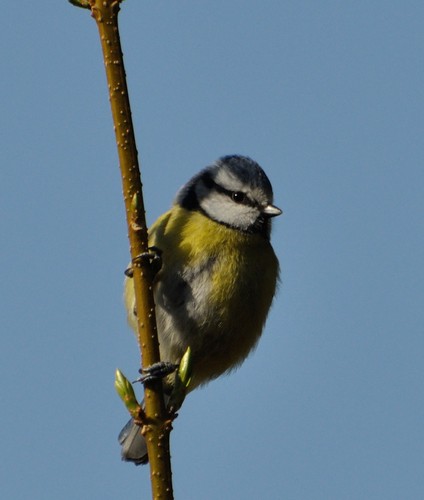
Blue Tit
11-12 cm (4.3-4.7 in) long, 17-20 cm wingspan
Red-billed Quelea
11.5–13 cm long, wingspan about 20–22 cm
White-plumed Antbird
13-14 cm (5-5.5 in) long
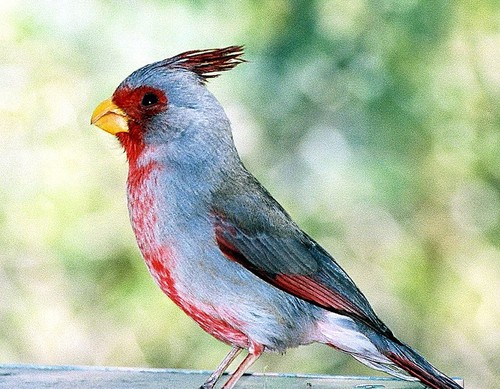
Pyrrhuloxia
19-22 cm (7.5-8.7 in) long, 30 cm wingspan
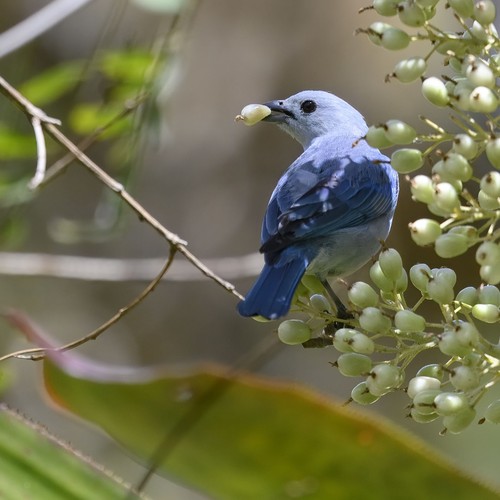
Blue-gray Tanager
16-18 cm (6-7 in) long
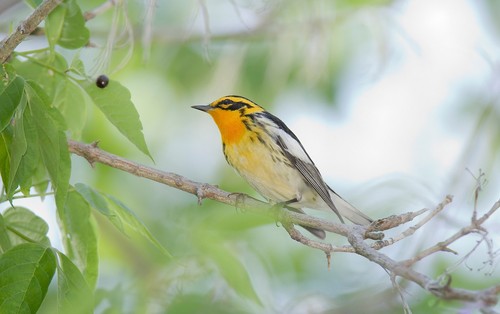
Blackburnian Warbler
11-13 cm (4.3-5.1 in) long, 20-22 cm wingspan
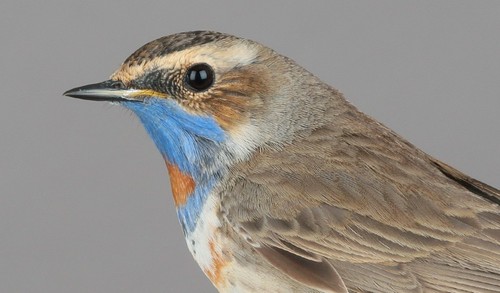
Bluethroat
13-14 cm (5.1-5.5 in) long, 20-22 cm wingspan
Eurasian Nuthatch
12-14.5 cm (4.7-5.7 in) long, 22.5-27 cm wingspan
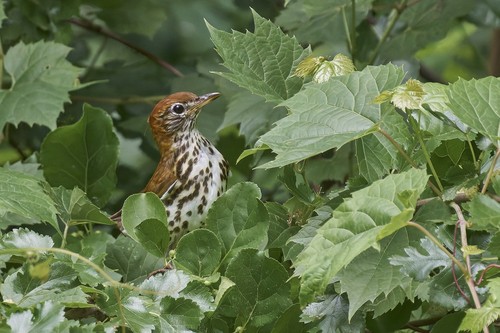
Wood Thrush
19-21 cm (7.5-8.3 in) long, about 33 cm (13 in) wingspan