
Great-tailed Grackle Identification Guide
A large, noisy blackbird of the American Southwest and beyond, distinguished by males' long keel-shaped tail, glossy iridescence, and pale eyes.
Read the full Great-tailed Grackle encyclopedia entry →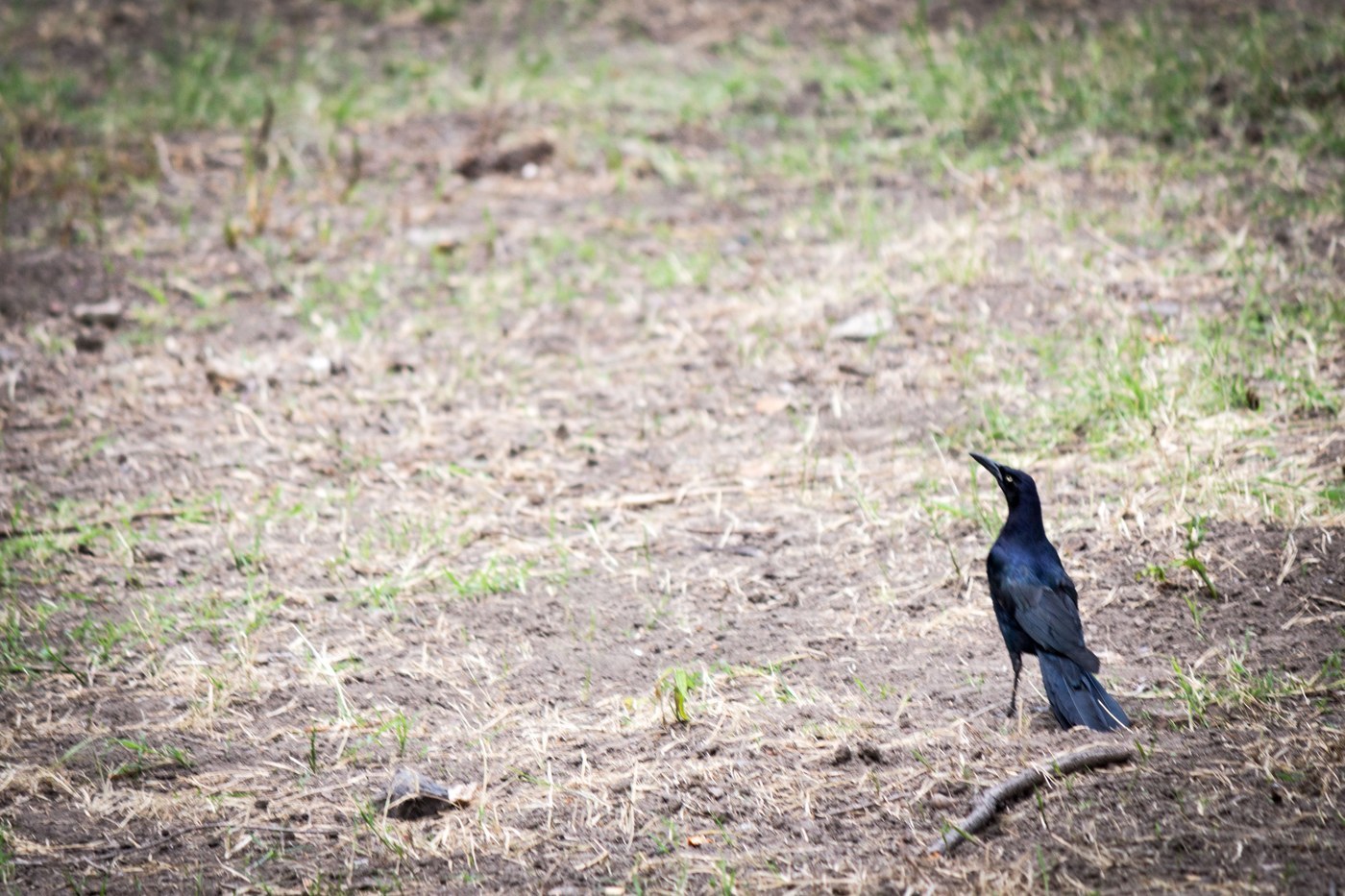
Key Field Marks
- Size & shape: A large icterid; males are notably larger than females, with a long, wedge-shaped tail that is folded into a deep V or keel shape in flight and especially during display.
- Male plumage: Glossy black overall with strong purple-blue iridescence in good light, a long heavy bill, and pale yellow eyes.
- Female plumage: Much smaller and duller, dark brown above, paler buffy-brown below, with a shorter tail than the male — females can look like a different species at first glance.
- Behavior: Highly social and vocal, often seen in large flocks around parking lots, agricultural fields, and urban parks; males perform tail-cocking, bill-up displays.
Separating It From Similar Species
- Boat-tailed Grackle: Very similar and the main identification challenge where ranges meet along the Gulf Coast; boat-tailed has a slightly shorter, less dramatically keeled tail, and Florida females typically have dark eyes versus the pale eyes of great-tailed females elsewhere. Habitat helps too — boat-tailed sticks closer to coastal marshes, while great-tailed is more common inland and in urban settings.
- Common Grackle: Noticeably smaller, with a shorter tail, bronze or purple sheen depending on subspecies, and pale yellow eyes in both sexes (unlike the strong male/female size difference in great-tailed).
- American Crow / other blackbirds: Ruled out by the grackle's slimmer build, long tail, and pale eye.
Where and When to See One
- Range: Resident across the south-central and southwestern United States, Mexico, and Central America, with an actively expanding range northward and eastward in recent decades.
- Habitat: Highly adaptable — urban areas, parking lots, agricultural fields, golf courses, marshes, and open woodland edges.
- Season: Present year-round throughout most of its core range; northern edge populations may be more seasonal.
Voice Cues
- An extremely varied and loud vocal repertoire including harsh whistles, sharp clacks, metallic squeaks, and rising "whistle-then-clatter" phrases.
- Communal roosts at dusk can be extremely noisy, with dozens to thousands of birds calling simultaneously — a good confirming clue alongside the visual field marks.
Frequently asked questions
How do you tell a great-tailed grackle from a common grackle?
Great-tailed grackles are noticeably larger with a much longer, deeply keeled tail, while common grackles are smaller with a shorter tail and more uniform size between sexes.
What is the difference between great-tailed and boat-tailed grackle?
They are very similar; boat-tailed has a slightly shorter tail and sticks to coastal marshes, while great-tailed favors inland and urban habitats and has a longer, more pronounced keel-shaped tail.
Why do male and female great-tailed grackles look so different?
The species shows strong sexual dimorphism: males are much larger, glossy black with a long tail, while females are smaller, dull brown, and short-tailed.
What color are a great-tailed grackle's eyes?
Pale yellow in both sexes across most of the range, which helps separate them from dark-eyed young birds or some boat-tailed grackle populations.
Where are great-tailed grackles most commonly seen?
In open urban and agricultural habitats across the southern and southwestern United States, Mexico, and Central America, often in noisy flocks around parking lots and fields.