
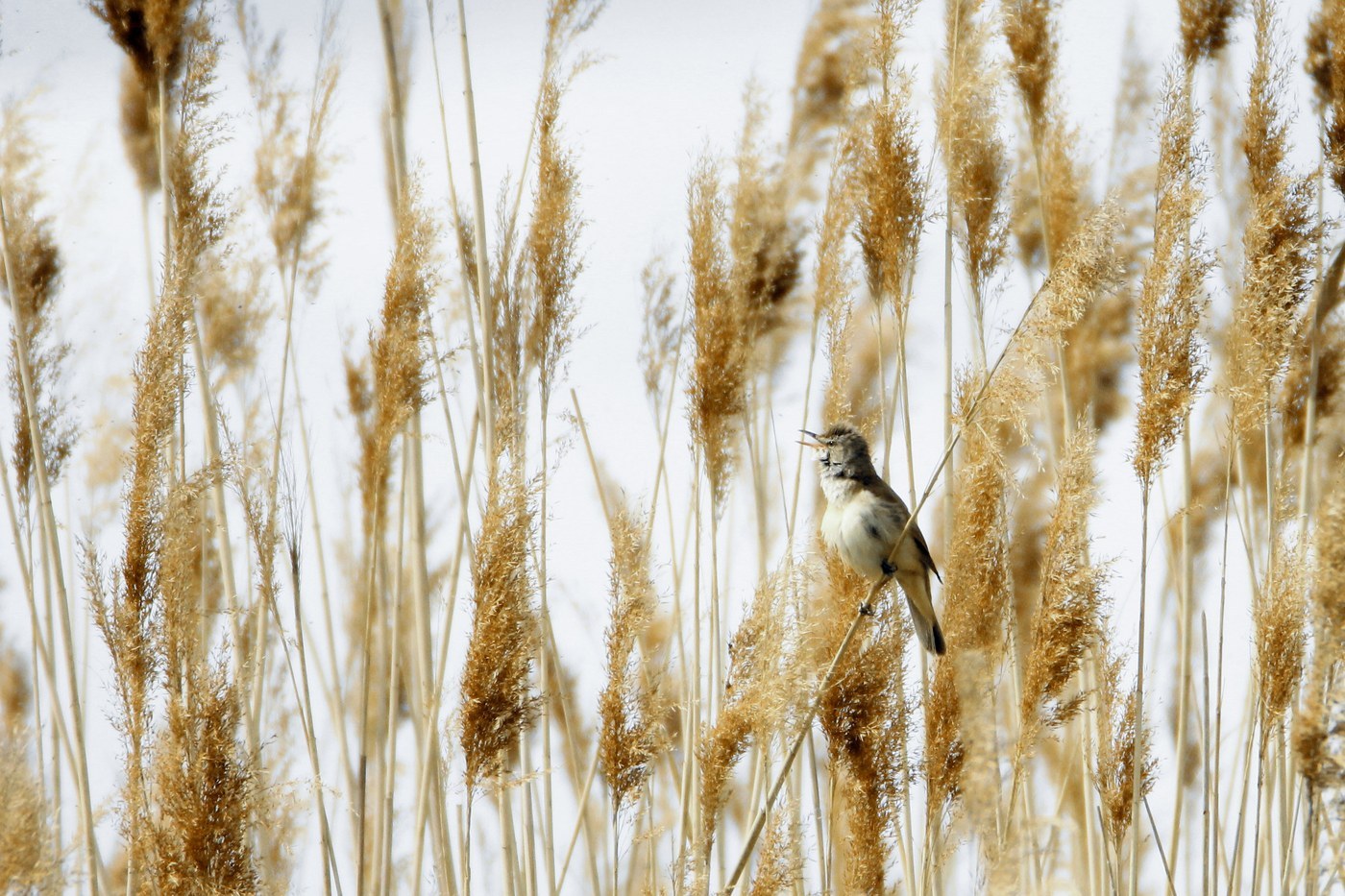
Great Reed Warbler
Acrocephalus arundinaceus
A large, powerful reed-dwelling warbler with a loud, harsh, croaking song that carries far across the reedbeds it calls home.
- Size
- 16-20 cm (6.3-7.9 in) long, 25-29 cm wingspan
- Habitat
- extensive reedbeds around lakes, rivers, and marshes
- Type
- songbird
Spotted a bird like this?
Identify any bird from a photo, free.
Overview
The Great Reed Warbler is the giant of the Acrocephalus warblers, noticeably larger and more robust than the familiar Eurasian Reed Warbler, with a heavier build, a stouter bill, and a more prominent pale supercilium. Plumage is plain warm brown above and paler buff below, similar in tone to its smaller relative but on a considerably larger frame.
Its size and heavy bill give it a slightly thrush-like impression at first glance, and it often perches conspicuously atop a reed stem, bending it under its weight, unlike the more furtive foraging typical of smaller reed warblers.
The species is renowned for its extremely loud, far-carrying, harsh song, among the loudest and most distinctive of any European songbird, which can be heard well beyond the reedbed itself.
How to identify it
Key field marks
- Notably large size for an Acrocephalus warbler, close to a small thrush
- Heavy, robust bill
- Plain brown upperparts with a more prominent pale supercilium than Reed Warbler
- Pale buffy-white underparts
- Often perches conspicuously atop swaying reed stems
Similar species
- Eurasian Reed Warbler: much smaller and slimmer with a finer bill and a far quieter, more even song.
- Sedge Warbler: smaller, streaked above, with a different, scratchier song.
- Thrush species: superficially similar in bulk but with completely different plumage patterns and a thicker, more generalist bill shape.
Habitat & range
Great Reed Warblers breed across much of continental Europe and western Asia, though they are absent as breeders from Britain and Ireland, favouring extensive, tall reedbeds around lakes, slow rivers, and large marshes, generally requiring larger stands of reed than the Eurasian Reed Warbler.
They are long-distance migrants, wintering in sub-Saharan Africa, and their loud song makes them one of the easiest reedbed species to detect even where dense vegetation obscures the birds themselves.
The species has declined in parts of western Europe linked to loss and degradation of large reedbed habitats.
Behavior & voice
Voice
The song is loud, deep, and harsh, a slow, grating, croaking sequence often rendered as "karra-karra-kreck-kreck-kreck," delivered at high volume and carrying well across open reedbed. It is one of the most distinctive and far-reaching songs among European songbirds.
Feeding
Great Reed Warblers feed on insects and spiders gleaned from reeds and waterside vegetation, and are also known to take small vertebrates such as tadpoles and occasionally small fish, a broader diet than most warblers.
Nesting and breeding
The nest is a large, deep cup woven around several reed stems, similar in construction to the Reed Warbler's but larger. Clutches typically contain four to six eggs.
Frequently asked questions
How do you identify a Great Reed Warbler?
Look for a large, robust reed warbler, noticeably bigger than a Eurasian Reed Warbler, with a heavy bill and a more prominent pale supercilium, often perched conspicuously atop bent reed stems.
What does a Great Reed Warbler sound like?
Its song is loud, deep, and harsh, a slow, grating, croaking sequence that carries much further than the songs of smaller reed warblers.
How big is a Great Reed Warbler compared to other warblers?
At 16-20 cm long, it is considerably larger than the Eurasian Reed Warbler, approaching the size of a small thrush.
What does a Great Reed Warbler eat?
It feeds mainly on insects and spiders but, unusually for a warbler, will also take small vertebrates such as tadpoles.
Does the Great Reed Warbler breed in Britain?
No, it breeds across much of continental Europe and western Asia but is not a breeding species in Britain or Ireland.
Great Reed Warbler guides
In-depth guides for identifying, finding, and understanding Great Reed Warbler.
Other birds you may enjoy

Black Redstart
13-14.5 cm (5.1-5.7 in) long, 23-26 cm wingspan

Black-throated Sparrow
12-14 cm (4.7-5.5 in) long, about 19-20 cm (7.5-8 in) wingspan

Greater Bird-of-paradise
Body about 43 cm; males with additional flank plumes up to 50 cm and long tail wires

Blue Tit
11-12 cm (4.3-4.7 in) long, 17-20 cm wingspan

Red-billed Quelea
11.5–13 cm long, wingspan about 20–22 cm
White-plumed Antbird
13-14 cm (5-5.5 in) long

Pyrrhuloxia
19-22 cm (7.5-8.7 in) long, 30 cm wingspan

Blue-gray Tanager
16-18 cm (6-7 in) long

Blackburnian Warbler
11-13 cm (4.3-5.1 in) long, 20-22 cm wingspan

Bluethroat
13-14 cm (5.1-5.5 in) long, 20-22 cm wingspan

Eurasian Nuthatch
12-14.5 cm (4.7-5.7 in) long, 22.5-27 cm wingspan

Wood Thrush
19-21 cm (7.5-8.3 in) long, about 33 cm (13 in) wingspan