
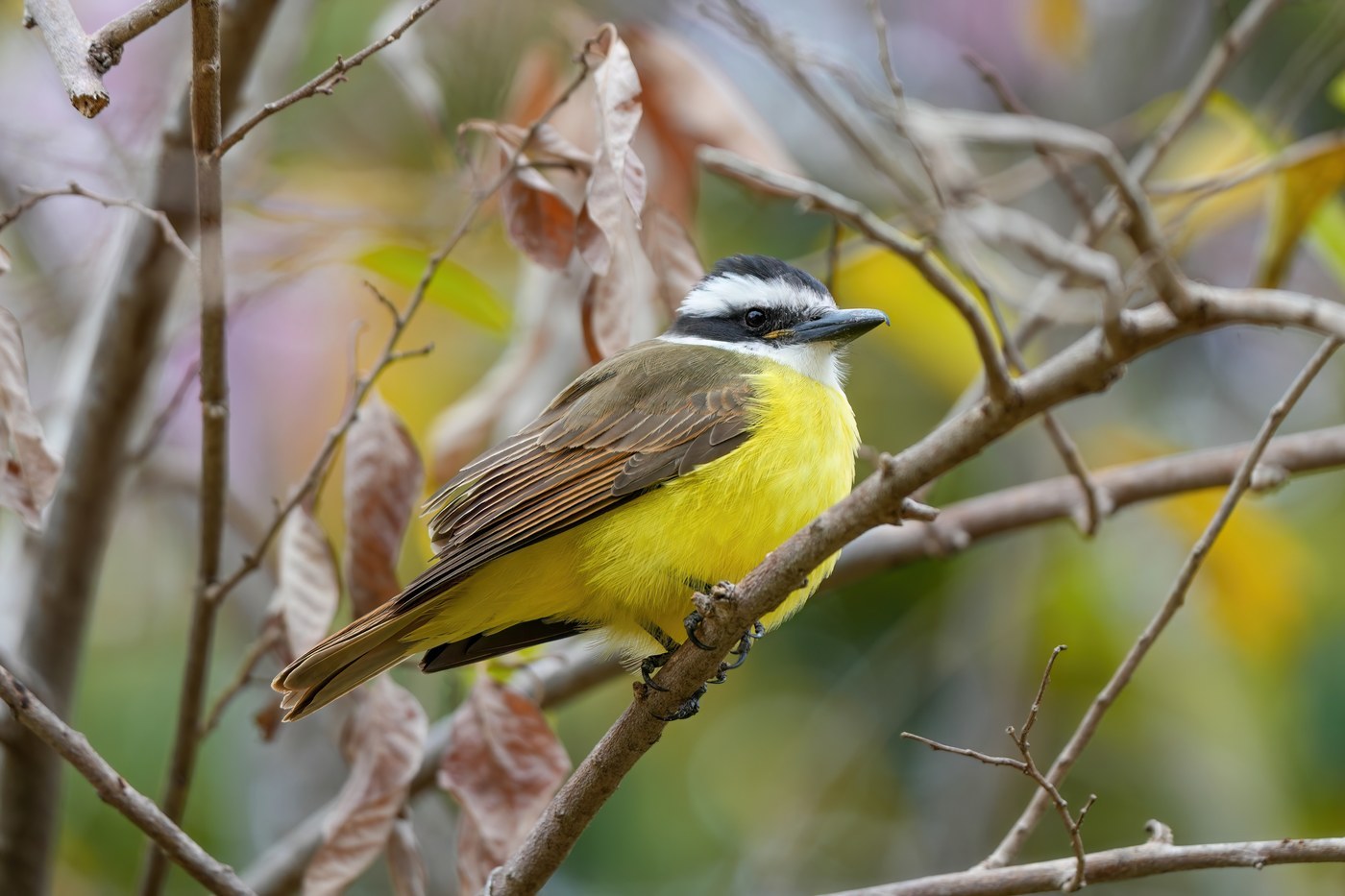
Great Kiskadee
Pitangus sulphuratus
A big, boldly patterned flycatcher named for its loud 'kis-ka-dee' call, often seen near water snatching insects, small fish, and fruit.
- Size
- 21-25 cm (8.5-9.5 in) long, 34-38 cm wingspan
- Habitat
- woodland edges, riparian corridors, and areas near water from south Texas through Mexico, Central America, and South America
- Type
- songbird
Spotted a bird like this?
Identify any bird from a photo, free.
Overview
The Great Kiskadee is one of the largest and most conspicuous flycatchers in the Americas, instantly recognizable by its bold head pattern: a black-and-white striped face topped with a hidden yellow crown patch (usually concealed unless the bird is excited). The back is brown, the wings and tail show rich rufous edging, and the underparts are a bright sulfur yellow. The bill is thick and black.
Unlike most flycatchers, kiskadees are true omnivores, taking everything from flying insects to small fish, lizards, and fruit, and they are frequently found near ponds, rivers, and resacas.
How to identify it
Key field marks
- Bold black-and-white striped head with a partly hidden yellow crown patch
- Brown back with rufous-edged wings and tail
- Bright yellow underparts
- Heavy black bill
Similar species
- No other flycatcher in its US range shares this striking head pattern; the combination of size, head stripes, and yellow underparts is diagnostic.
- Boat-billed Flycatcher (found farther south in the tropics) is similar but has an even larger, flatter bill and lacks rufous in the wings.
Habitat & range
Range and habitat
Great Kiskadee ranges from south Texas through Mexico, Central America, and much of South America. It favors open woodland edges, riparian growth, farmland with scattered trees, and especially areas near ponds, rivers, and resacas.
Migration
Largely non-migratory; US populations in south Texas are year-round residents, and the species has slowly expanded its range northward over recent decades.
Behavior & voice
Behavior
Kiskadees are bold, noisy, and conspicuous, often perching in the open on wires, fence posts, or bare branches. They hunt with dramatic sallies, sometimes plunging into shallow water to snatch small fish or diving to the ground for insects and lizards.
Voice
A loud, ringing "kis-ka-dee" call (also rendered "bien-te-veo" in Spanish-speaking areas), given frequently and giving the bird its name.
Feeding
True omnivores: large insects, small fish caught by shallow plunge-diving, lizards, small rodents, and a good deal of berries and fruit.
Nesting and breeding
Builds a large, messy, domed nest with a side entrance, placed in a tree, often near water or even on utility poles. The female incubates 2-5 eggs for about 2 weeks.
Frequently asked questions
Why is it called a Kiskadee?
The name comes from its loud, distinctive call, which sounds like 'kis-ka-dee.'
What does a Great Kiskadee eat?
It is an omnivore that eats large insects, small fish caught by plunge-diving, lizards, and fruit.
Where do Great Kiskadees live?
They range from south Texas through Mexico, Central America, and much of South America, usually near water and woodland edges.
Is the Great Kiskadee a flycatcher?
Yes, it is one of the largest members of the tyrant flycatcher family, though its diet is much broader than typical flycatchers.
Great Kiskadee guides
In-depth guides for identifying, finding, and understanding Great Kiskadee.
Other birds you may enjoy

Black Redstart
13-14.5 cm (5.1-5.7 in) long, 23-26 cm wingspan

Black-throated Sparrow
12-14 cm (4.7-5.5 in) long, about 19-20 cm (7.5-8 in) wingspan

Greater Bird-of-paradise
Body about 43 cm; males with additional flank plumes up to 50 cm and long tail wires

Blue Tit
11-12 cm (4.3-4.7 in) long, 17-20 cm wingspan

Red-billed Quelea
11.5–13 cm long, wingspan about 20–22 cm
White-plumed Antbird
13-14 cm (5-5.5 in) long

Pyrrhuloxia
19-22 cm (7.5-8.7 in) long, 30 cm wingspan

Blue-gray Tanager
16-18 cm (6-7 in) long

Blackburnian Warbler
11-13 cm (4.3-5.1 in) long, 20-22 cm wingspan

Bluethroat
13-14 cm (5.1-5.5 in) long, 20-22 cm wingspan

Eurasian Nuthatch
12-14.5 cm (4.7-5.7 in) long, 22.5-27 cm wingspan

Wood Thrush
19-21 cm (7.5-8.3 in) long, about 33 cm (13 in) wingspan