
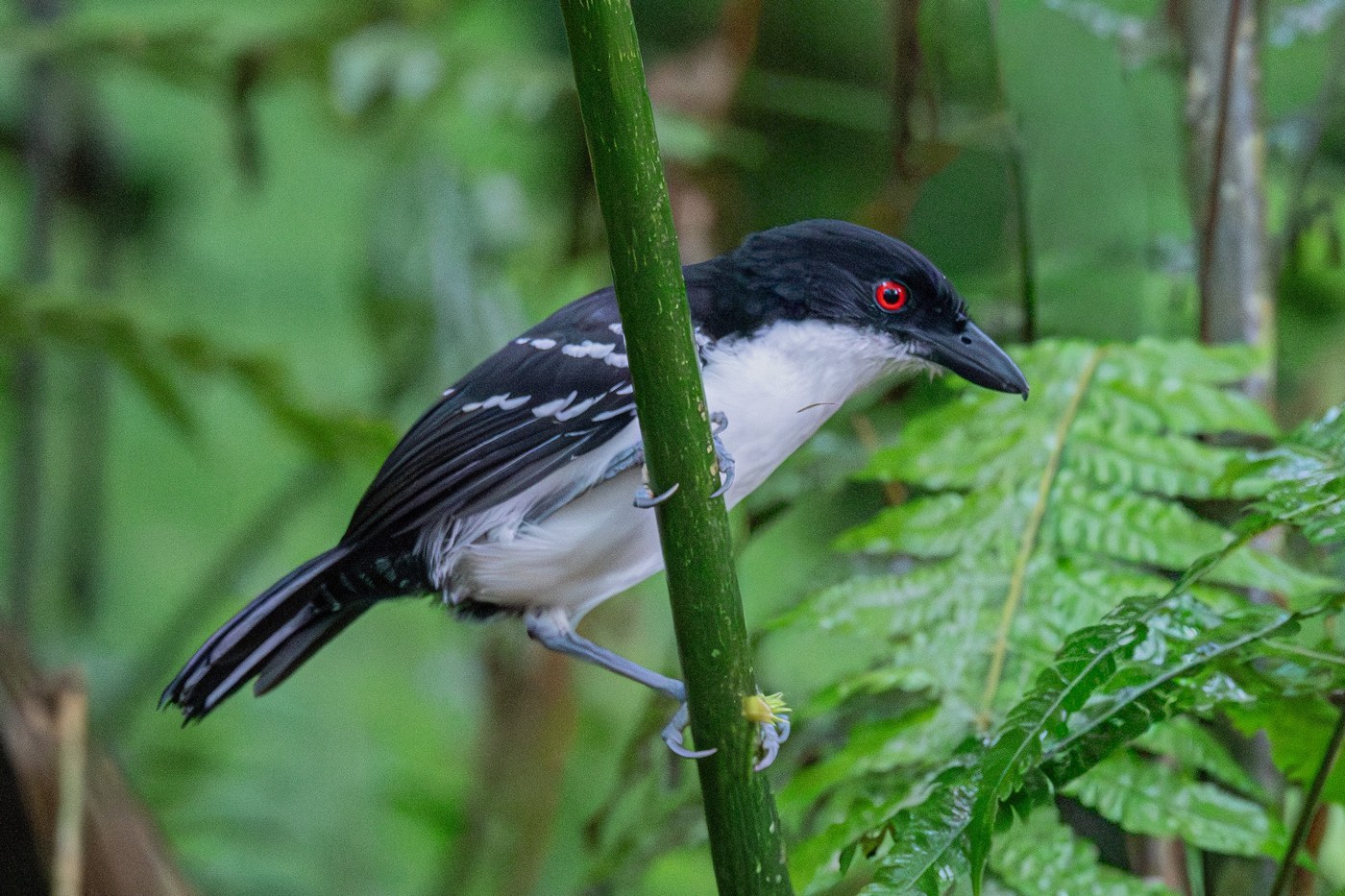
Great Antshrike
Taraba major
A large, red-eyed antbird with strongly different plumage between the sexes: black-and-white males and rich rufous-brown females, both skulking in dense undergrowth.
- Size
- 18-20 cm (7-8 in) long
- Habitat
- dense undergrowth, thickets, and forest edge
- Type
- songbird
Spotted a bird like this?
Identify any bird from a photo, free.
Overview
The Great Antshrike is a large, distinctive member of the antbird family, notable for its striking sexual dimorphism: males are boldly patterned in black and white, with a black crown, back, and bushy crest contrasting against clean white underparts and white-edged wing feathers, while females are entirely different, rich rufous-chestnut above with buffy-orange underparts and a similar bushy rufous crest. Both sexes share a piercing red eye and a heavy, hook-tipped bill typical of antshrikes.
Despite its bold coloring, the species is notoriously skulking, preferring to remain hidden within dense tangles and thickets rather than venturing into the open, so that its presence is often revealed first by its distinctive voice rather than by sight.
How to identify it
Key field marks
- Males: black crown, back, and bushy crest; white underparts and white-edged wings
- Females: rich rufous-chestnut upperparts, buffy-orange underparts, rufous crest
- Both sexes: bright red eye, heavy hook-tipped bill
- Skulking behavior within dense undergrowth
Similar species
- Barred Antshrike shows fine black-and-white barring in males rather than solid black-and-white blocks, and is smaller overall.
- Female Great Antshrikes can resemble other large rufous antbirds but the red eye and bushy crest are useful distinguishing features.
Habitat & range
Habitat
Inhabits dense undergrowth, thickets, vine tangles, and forest edge, including secondary growth and riverine scrub.
Range
Widespread from Mexico and Central America through much of tropical South America, including the Amazon basin, extending south to Argentina.
Migration
Resident and non-migratory throughout its range.
Behavior & voice
Behavior
Skulking and often difficult to observe, staying low within dense vegetation; pairs may duet, calling back and forth from within cover.
Voice
A distinctive, accelerating series of low, hollow notes, often ending in a sharp, growling or nasal note, frequently given as a duet between paired birds.
Feeding
Feeds on insects and other arthropods, and occasionally small vertebrates such as lizards, gleaned and captured within dense low vegetation; not a dedicated ant-following species despite the family name.
Nesting
Builds an open cup nest low in dense vegetation or a vine tangle; both parents share incubation and care of the typically 2-egg clutch.
Frequently asked questions
How do you identify a Great Antshrike?
Males are boldly black and white with a bushy black crest, while females are rich rufous-chestnut with a rufous crest; both sexes show a distinctive bright red eye.
Why is it hard to see a Great Antshrike?
Despite its bold plumage, it is a notoriously skulking bird that stays low within dense undergrowth and thickets, so it is often heard calling long before it is seen.
What does a Great Antshrike eat?
Mainly insects and other arthropods, and occasionally small vertebrates such as lizards, captured within dense low vegetation.
Does the Great Antshrike follow army ants?
No, unlike some antbirds it is not a dedicated ant-following species; the family name 'antbird' refers to the broader group, not a strict foraging behavior in this particular species.
Great Antshrike guides
In-depth guides for identifying, finding, and understanding Great Antshrike.
Other birds you may enjoy

Black Redstart
13-14.5 cm (5.1-5.7 in) long, 23-26 cm wingspan

Black-throated Sparrow
12-14 cm (4.7-5.5 in) long, about 19-20 cm (7.5-8 in) wingspan

Greater Bird-of-paradise
Body about 43 cm; males with additional flank plumes up to 50 cm and long tail wires

Blue Tit
11-12 cm (4.3-4.7 in) long, 17-20 cm wingspan

Red-billed Quelea
11.5–13 cm long, wingspan about 20–22 cm
White-plumed Antbird
13-14 cm (5-5.5 in) long

Pyrrhuloxia
19-22 cm (7.5-8.7 in) long, 30 cm wingspan

Blue-gray Tanager
16-18 cm (6-7 in) long

Blackburnian Warbler
11-13 cm (4.3-5.1 in) long, 20-22 cm wingspan

Bluethroat
13-14 cm (5.1-5.5 in) long, 20-22 cm wingspan

Eurasian Nuthatch
12-14.5 cm (4.7-5.7 in) long, 22.5-27 cm wingspan

Wood Thrush
19-21 cm (7.5-8.3 in) long, about 33 cm (13 in) wingspan