
Great Antshrike Identification Guide
A large, red-eyed antshrike of dense Neotropical undergrowth, with strongly dimorphic plumage — black-and-white striped males versus rich rufous females — and a far-carrying, accelerating song.
Read the full Great Antshrike encyclopedia entry →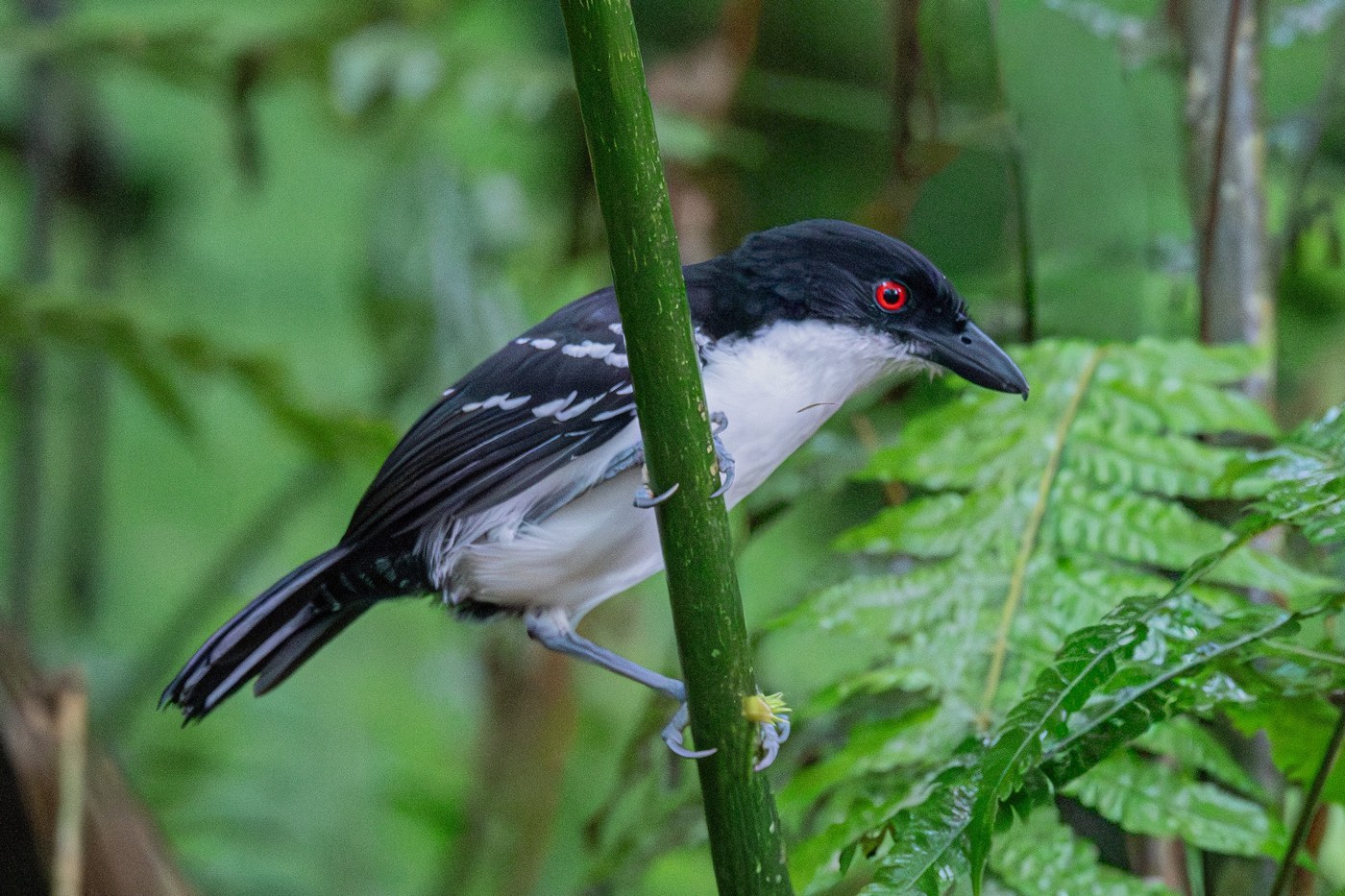
Key Field Marks
- Size & shape: A big, bulky antshrike about 11 inches (28 cm) long, among the largest members of its family, with a heavy hooked bill, a shaggy, often-raised crest, and a long tail.
- Male plumage: Bold black and white — glossy black upperparts finely barred/streaked with white, black crown with a partly concealed white crest patch, and white underparts.
- Female plumage: Entirely different — rich rufous-chestnut above, with a rufous crown and buffy-white to pale rufous underparts; lacks the male's black-and-white pattern entirely.
- Eyes: Bright red to red-orange iris in adults of both sexes — a striking and useful mark at close range.
- Behavior: Skulks low in tangled undergrowth and thickets, usually staying hidden; more often heard than seen. Often cocks and slowly raises its crest.
Similar Species
- Barred Antshrike: Smaller, both sexes barred (male black-and-white barred all over rather than solid black above; female warm buffy-rufous with a rufous cap but streakier), and has a different, faster bouncing-ball song.
- Fasciated Antshrike: Smaller and finely barred in both sexes rather than showing the Great Antshrike's strong male/female plumage contrast.
- Female Great Antshrike can suggest a large woodcreeper or foliage-gleaner at a glance, but its heavy hooked bill, red eye, and antshrike shape are distinctive.
Habitat & Range
Found in dense undergrowth, thickets, tangled second growth, and forest edge from southern Mexico (rarely) and Central America through much of tropical South America east of the Andes, south to northern Argentina. Prefers low, viney tangles rather than the forest interior canopy.
Season
Resident and non-migratory throughout its range; present year-round.
Voice
A distinctive, far-carrying song: a slow series of hollow, resonant bup notes that accelerate and rise in pitch, ending in an emphatic final note — often likened to a ball bouncing to a stop, though slower and more resonant than Barred Antshrike's version. Also gives harsh, nasal scolding calls when agitated.
Frequently asked questions
How different do male and female Great Antshrikes look?
Very different — males are bold black above with fine white barring and white below, while females are entirely rufous-chestnut above with paler underparts, making them look like separate species if seen alone.
What is the easiest way to detect a Great Antshrike in the field?
Listen for its distinctive slow, accelerating series of hollow bup notes rising in pitch and ending with an emphatic note; it is far more often heard calling from dense cover than seen.
How can I distinguish Great Antshrike from Barred Antshrike?
Great Antshrike is larger and shows solid black (not barred) upperparts in the male, a plain rufous (not barred) female, and a red eye, while Barred Antshrike is barred in both sexes and gives a faster, more clipped bouncing-ball song.
What habitat should I search for Great Antshrike?
Look in dense low tangles, vine thickets, and brushy forest edges or second growth rather than open forest interior or canopy.