
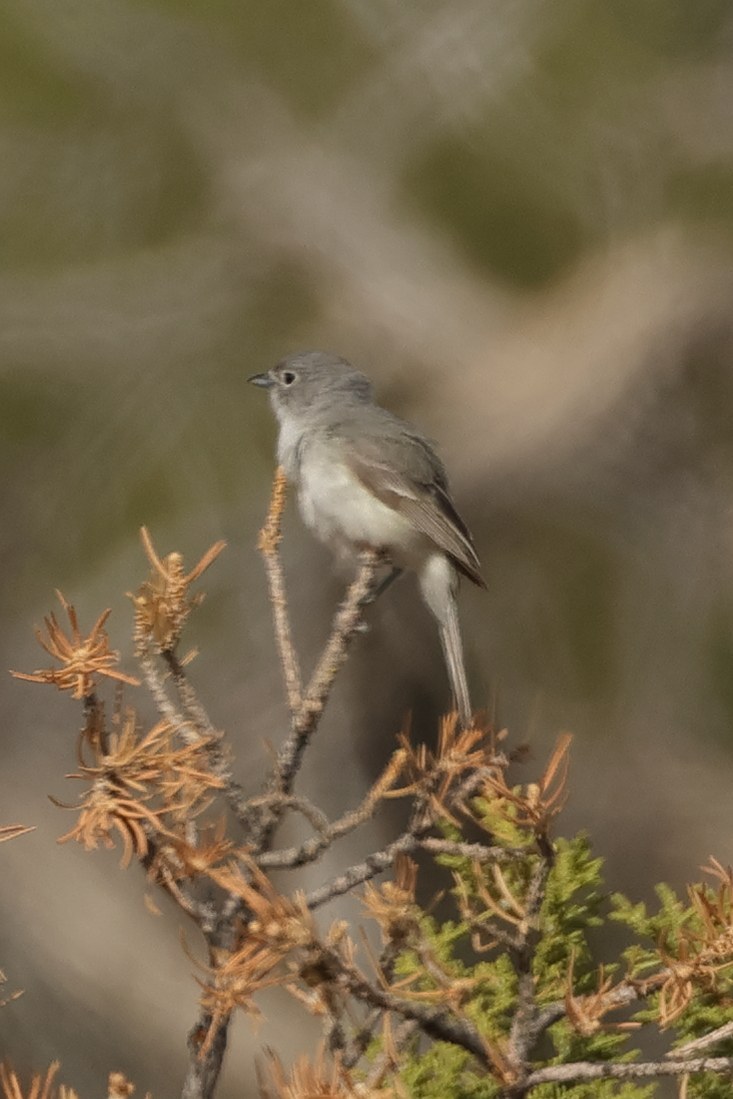
Gray Vireo
Vireo vicinior
A plain, uniformly gray, tail-flicking vireo of arid pinyon-juniper and chaparral country in the desert Southwest.
- Size
- 13-14 cm (5-5.5 in) long, 19-22 cm wingspan
- Habitat
- arid pinyon-juniper woodland, chaparral, and desert scrub of the southwestern US and northern Mexico
- Type
- songbird
Spotted a bird like this?
Identify any bird from a photo, free.
Overview
The Gray Vireo is a subtly marked bird of dry, scrubby habitats, appearing almost entirely plain gray with only a faint white eye-ring and, often, a single indistinct wing bar. Its underparts are whitish. The long tail, which it frequently flicks and cocks, is one of the more distinctive behavioral clues to its identity, recalling a gnatcatcher more than a typical vireo.
It breeds in arid pinyon-juniper woodland, chaparral, and desert scrub across the interior Southwest, often in rocky, hilly terrain with sparse, low vegetation.
How to identify it
Key field marks
- Plain gray overall with whitish underparts
- Faint white eye-ring, no bold spectacles
- One faint wing bar (sometimes absent)
- Long tail, frequently flicked and cocked
Similar species
- Plumbeous Vireo: bolder white spectacles and two clear wing bars, less tail-flicking behavior.
- Bell's Vireo: smaller, more olive-toned, favors dense riparian thickets rather than dry, open scrub.
- Black-tailed Gnatcatcher: much smaller and thinner-billed, with a black tail and constant tail-wagging.
Habitat & range
Range and habitat
Gray Vireo breeds in the interior Southwest—parts of California, Nevada, Utah, Arizona, New Mexico, Colorado, and Texas—and northern Mexico, favoring arid pinyon-juniper woodland, chaparral, and desert scrub, often on rocky slopes.
Migration
Migrates to winter mainly in the deserts of northwestern Mexico.
Behavior & voice
Behavior
Forages actively in low, sparse vegetation, frequently flicking and cocking its long tail in a manner reminiscent of a gnatcatcher.
Voice
A sweet, robin-like song delivered as a series of short, distinct phrases, similar in quality to other vireos but given from sparse desert scrub habitat.
Feeding
Almost entirely insects, gleaned from low shrubs and the ground in arid habitat.
Nesting and breeding
Builds a hanging cup nest low in a shrub or small tree. The female incubates 3-4 eggs for roughly 2 weeks.
Frequently asked questions
What does a Gray Vireo look like?
It is almost entirely plain gray with whitish underparts, a faint eye-ring, and often just one indistinct wing bar.
What behavior helps identify a Gray Vireo?
It frequently flicks and cocks its long tail, a habit that recalls a gnatcatcher more than a typical vireo.
Where does the Gray Vireo live?
In arid pinyon-juniper woodland, chaparral, and desert scrub across the interior southwestern United States and northern Mexico.
What does the Gray Vireo eat?
Almost entirely insects, gleaned from low shrubs and the ground.
Gray Vireo guides
In-depth guides for identifying, finding, and understanding Gray Vireo.
Other birds you may enjoy

Black Redstart
13-14.5 cm (5.1-5.7 in) long, 23-26 cm wingspan

Black-throated Sparrow
12-14 cm (4.7-5.5 in) long, about 19-20 cm (7.5-8 in) wingspan

Greater Bird-of-paradise
Body about 43 cm; males with additional flank plumes up to 50 cm and long tail wires

Blue Tit
11-12 cm (4.3-4.7 in) long, 17-20 cm wingspan

Red-billed Quelea
11.5–13 cm long, wingspan about 20–22 cm
White-plumed Antbird
13-14 cm (5-5.5 in) long

Pyrrhuloxia
19-22 cm (7.5-8.7 in) long, 30 cm wingspan

Blue-gray Tanager
16-18 cm (6-7 in) long

Blackburnian Warbler
11-13 cm (4.3-5.1 in) long, 20-22 cm wingspan

Bluethroat
13-14 cm (5.1-5.5 in) long, 20-22 cm wingspan

Eurasian Nuthatch
12-14.5 cm (4.7-5.7 in) long, 22.5-27 cm wingspan

Wood Thrush
19-21 cm (7.5-8.3 in) long, about 33 cm (13 in) wingspan