
Gray Vireo Identification Guide
A plain, pale gray, arid-country vireo of pinyon-juniper and desert scrub, identified by its uniform gray plumage, faint eye-ring, and habit of tail-flicking like a gnatcatcher.
Read the full Gray Vireo encyclopedia entry →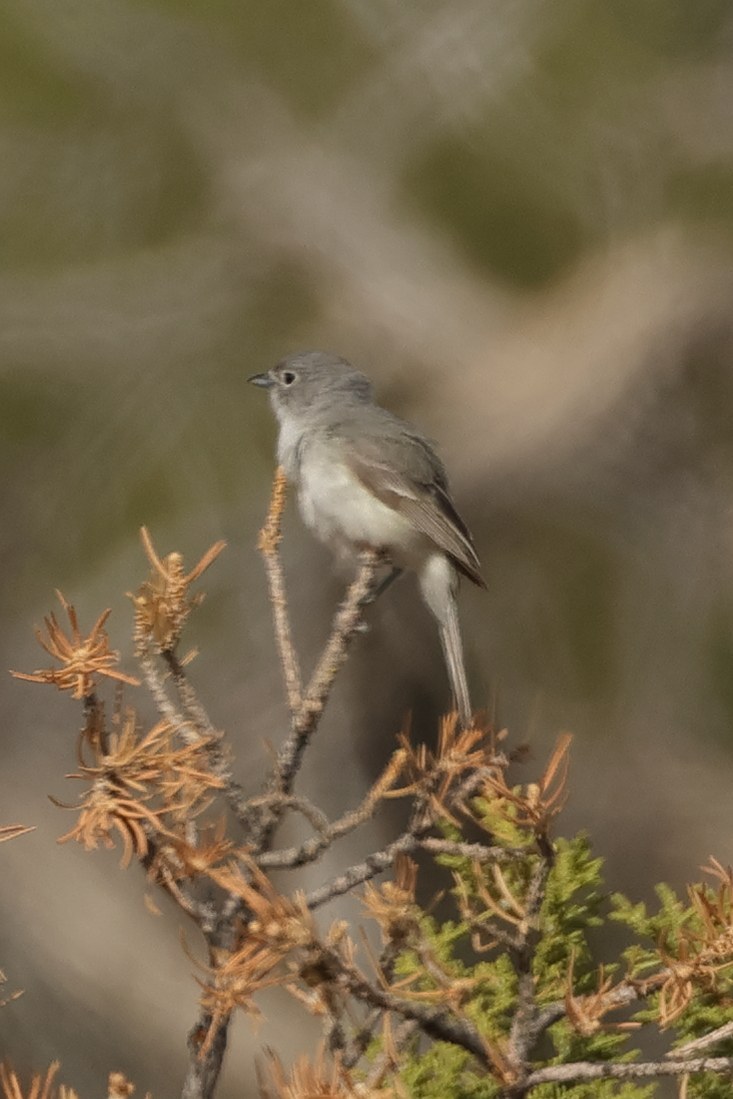
Key Field Marks
- Size & shape: A small, slim vireo about 5-5.5 inches (13-14 cm) long with a fairly long tail for a vireo and a thin, slightly hooked bill.
- Plumage: Very plain overall pale gray above and whitish-gray below, with little to no wingbars (at most one faint, indistinct wingbar) and a thin, incomplete white eye-ring that can look like broken "spectacles." Lacks the bold face pattern of most vireos.
- Behavior: Frequently flicks and cocks its tail up, gnatcatcher- or kinglet-like, a habit unusual among vireos and a useful giveaway. Forages actively and often low in dense, scrubby vegetation, gleaning insects.
- Bill & legs: Thin, pale-based bill with a small hook at the tip; grayish legs.
Similar Species
- Plumbeous Vireo: Bolder white spectacles (complete eye-ring connecting to lores), stronger double wingbars, stockier build, and does not flick its tail.
- Bell's Vireo: Has a more olive-gray tone, faint wingbars, and different habitat (dense riparian thickets); also less prone to tail-flicking.
- Blue-gray Gnatcatcher: Much smaller with a thin black bill, white outer tail feathers, and constant tail-wagging, but lacks the vireo's slightly hooked bill and overall shape.
Habitat & Range
Breeds in arid pinyon-juniper woodland, juniper-oak scrub, and desert chaparral across the interior Southwest — southern California, Nevada, Utah, Arizona, New Mexico, and western Texas — as well as parts of northern Mexico. Prefers steep, rocky slopes with scattered junipers and scrub.
Season
A summer breeding visitor across most of its U.S. range, arriving in April and departing by September/October to winter in Mexico; a small number winter in southernmost Arizona/Sonora desert scrub.
Voice
Song is a series of short, harsh, slightly burry phrases delivered in a deliberate, halting rhythm, similar in cadence to other vireos but rougher and more monotonous — often transcribed as cher-wee, cher-wee-o repeated with pauses.
Frequently asked questions
What is the single best way to identify a Gray Vireo?
Look for an overall plain pale gray bird with almost no wingbars, a faint broken eye-ring, and a habit of flicking its tail upward — a combination unique among vireos.
How is Gray Vireo different from Plumbeous Vireo?
Plumbeous Vireo shows a complete, bold white spectacle pattern and distinct double wingbars and is bulkier, while Gray Vireo is plainer, thinner-billed, nearly wingbarless, and flicks its tail — Plumbeous does not.
Where should I look for Gray Vireo?
Search dry, rocky pinyon-juniper or juniper-scrub hillsides in the interior Southwest during the breeding season (spring through late summer).
Does Gray Vireo migrate?
Yes, most of the population is migratory, breeding in the southwestern U.S. and wintering mainly in Mexico, with only a few birds lingering in the mildest desert areas near the border in winter.