
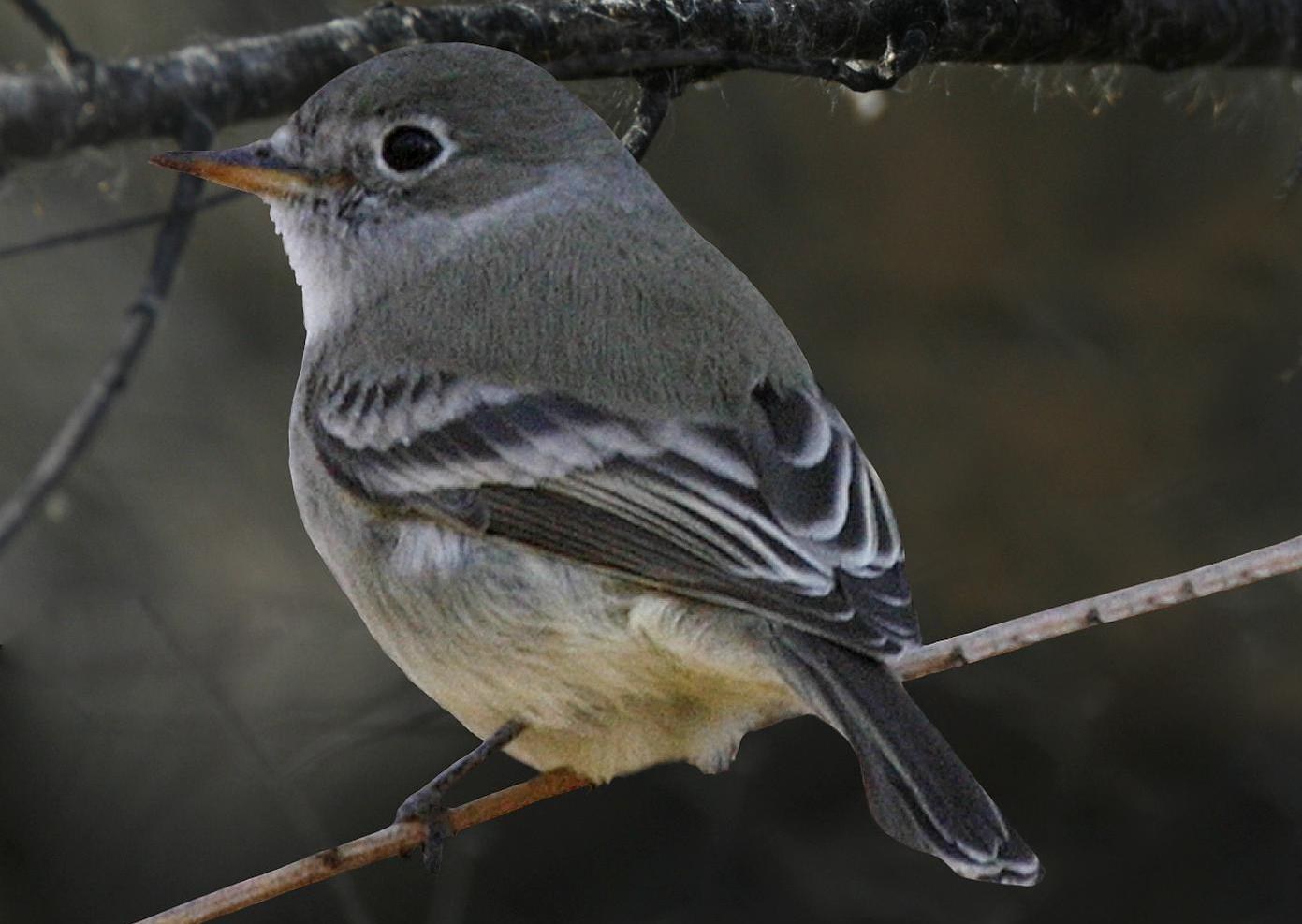
Gray Flycatcher
Empidonax wrightii
A pale, long-tailed Empidonax flycatcher of sagebrush and pinyon-juniper country, distinguished by its habit of slowly dipping its tail downward.
- Size
- 14-16 cm (5.5-6.3 in) long, 22-23 cm wingspan
- Habitat
- sagebrush flats, pinyon-juniper woodland, and dry open shrubland of the interior western United States
- Type
- songbird
Spotted a bird like this?
Identify any bird from a photo, free.
Overview
The Gray Flycatcher is a pale, understated member of the Empidonax genus adapted to dry, open shrubland habitats of the interior western United States, particularly sagebrush flats and pinyon-juniper woodland. It shows pale gray upperparts with little olive tone, a thin whitish eye-ring, faint wing bars, and a relatively long, dark-tipped bill with a mostly pale lower mandible.
One of its most useful identification traits is behavioral rather than visual: unlike most other flycatchers, which flick their tails upward, the Gray Flycatcher characteristically dips its tail slowly downward, a habit that helps separate it from very similar relatives.
How to identify it
Key Field Marks
- Pale gray upperparts with minimal olive or yellow tone, appearing washed-out compared to other Empidonax
- Thin, faint whitish eye-ring
- Relatively long tail and long bill with a pale lower mandible
- Distinctive habit of slowly dipping the tail downward, unlike the upward tail-flick of most relatives
Similar Species
- Dusky Flycatcher is similar but shows more olive tone, a shorter bill, and flicks its tail upward rather than dipping it down.
- Willow Flycatcher and Hammond's Flycatcher are both more olive-toned and lack the pale, gray-washed appearance.
- The downward tail-dip is the single most useful behavioral field mark for this species.
Habitat & range
Gray Flycatchers breed in dry, open shrub-steppe habitats of the interior western United States, particularly sagebrush flats, pinyon-juniper woodland, and open areas with scattered junipers, from the Great Basin and southern Rockies south into parts of the Southwest.
The species winters primarily in Mexico, in similarly arid scrub and woodland habitats.
Behavior & voice
Voice
Sings a series of low, husky notes often rendered as chuwip and sillip, delivered in a simple pattern; gives a sharp wit call.
Feeding
Sallies from a low perch in open shrubland to catch flying insects, and also drops to the ground to capture prey, a foraging style suited to its sparse, arid habitat.
Nesting
Builds a cup nest of plant fibers, bark strips, and grass, typically placed in a low sagebrush, juniper, or other shrub in open country.
Frequently asked questions
How do I identify a Gray Flycatcher?
Look for a pale, grayish Empidonax flycatcher with minimal olive tone in dry sagebrush or pinyon-juniper habitat, and watch for its distinctive habit of slowly dipping its tail downward.
What makes the Gray Flycatcher's tail behavior unique?
Unlike most flycatchers, which flick their tails upward, the Gray Flycatcher characteristically dips its tail slowly downward, a useful behavioral clue for identification.
Where does the Gray Flycatcher breed?
It breeds in dry, open shrub-steppe habitats such as sagebrush flats and pinyon-juniper woodland across the interior western United States.
Where do Gray Flycatchers spend the winter?
They migrate to winter primarily in Mexico in similarly arid scrub and woodland habitats.
Gray Flycatcher guides
In-depth guides for identifying, finding, and understanding Gray Flycatcher.
Other birds you may enjoy

Black Redstart
13-14.5 cm (5.1-5.7 in) long, 23-26 cm wingspan

Black-throated Sparrow
12-14 cm (4.7-5.5 in) long, about 19-20 cm (7.5-8 in) wingspan

Greater Bird-of-paradise
Body about 43 cm; males with additional flank plumes up to 50 cm and long tail wires

Blue Tit
11-12 cm (4.3-4.7 in) long, 17-20 cm wingspan

Red-billed Quelea
11.5–13 cm long, wingspan about 20–22 cm
White-plumed Antbird
13-14 cm (5-5.5 in) long

Pyrrhuloxia
19-22 cm (7.5-8.7 in) long, 30 cm wingspan

Blue-gray Tanager
16-18 cm (6-7 in) long

Blackburnian Warbler
11-13 cm (4.3-5.1 in) long, 20-22 cm wingspan

Bluethroat
13-14 cm (5.1-5.5 in) long, 20-22 cm wingspan

Eurasian Nuthatch
12-14.5 cm (4.7-5.7 in) long, 22.5-27 cm wingspan

Wood Thrush
19-21 cm (7.5-8.3 in) long, about 33 cm (13 in) wingspan