
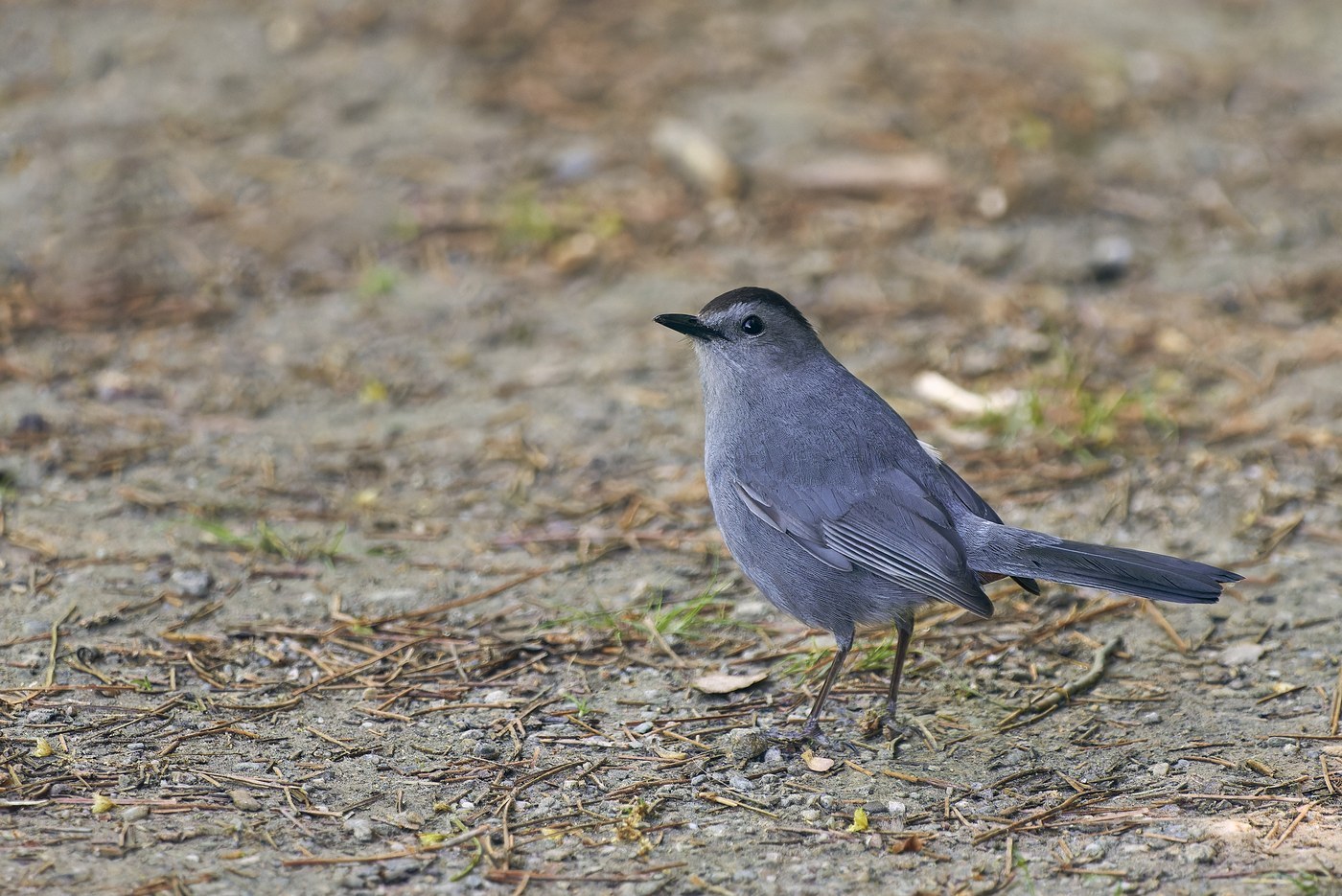
Gray Catbird
Dumetella carolinensis
A slate-gray songbird with a neat black cap and a rusty patch under the tail, named for its distinctive cat-like mewing call.
- Size
- 21-24 cm (8.3-9.4 in) long, 22-30 cm (8.7-11.8 in) wingspan
- Habitat
- dense shrubby thickets, woodland edges, and overgrown gardens
- Type
- songbird
Spotted a bird like this?
Identify any bird from a photo, free.
Overview
The Gray Catbird is a slender, medium-sized songbird, uniformly dark slate-gray over most of its body, with a contrasting black cap on the crown and a rich rusty-chestnut patch of feathers under the tail (undertail coverts), a detail that is often hidden but visible when the tail is raised. It has a long tail, frequently held cocked or flicked, and a straight, thin, dark bill.
Related to mockingbirds and thrashers, the Gray Catbird shares their skilled mimicry and improvisational singing style, but is most famous for its distinctive raspy, cat-like "mew" call, which gives the species its common name.
How to identify it
Key Field Marks
- Uniform slate-gray body plumage
- Black cap on the crown
- Rusty-chestnut undertail coverts, visible when the tail is raised or from below
- Long tail often held cocked, thin dark bill
Similar Species
- Northern Mockingbird: paler gray overall, with bold white wing patches and white outer tail feathers, lacking the catbird's black cap and rusty undertail patch.
- Loggerhead Shrike: has a black mask (not cap) and a stouter hooked bill, with white wing patches absent in the catbird.
- No other common North American songbird shares the combination of overall slate-gray body, black cap, and rusty undertail patch.
Habitat & range
Habitat
Gray Catbirds favor dense, shrubby thickets, tangled vegetation, woodland edges, hedgerows, and overgrown or brushy gardens, staying close to cover.
Range
They breed across most of the eastern and central United States and southern Canada, and winter in the southeastern United States, Mexico, Central America, and the Caribbean.
Migration
Gray Catbirds are medium- to long-distance migrants, typically migrating at night, moving between northern and central breeding grounds and more southerly wintering areas.
Behavior & voice
Behavior
Catbirds are often secretive, staying low in dense cover, but they can also be curious and will approach observers who make squeaking noises ("pishing"), often responding with their own scolding calls.
Voice
The song is a long, varied series of musical and harsh notes and phrases, often including mimicked sounds, generally not repeated in the structured pattern typical of a mockingbird; the namesake call is a nasal, cat-like "mew."
Feeding
They eat a mix of insects and fruit, with insects more prominent during the breeding season and fruit becoming increasingly important later in summer and during migration.
Nesting & Breeding
Females build a bulky cup nest low in dense shrubs or vine tangles, typically laying 1-5 deep blue-green eggs. Catbirds are known to sometimes recognize and eject the eggs of brood-parasitic Brown-headed Cowbirds from their nests, a relatively rare defense among host species.
Frequently asked questions
Why is the Gray Catbird named after a cat?
Its distinctive call is a nasal, raspy "mew" that closely resembles a cat's meow, giving the species its common name.
How can I tell a Gray Catbird from a Northern Mockingbird?
Catbirds are uniformly darker slate-gray with a black cap and a rusty patch under the tail and lack white wing patches, while mockingbirds are paler gray with bold white patches on the wings and tail.
Do Gray Catbirds mimic other birds?
Yes, as relatives of mockingbirds and thrashers, catbirds incorporate mimicked sounds into their long, rambling songs, though usually less methodically repeated than a mockingbird's mimicry.
Do Gray Catbirds migrate?
Yes, most populations are medium- to long-distance nocturnal migrants, wintering in the southeastern U.S., Mexico, Central America, and the Caribbean.
Can Gray Catbirds recognize cowbird eggs in their nest?
Yes, catbirds are one of the relatively few host species known to often recognize and eject the eggs of parasitic Brown-headed Cowbirds from their nest.
Gray Catbird guides
In-depth guides for identifying, finding, and understanding Gray Catbird.
Other birds you may enjoy

Black Redstart
13-14.5 cm (5.1-5.7 in) long, 23-26 cm wingspan

Black-throated Sparrow
12-14 cm (4.7-5.5 in) long, about 19-20 cm (7.5-8 in) wingspan

Greater Bird-of-paradise
Body about 43 cm; males with additional flank plumes up to 50 cm and long tail wires

Blue Tit
11-12 cm (4.3-4.7 in) long, 17-20 cm wingspan

Red-billed Quelea
11.5–13 cm long, wingspan about 20–22 cm
White-plumed Antbird
13-14 cm (5-5.5 in) long

Pyrrhuloxia
19-22 cm (7.5-8.7 in) long, 30 cm wingspan

Blue-gray Tanager
16-18 cm (6-7 in) long

Blackburnian Warbler
11-13 cm (4.3-5.1 in) long, 20-22 cm wingspan

Bluethroat
13-14 cm (5.1-5.5 in) long, 20-22 cm wingspan

Eurasian Nuthatch
12-14.5 cm (4.7-5.7 in) long, 22.5-27 cm wingspan

Wood Thrush
19-21 cm (7.5-8.3 in) long, about 33 cm (13 in) wingspan