
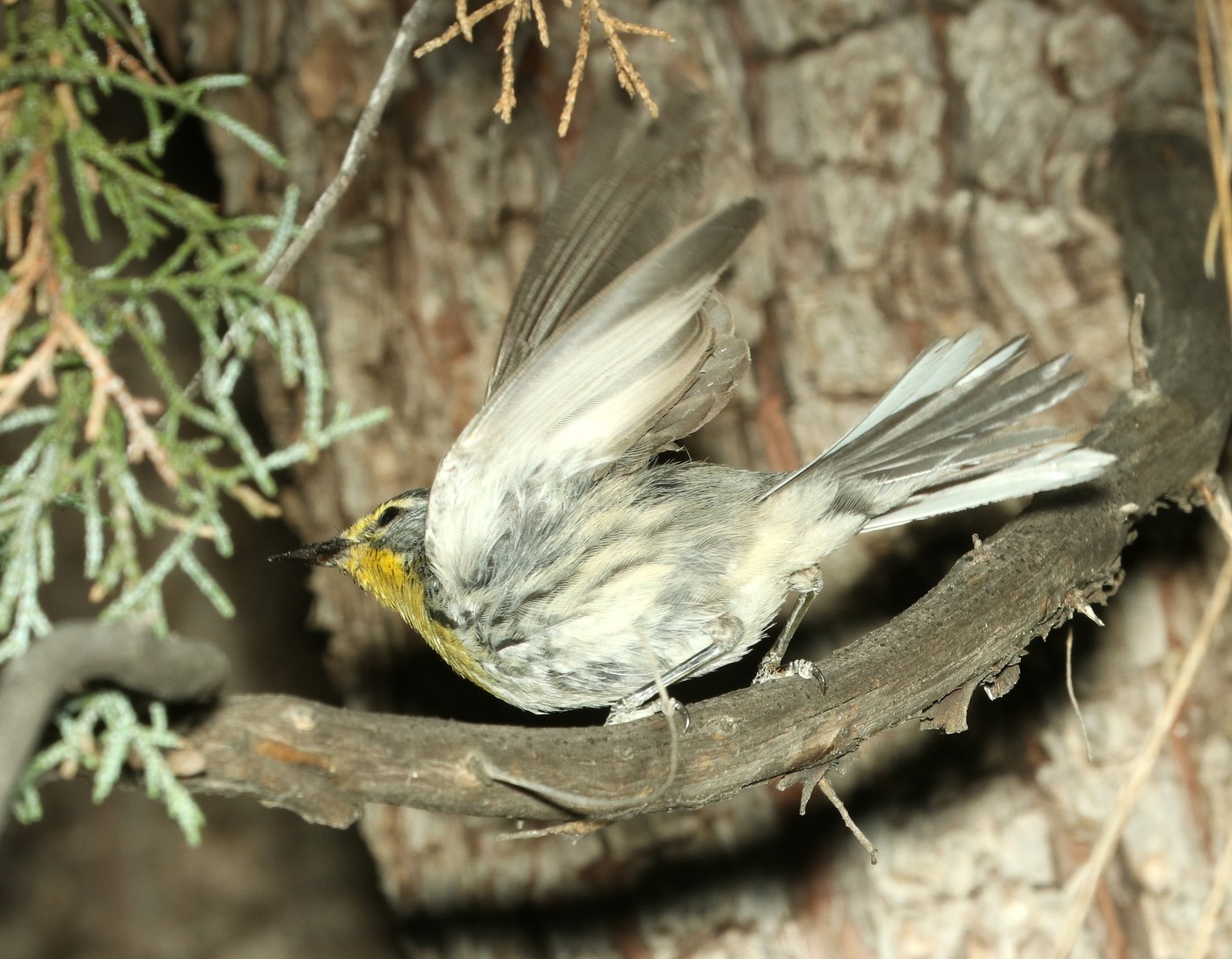
Grace's Warbler
Setophaga graciae
A gray-backed warbler of southwestern pine forests with a yellow throat and supercilium, resembling a smaller-scale Yellow-throated Warbler adapted to high pine canopy.
- Size
- 11-12 cm (4.3-4.7 in) long, 18-19 cm wingspan
- Habitat
- open pine forest, especially ponderosa pine, in mountainous terrain
- Type
- songbird
Spotted a bird like this?
Identify any bird from a photo, free.
Overview
Grace's Warbler is a compact warbler of montane pine forest, sharing a similar overall pattern with the more widespread Yellow-throated Warbler but on a smaller, more understated scale. It has gray upperparts, a bright yellow throat and upper breast, and a yellow supercilium that does not extend far behind the eye, along with black streaking on the flanks and back.
It spends much of its time high in the canopy of pine trees, where its plumage and habits closely mirror its relative, making patient observation and careful attention to its shorter supercilium and less extensive yellow underparts important for a confident identification.
How to identify it
Key field marks
- Gray upperparts with black streaking on the back and flanks
- Yellow throat and upper breast, with white on the lower belly
- Short yellow supercilium that does not extend well past the eye
- Two white wingbars
Similar species
Yellow-throated Warbler is very similar but has a longer white supercilium extending past the eye, a white (not yellow) patch on the neck side, and more extensive yellow on the underparts; it also occurs mainly in the East rather than the southwestern mountains favored by Grace's Warbler.
Habitat & range
Grace's Warblers breed in open, mature pine forest, especially ponderosa pine, in mountain ranges of the southwestern United States and Mexico, typically foraging and nesting high in the pine canopy.
They winter in pine and pine-oak forest from Mexico south through Central America, generally in habitat similar to their breeding range.
Behavior & voice
Behavior and voice
Grace's Warblers forage high in pine canopy, gleaning insects from needle clusters much like Yellow-throated Warbler, and can be difficult to see well given their preference for the treetops.
The song is a rapid, trilled series of chip notes, similar in structure to Yellow-throated Warbler's song but generally faster and simpler.
Nesting
The nest is built high in a pine tree, often well out on a horizontal branch, made of pine needles, bark strips, and plant down. Clutches typically contain 3-4 eggs.
Frequently asked questions
How do you tell Grace's Warbler from Yellow-throated Warbler?
Grace's Warbler has a shorter yellow supercilium that doesn't extend far past the eye, a yellow (not white) neck patch, and less extensive yellow on the underparts, and it occurs in southwestern pine forest rather than the East.
What habitat does Grace's Warbler prefer?
Open, mature pine forest, especially ponderosa pine, in mountainous terrain of the southwestern United States and Mexico.
Why is Grace's Warbler hard to observe?
It forages primarily high in pine canopy, similar to Yellow-throated Warbler, making it more often heard than clearly seen.
Who was Grace's Warbler named after?
It was named by ornithologist Spencer Baird in honor of Grace Darling Coues, sister of naturalist Elliott Coues, who first collected the species.
What does a Grace's Warbler eat?
Insects, foraged mostly by gleaning from pine needle clusters high in the canopy.
Grace's Warbler guides
In-depth guides for identifying, finding, and understanding Grace's Warbler.
Other birds you may enjoy

Black Redstart
13-14.5 cm (5.1-5.7 in) long, 23-26 cm wingspan

Black-throated Sparrow
12-14 cm (4.7-5.5 in) long, about 19-20 cm (7.5-8 in) wingspan

Greater Bird-of-paradise
Body about 43 cm; males with additional flank plumes up to 50 cm and long tail wires

Blue Tit
11-12 cm (4.3-4.7 in) long, 17-20 cm wingspan

Red-billed Quelea
11.5–13 cm long, wingspan about 20–22 cm
White-plumed Antbird
13-14 cm (5-5.5 in) long

Pyrrhuloxia
19-22 cm (7.5-8.7 in) long, 30 cm wingspan

Blue-gray Tanager
16-18 cm (6-7 in) long

Blackburnian Warbler
11-13 cm (4.3-5.1 in) long, 20-22 cm wingspan

Bluethroat
13-14 cm (5.1-5.5 in) long, 20-22 cm wingspan

Eurasian Nuthatch
12-14.5 cm (4.7-5.7 in) long, 22.5-27 cm wingspan

Wood Thrush
19-21 cm (7.5-8.3 in) long, about 33 cm (13 in) wingspan