
Grace's Warbler Identification Guide
A small gray-backed, yellow-throated warbler tied closely to tall pine forests of the southwestern United States and Mexico.
Read the full Grace's Warbler encyclopedia entry →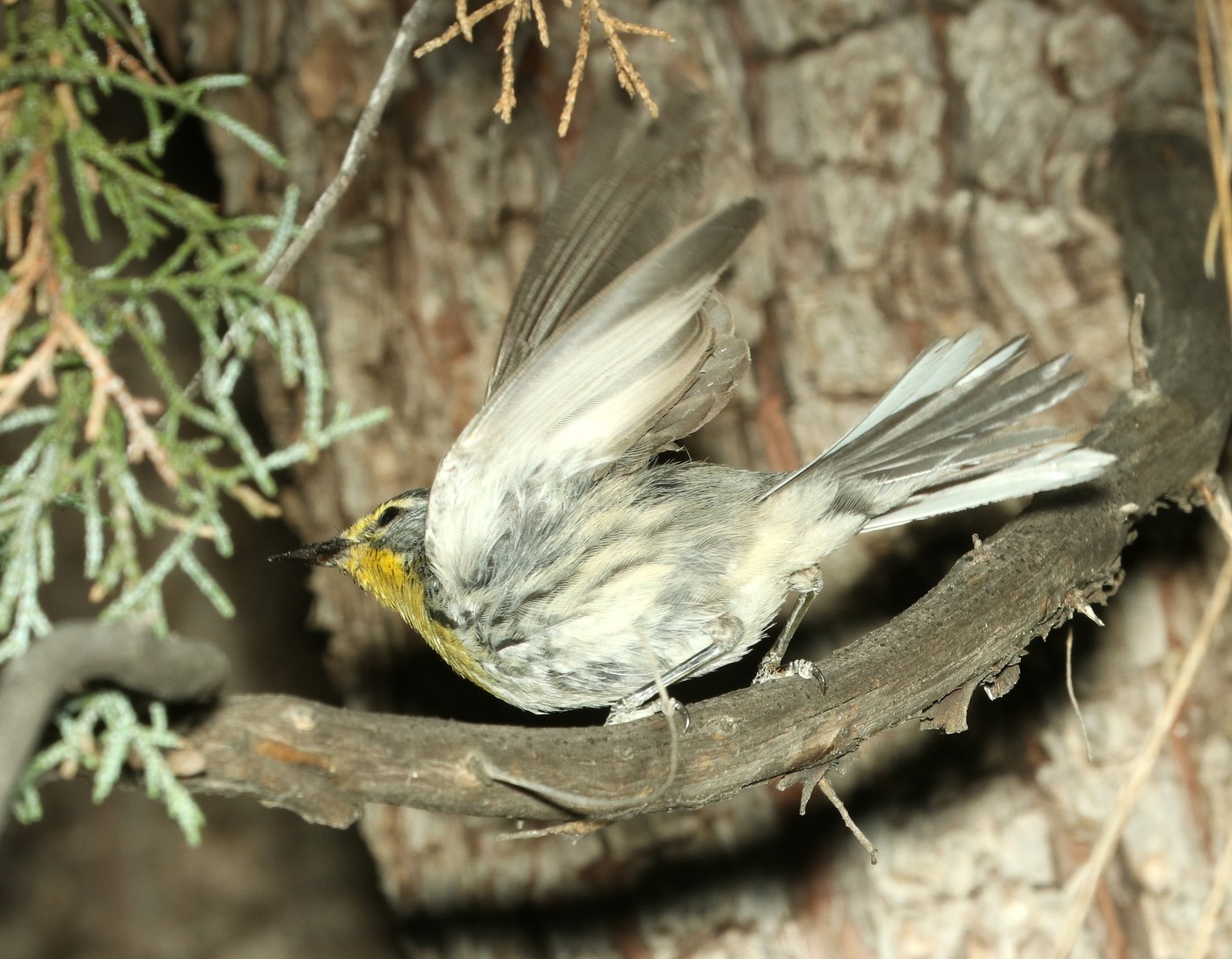
Key Field Marks
- Small warbler with gray upperparts, two white wingbars, and a yellow throat and breast that fades to a white belly.
- Short yellow supercilium (eyebrow) in front of the eye, often not extending fully behind it, plus a thin yellow crescent below the eye.
- Fine black streaking along the flanks and sides of the breast.
- Gray cheek and a subtle whitish eye-arc; overall a crisp, clean-looking warbler without bold facial contrast.
- Thin, sharply pointed bill typical of canopy-foraging Setophaga warblers.
Separating It From Similar Species
- Yellow-throated Warbler: larger, with much more extensive yellow reaching further onto the breast, a bold black patch on the side of the neck, and a striking white-and-black face pattern with a full white supercilium — Grace's is smaller and plainer-faced.
- Yellow-rumped Warbler (Audubon's): shows a yellow rump patch and yellow shoulder patches that Grace's Warbler lacks entirely.
- Habitat is a strong clue: Grace's Warbler is essentially confined to pine and pine-oak forest, unlike the broader habitat tolerance of Yellow-throated Warbler.
Habitat, Range & Season
- Breeds in high-elevation ponderosa and other yellow pine forests, and pine-oak woodland, from the mountains of the southwestern U.S. (Arizona, New Mexico) south through Mexico to Nicaragua.
- Forages mostly high in the pine canopy, making it easy to hear but hard to spot.
- A short- to medium-distance migrant; most U.S. breeders winter in Mexico and northern Central America, with birds present on breeding grounds roughly April through September.
Behavior & Voice
- Gleans insects and spiders from pine needle clusters and outer branches high in the canopy, moving actively but often staying out of easy view.
- Song is a musical, accelerating trill on one pitch, reminiscent of a Yellow-rumped Warbler's song but typically faster, sharper, and more insistent.
- Often located first by voice from deep within tall pines before being seen.
Frequently asked questions
How do I tell Grace's Warbler from Yellow-throated Warbler?
Grace's Warbler is smaller with limited yellow confined mostly to the throat and upper breast and a plainer face, while Yellow-throated Warbler is larger with yellow extending further down, a bold black neck patch, and a striking black-and-white face.
What habitat should I search for Grace's Warbler?
Look high in the canopy of tall pine or pine-oak forest, especially ponderosa pine stands in mountain ranges of the southwestern U.S. and Mexico.
What does Grace's Warbler sound like?
A musical, accelerating trill on a single pitch, similar to but faster and sharper than a Yellow-rumped Warbler's song.
When is Grace's Warbler present in the U.S.?
Roughly April through September on its breeding grounds, after which most birds migrate to Mexico and northern Central America for winter.
Why is Grace's Warbler hard to see even when singing nearby?
It forages high in pine canopies and tends to stay among needle clusters, so it is often heard well before it comes into clear view.