
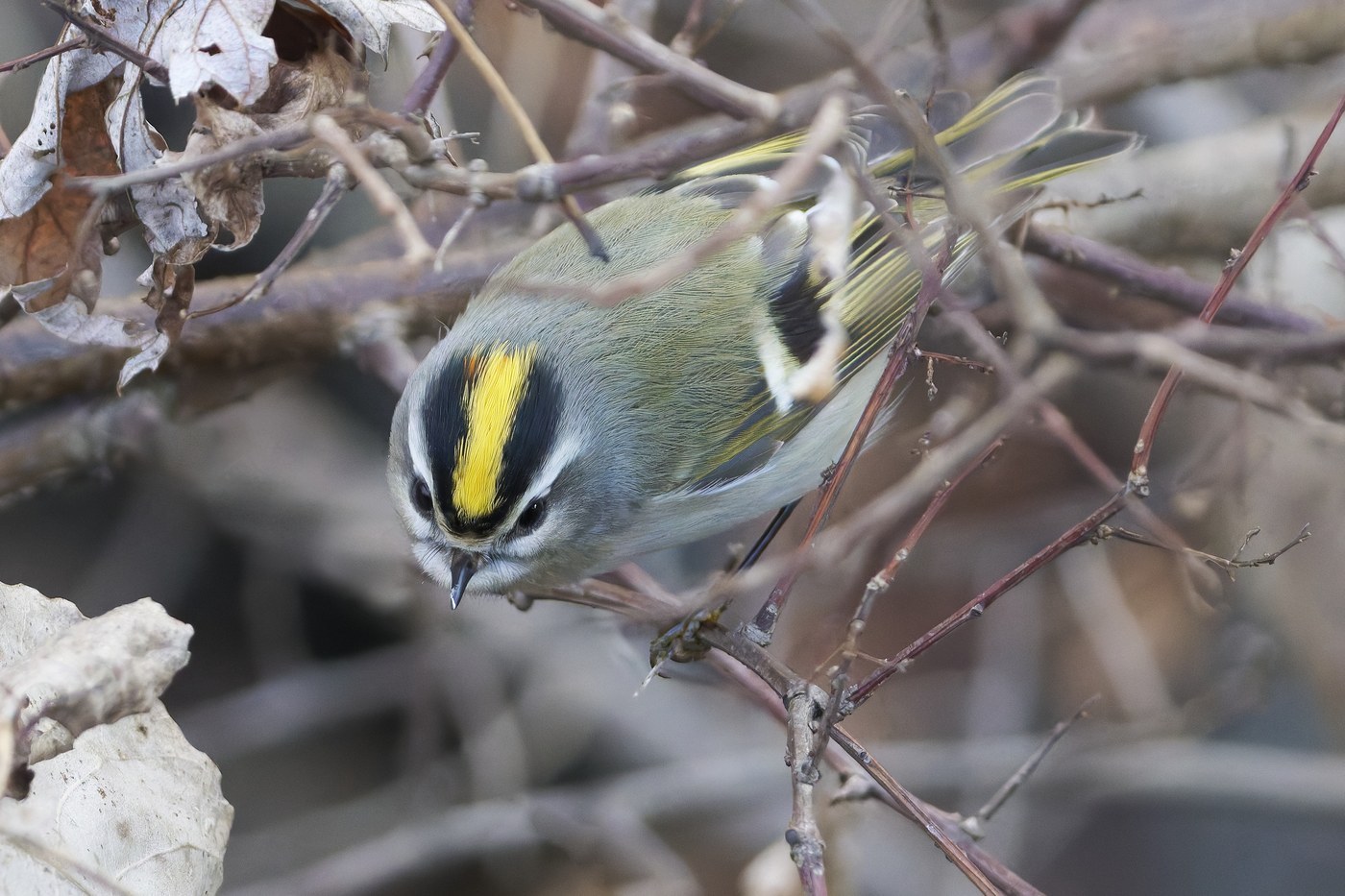
Golden-crowned Kinglet
Regulus satrapa
A tiny, hyperactive conifer-dwelling songbird with a bright orange or yellow crown patch bordered in black.
- Size
- 9-11 cm (3.5-4.3 in) long, 14-18 cm wingspan
- Habitat
- dense coniferous and mixed forests, including spruce, fir, and pine stands
- Type
- songbird
Spotted a bird like this?
Identify any bird from a photo, free.
Overview
The Golden-crowned Kinglet is one of North America's smallest songbirds, weighing barely more than a coin, yet it survives even the coldest winter nights in northern conifer forests. Its plumage is olive-gray above and pale gray-white below, with two white wingbars and a bold black-and-white striped face pattern.
Its namesake feature is the vivid crown patch: males show a flame-orange center bordered by yellow and black, while females have a yellow crown bordered in black, both of which can be raised into a small crest during excitement or display. These tiny birds are constantly in motion, flicking their wings as they forage high in conifer canopies.
How to identify it
Key Field Marks
- Bold black-and-white striped face with a black eyeline but no obvious eye-ring
- Bright yellow-orange crown patch bordered in black (orange center visible mainly in males)
- Olive-gray upperparts with two white wingbars
- Very small size and constant wing-flicking behavior
- Thin, needle-like black bill
Similar Species
Ruby-crowned Kinglet lacks the bold black-and-white face stripes, has a plain face with a bold white eye-ring, and shows a red crown patch (in males) that is usually concealed and only flashed during excitement. Golden-crowned Kinglet's crown patch is visible much more often and its face pattern is far more strongly marked.
Habitat & range
Habitat
This species favors dense coniferous forest, especially spruce, fir, and pine, but also uses mixed woodlands, particularly during migration and winter when it may join mixed-species foraging flocks in deciduous or mixed stands.
Range
Golden-crowned Kinglets breed across the boreal forest of Canada and Alaska, south through the Appalachians and mountainous conifer forests of the western United States. In winter, the range expands across most of the continental United States wherever conifers or mixed woods occur.
Migration
Northern populations migrate south for winter, though many birds in milder or higher-elevation forested regions remain resident; remarkably, this tiny bird can survive temperatures well below freezing on northern winter nights.
Behavior & voice
Behavior
Golden-crowned Kinglets are almost constantly active, hovering and flitting among conifer needles while flicking their wings rapidly, rarely pausing for more than a second or two.
Voice
The song is a thin, rising series of very high-pitched 'see' notes ending in a chattered jumble. The call is a very high, thin 'see-see-see,' often the first clue to the bird's presence in a conifer canopy.
Feeding
It gleans tiny insects, spiders, and insect eggs from needles and twigs, frequently hovering briefly to pick prey from the tips of branches, and will also take some tree sap.
Nesting & Breeding
The pair builds a deep, well-insulated hanging cup nest of moss, lichen, and spider silk suspended high in dense conifer foliage, well hidden from view. The female lays a large clutch of 8-9 tiny eggs, an impressive number relative to her small body size.
Frequently asked questions
How do you tell a Golden-crowned Kinglet from a Ruby-crowned Kinglet?
Golden-crowned Kinglet has a bold black-and-white striped face and a crown patch that is usually visible, while Ruby-crowned Kinglet has a plain face with a white eye-ring and a red crown patch that is normally hidden.
How does such a tiny bird survive freezing winter nights?
Golden-crowned Kinglets huddle together, fluff their dense plumage for insulation, and enter a state of controlled hypothermia overnight to conserve energy in extreme cold.
What does a Golden-crowned Kinglet eat?
It eats tiny insects, spiders, and insect eggs gleaned from conifer needles, occasionally supplemented with tree sap.
Where do Golden-crowned Kinglets nest?
They build a deep, insulated hanging cup nest high in dense conifer foliage, well concealed from predators.
What does a Golden-crowned Kinglet sound like?
Its call is an extremely high, thin 'see-see-see,' and its song rises in pitch before ending in a chattered jumble.
Golden-crowned Kinglet guides
In-depth guides for identifying, finding, and understanding Golden-crowned Kinglet.
Other birds you may enjoy

Black Redstart
13-14.5 cm (5.1-5.7 in) long, 23-26 cm wingspan

Black-throated Sparrow
12-14 cm (4.7-5.5 in) long, about 19-20 cm (7.5-8 in) wingspan

Greater Bird-of-paradise
Body about 43 cm; males with additional flank plumes up to 50 cm and long tail wires

Blue Tit
11-12 cm (4.3-4.7 in) long, 17-20 cm wingspan

Red-billed Quelea
11.5–13 cm long, wingspan about 20–22 cm
White-plumed Antbird
13-14 cm (5-5.5 in) long

Pyrrhuloxia
19-22 cm (7.5-8.7 in) long, 30 cm wingspan

Blue-gray Tanager
16-18 cm (6-7 in) long

Blackburnian Warbler
11-13 cm (4.3-5.1 in) long, 20-22 cm wingspan

Bluethroat
13-14 cm (5.1-5.5 in) long, 20-22 cm wingspan

Eurasian Nuthatch
12-14.5 cm (4.7-5.7 in) long, 22.5-27 cm wingspan

Wood Thrush
19-21 cm (7.5-8.3 in) long, about 33 cm (13 in) wingspan