
Golden-crowned Kinglet Identification Guide
A tiny, hyperactive North American songbird with a bold black-and-white striped face and a bright orange-and-yellow crown patch bordered in black.
Read the full Golden-crowned Kinglet encyclopedia entry →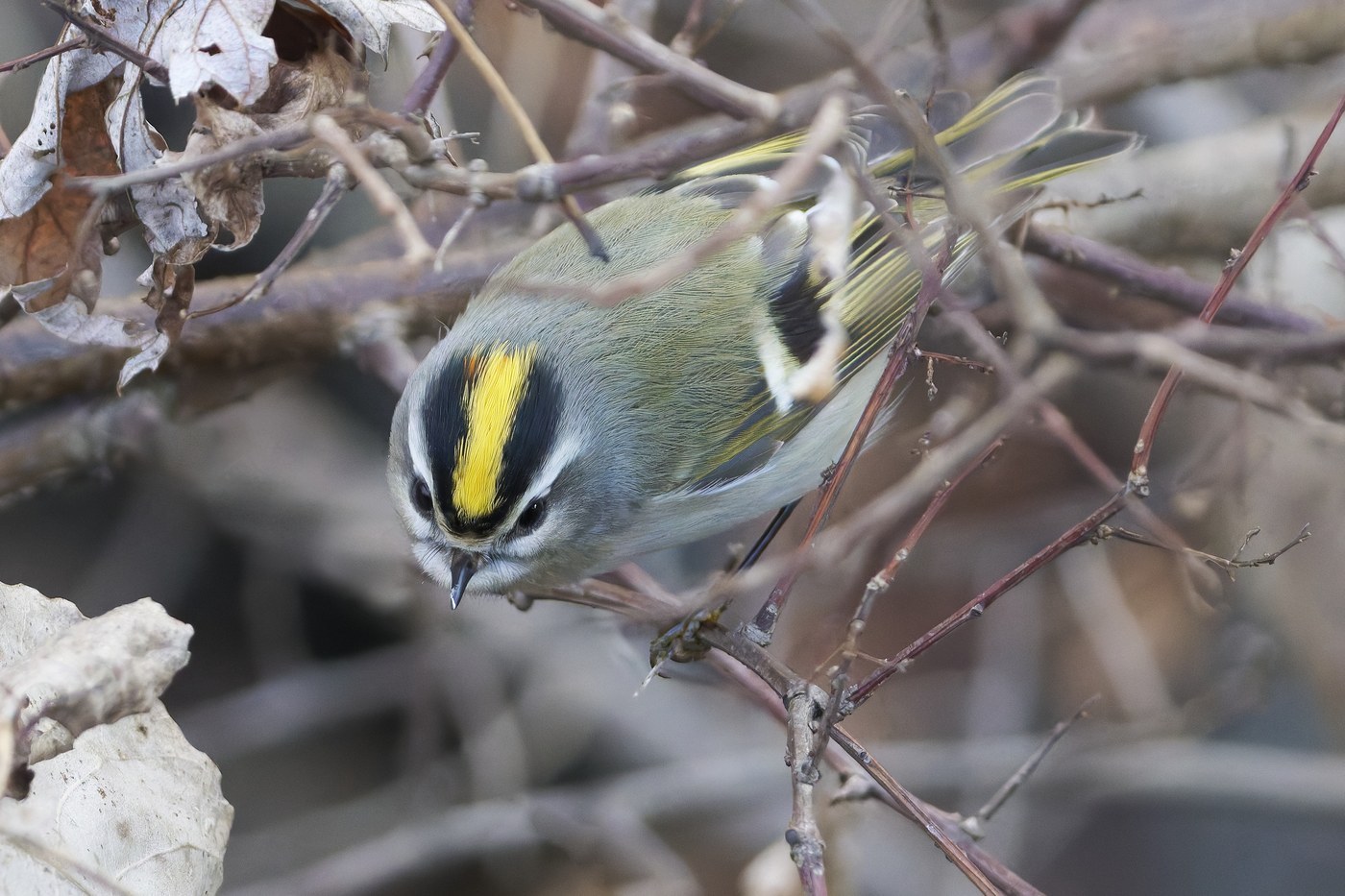
Key Field Marks
- Size & shape: Very small, around 9-10 cm and 5-6 g, among the smallest songbirds in North America; compact, round-bodied, short-tailed, with a short, thin, needle-like black bill.
- Plumage: Olive-gray above, dull whitish-gray below, with two white wingbars, the lower one bordered by a black bar across the folded wing.
- Face pattern: Bold black eyebrow stripe over a white supercilium and black eye-line give a distinctly striped, "masked" face — more strongly patterned than most other small songbirds.
- Crown patch: Bright crown stripe bordered in black — orange-and-yellow in males (orange center often hidden unless the crest is raised), plain yellow in females; both sexes can raise this patch into a small crest when excited.
- Behavior: Constantly flicks its wings while foraging, hovers briefly at branch tips and needle clusters to glean tiny insects and eggs, and often joins mixed foraging flocks with chickadees, nuthatches, and kinglets in winter.
Similar Species
- Ruby-crowned Kinglet: Lacks the bold black-and-white striped face and has a plain gray-green face with a bold white eye-ring instead; the male's red crown patch is usually concealed and only flashed briefly, unlike the more visible golden crown of this species.
- Warblers (e.g., Orange-crowned Warbler): Larger-bodied and lack the double wingbar plus striped face combination.
- Old World Goldcrest: Very similar in plumage and habits but restricted to Eurasia; ranges do not overlap with Golden-crowned Kinglet in North America.
Where & When to See It
Breeds across the boreal forest of Canada and Alaska, the Pacific Northwest, and high-elevation conifer forests south through the Appalachians and western mountains, favoring dense spruce, fir, and hemlock stands. Northern and high-elevation breeders move to lower elevations and further south for winter, when the species becomes widespread across much of the U.S. in mixed and coniferous woodland, often in loose flocks with chickadees and other kinglets. It is present somewhere in its range year-round, with peak visibility in winter across much of the lower 48 states.
Voice & Song Cues
Call is a very high, thin, repeated "see-see-see," similar in pitch to the Brown Creeper's call and easy to miss; the song is a rising series of thin "see" notes that accelerates into a brief chatter at the end. Both calls and song are pitched high enough that they can be difficult for some observers to hear.
Frequently asked questions
How do you tell a Golden-crowned Kinglet from a Ruby-crowned Kinglet?
Golden-crowned Kinglet has a bold black-and-white striped face with a visible orange-yellow crown patch, while Ruby-crowned Kinglet has a plain face with a bold white eye-ring and a red crown patch that is usually hidden.
Why is the male's orange crown patch sometimes hard to see?
The orange center of the crown is often covered by the surrounding yellow feathers and is only revealed when the bird raises its crest during excitement or display, so at rest the crown can look mostly yellow.
Where do Golden-crowned Kinglets live in winter?
They winter widely across most of the contiguous United States in coniferous and mixed woodlands, often traveling in mixed flocks with chickadees, nuthatches, and other small songbirds.
What kind of trees do Golden-crowned Kinglets prefer for breeding?
They favor dense conifer stands — spruce, fir, and hemlock — in boreal forest, the Pacific Northwest, and high-elevation forests further south.