
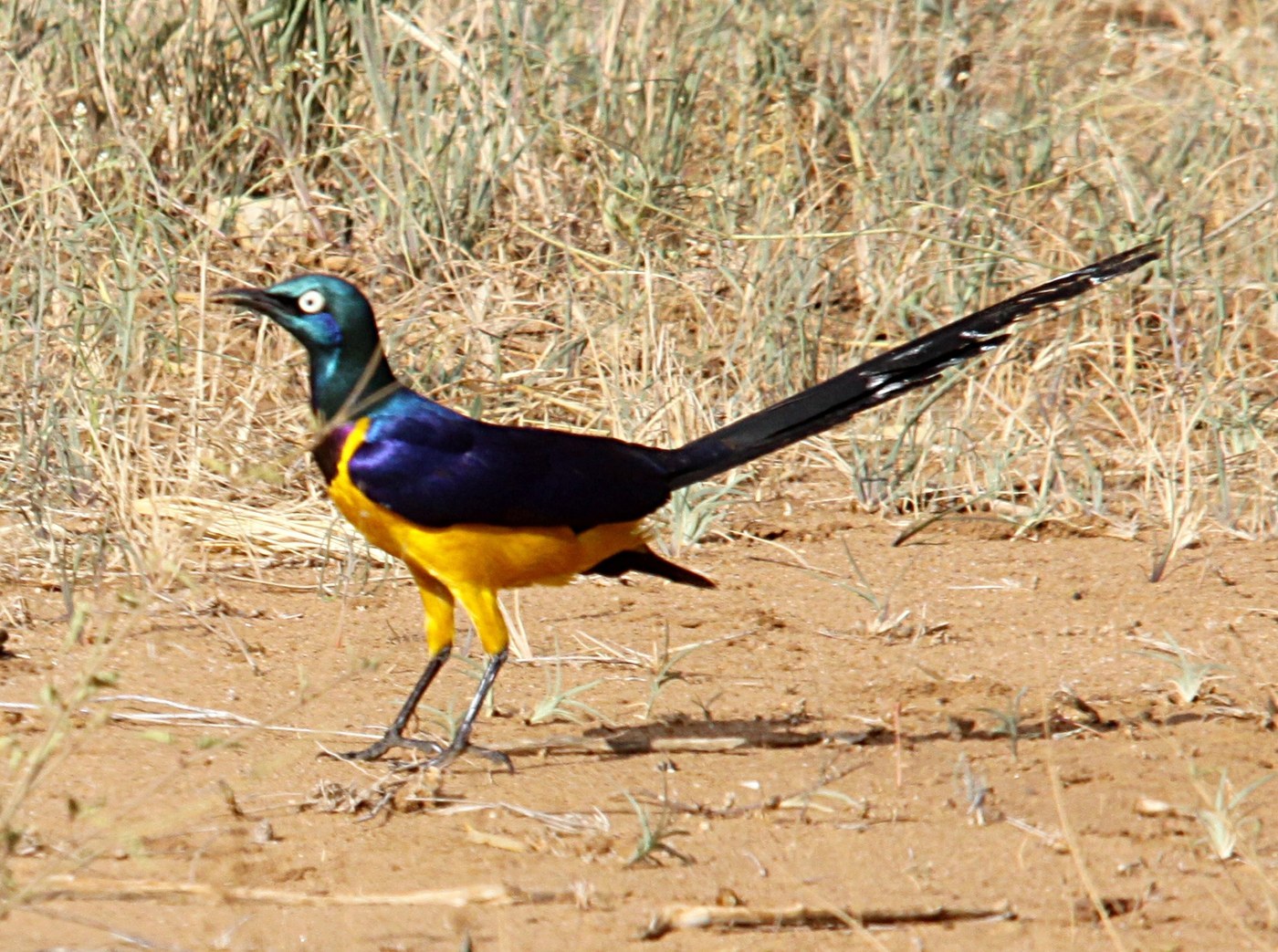
Golden-breasted Starling
Lamprotornis regius
A dazzling East African starling with a shimmering emerald-and-violet body, golden-yellow belly, and an extravagantly long tail.
- Size
- About 28-34 cm long including a very long graduated tail
- Habitat
- Dry bushland, thornscrub and semi-arid savanna in the Horn of Africa and East Africa
- Type
- songbird
Spotted a bird like this?
Identify any bird from a photo, free.
Overview
The Golden-breasted Starling, also known as the Royal Starling, is widely regarded as one of the most beautiful starlings in the world. It inhabits dry bushland and thornscrub in the Horn of Africa and parts of East Africa.
Appearance
Both sexes share the same brilliant plumage: a metallic green and violet-blue head, back, and wings, a narrow violet band across the upper breast, and a rich golden-yellow belly. The tail is exceptionally long and strongly graduated, giving the bird an elegant, elongated silhouette unlike any other starling in its range. The eye is pale yellow-white, standing out against the dark, glossy head.
How to identify it
Key field marks
- Very long, graduated tail, longer proportionally than in any other African starling
- Iridescent green and violet upperparts with a violet breast band
- Bright golden-yellow belly
- Pale, whitish-yellow eye
Similar species
No other starling within its range shares the combination of a golden belly and such an extremely long tail, making the Golden-breasted Starling essentially unmistakable where it occurs. Superb and Greater Blue-eared Starlings, which can share similar dry bush habitat, both have much shorter tails and lack the golden-yellow belly.
Habitat & range
Habitat
This species inhabits dry, thorny bushland, acacia-commiphora scrub, and semi-arid savanna, generally avoiding both dense forest and open grassland.
Range
It is restricted to the Horn of Africa and adjacent East Africa, including Somalia, eastern Ethiopia, and northern and eastern Kenya, with some range extending into northeastern Tanzania.
Migration
Generally resident and nomadic within its arid range, with local movements likely tied to rainfall and food availability rather than true long-distance migration.
Behavior & voice
Behavior
Golden-breasted Starlings are typically seen in small, active flocks moving through dry bush, foraging both on the ground and in low trees and shrubs. Their long tails are conspicuous in flight and while perched.
Voice
Calls include a variety of harsh chattering notes, squeaks, and whistles typical of starlings, often given as a flock communicates while foraging.
Feeding
The diet consists mainly of insects such as grasshoppers, beetles, and termites, taken from the ground or foliage, supplemented with fruit and berries when available.
Nesting
Golden-breasted Starlings nest in cavities, often old woodpecker or barbet holes, or natural holes in trees, sometimes reusing the same site across seasons. They are known to breed cooperatively at times, with helpers assisting a breeding pair in feeding young.
Frequently asked questions
Why is the Golden-breasted Starling called the Royal Starling?
Its extremely long, elegant tail combined with brilliant iridescent green, violet, and gold plumage gives it a particularly regal appearance, inspiring the alternate name Royal Starling.
Where does the Golden-breasted Starling live?
It is found in dry bushland of the Horn of Africa and East Africa, including Somalia, eastern Ethiopia, and northern and eastern Kenya.
What makes the Golden-breasted Starling different from other starlings?
It has a much longer, more graduated tail than any other African starling, along with a distinctive golden-yellow belly.
What does the Golden-breasted Starling eat?
Mostly insects like grasshoppers, beetles, and termites, along with some fruit.
Do male and female Golden-breasted Starlings look different?
No, the sexes are alike, both showing the same iridescent plumage and long tail.
Golden-breasted Starling guides
In-depth guides for identifying, finding, and understanding Golden-breasted Starling.
Other birds you may enjoy

Black Redstart
13-14.5 cm (5.1-5.7 in) long, 23-26 cm wingspan

Black-throated Sparrow
12-14 cm (4.7-5.5 in) long, about 19-20 cm (7.5-8 in) wingspan

Greater Bird-of-paradise
Body about 43 cm; males with additional flank plumes up to 50 cm and long tail wires

Blue Tit
11-12 cm (4.3-4.7 in) long, 17-20 cm wingspan

Red-billed Quelea
11.5–13 cm long, wingspan about 20–22 cm
White-plumed Antbird
13-14 cm (5-5.5 in) long

Pyrrhuloxia
19-22 cm (7.5-8.7 in) long, 30 cm wingspan

Blue-gray Tanager
16-18 cm (6-7 in) long

Blackburnian Warbler
11-13 cm (4.3-5.1 in) long, 20-22 cm wingspan

Bluethroat
13-14 cm (5.1-5.5 in) long, 20-22 cm wingspan

Eurasian Nuthatch
12-14.5 cm (4.7-5.7 in) long, 22.5-27 cm wingspan

Wood Thrush
19-21 cm (7.5-8.3 in) long, about 33 cm (13 in) wingspan