
Golden-breasted Starling Identification Guide
A dazzling East African starling with iridescent emerald-and-violet upperparts, a long graduated tail, and a rich golden-orange breast.
Read the full Golden-breasted Starling encyclopedia entry →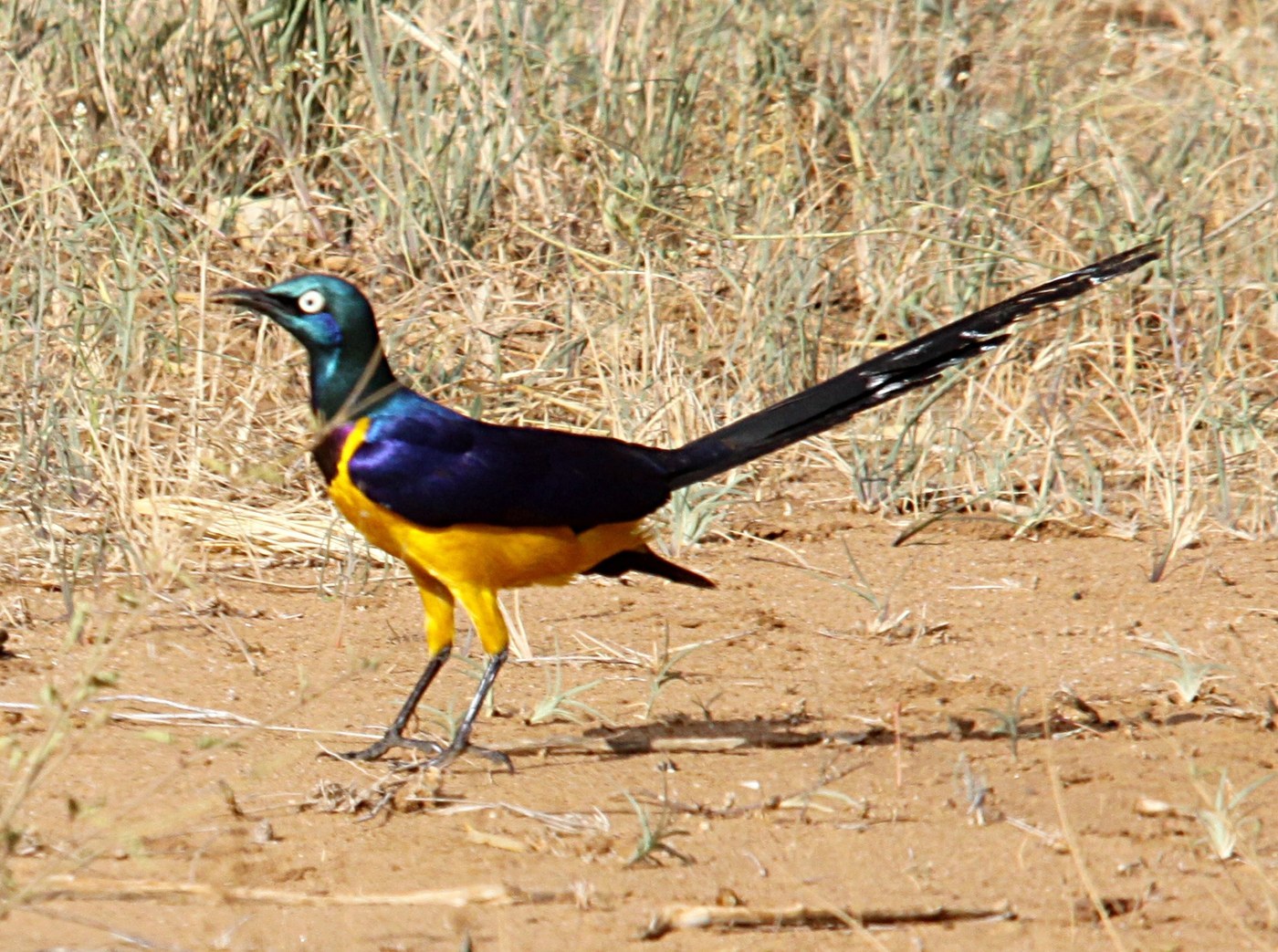
Key Field Marks
- Size & shape: Medium-sized starling, about 28-35 cm including a notably long, graduated, wedge-shaped tail that makes up a large portion of total length — longer-tailed and more slender than most other glossy starlings.
- Plumage: Head, back, and wings are brilliant iridescent emerald-green shading to violet-blue, especially on the wings and tail; the breast and belly are a rich golden-orange to amber, a color combination unique among African starlings.
- Bill & eye: Fairly short, sharply pointed black bill typical of starlings; eye is pale yellow to whitish, standing out against the dark, glossy head.
- Structure in flight: The long tail streams behind in flight and is a good distant clue even before color can be judged.
- Behavior: Forages on the ground and in low bushes for insects, often in small flocks; perches conspicuously on acacia and thorn-scrub branches, flicking its long tail.
Similar Species
- Superb Starling: Overlaps in range and also shows glossy upperparts with a colorful underside, but Superb Starling has a shorter tail, a white breast band separating blue upperparts from chestnut/orange belly, and lacks the extreme tail length.
- Hildebrandt's Starling: Similar chestnut underparts but again a much shorter tail and dark (not pale) eye, plus lacks the golden tone of the breast.
- Other glossy starlings (Lamprotornis spp.): Most East African glossy starlings are shorter-tailed; the combination of very long graduated tail plus golden-orange underparts is diagnostic for this species.
Where & When to See It
Resident in dry thornbush, acacia savanna, and semi-arid scrub of the Horn of Africa and East Africa, including Somalia, Ethiopia, Kenya, and Tanzania. It is non-migratory and can be found year-round, typically in pairs or small flocks, often around thorn scrub and dry woodland edges rather than deep forest.
Voice & Song Cues
Calls include harsh, chattering, squeaky notes typical of glossy starlings, along with a more melodic, warbling song mixed with grating chatters given from perches; flocks are often noisy, giving away their presence before they are seen.
Frequently asked questions
What is the most distinctive feature of the Golden-breasted Starling?
Its extremely long, graduated tail combined with a golden-orange breast and iridescent emerald-violet upperparts — a color and shape combination unmatched by other African starlings.
How do you separate it from a Superb Starling?
Superb Starling has a much shorter tail and a white breast band dividing the blue chest from the chestnut belly, while Golden-breasted Starling has a very long tail and no white breast band.
Where does the Golden-breasted Starling live?
It inhabits dry thornbush and acacia savanna in the Horn of Africa and East Africa, including Somalia, Ethiopia, Kenya, and Tanzania, and is a non-migratory resident.
Does the Golden-breasted Starling flock with other birds?
It is often seen in small flocks of its own species foraging on the ground or in low scrub, and may associate loosely with other dry-country starlings.