
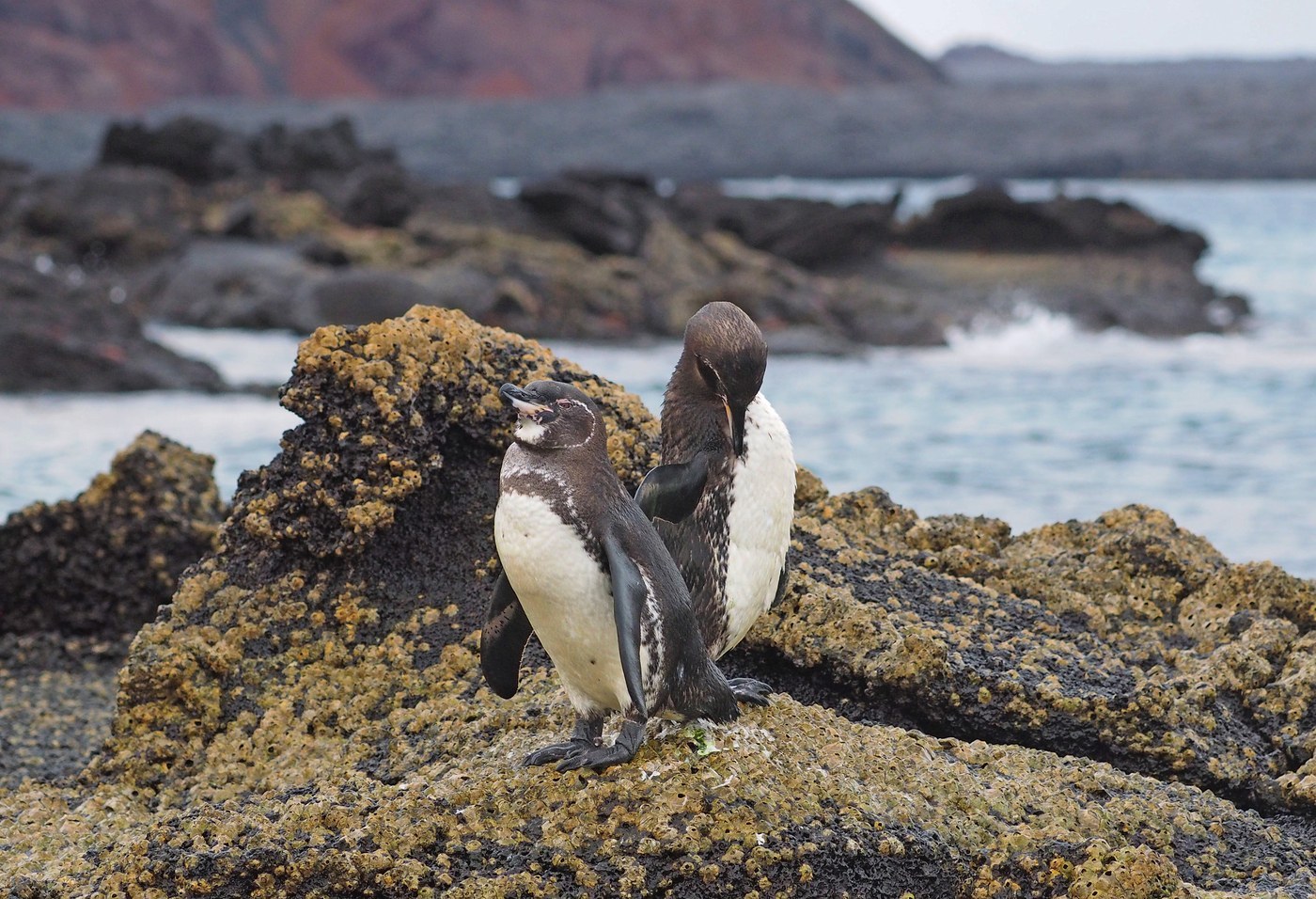
Galapagos Penguin
Spheniscus mendiculus
The smallest banded penguin and the only penguin species found north of the equator, confined entirely to the volcanic shores of the Galapagos Islands.
- Size
- 48-53 cm (19-21 in) tall, 1.7-2.6 kg (3.7-5.7 lb)
- Habitat
- rocky volcanic shorelines of the Galapagos Islands
- Type
- seabird
Spotted a bird like this?
Identify any bird from a photo, free.
Overview
The Galapagos Penguin is a small banded penguin restricted entirely to the Galapagos Islands, straddling the equator and making it the only penguin species that regularly ranges into the Northern Hemisphere. It shares the classic black-and-white banded pattern of its South American relatives, with a thin black band curving across the white chest, though it is the smallest species in this group.
Galapagos Penguins survive in a tropical setting thanks only to the cool, nutrient-rich waters of the Cromwell and Humboldt Currents, which bring cold water and abundant fish to the equatorial islands. Without this upwelling, the warm tropical waters surrounding the islands would be inhospitable to a penguin.
With one of the smallest total populations of any penguin species, the Galapagos Penguin is highly vulnerable to fluctuations in ocean temperature, particularly during El Niño events, which can drastically reduce its food supply.
How to identify it
Key field marks
- Small size, with a thin, sometimes broken, black band across the chest
- White facial stripe running from the eye around the black cheek
- Black upperparts, white underside, blackish bill
Similar species
- Humboldt and Magellanic Penguins are larger, occur only in mainland South America, and are never found on the Galapagos Islands, so range alone separates them.
- No other penguin species occurs within the Galapagos Islands, making identification straightforward by location.
Habitat & range
The Galapagos Penguin is restricted to the Galapagos Islands, particularly the western islands of Fernandina and Isabela, where cold water welling up from the Cromwell Current keeps sea temperatures low enough to support the species despite the equatorial latitude. It nests in caves, crevices, and burrows dug into volcanic rock and lava along the shoreline.
The species is non-migratory and remains within the Galapagos archipelago year-round, closely tied to the availability of cold, productive water.
Behavior & voice
Voice
Galapagos Penguins give braying calls similar to other banded penguins, along with softer contact calls between mates and chicks.
Feeding
They forage close to shore, often in small groups, sometimes cooperatively herding schools of small fish such as sardines and mullet into shallow water before diving in to feed.
Nesting and breeding
Pairs nest in shaded lava crevices, caves, or burrows that protect eggs and chicks from intense equatorial sun. Breeding can occur more than once a year when food is abundant, but pairs may skip breeding entirely during poor food years such as El Niño events.
Frequently asked questions
Where do Galapagos Penguins live?
They live only on the Galapagos Islands, mainly around Fernandina and Isabela, making them the only penguin found north of the equator.
How can Galapagos Penguins survive near the equator?
Cold, nutrient-rich water from the Cromwell and Humboldt Currents keeps the surrounding sea cool enough to support them despite the tropical latitude.
How big is a Galapagos Penguin?
It stands about 48-53 cm (19-21 in) tall, making it the smallest of the banded penguin species.
Why is the Galapagos Penguin endangered?
Its small population is highly sensitive to warm-water events like El Niño, which reduce the fish it depends on for food.
What do Galapagos Penguins eat?
They eat small schooling fish such as sardines and mullet, sometimes herded cooperatively into shallow water.
Galapagos Penguin guides
In-depth guides for identifying, finding, and understanding Galapagos Penguin.
Other birds you may enjoy
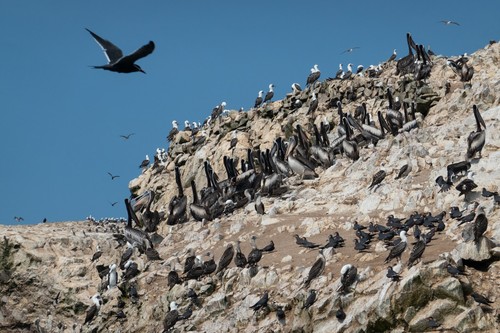
Peruvian Pelican
137-152 cm (54-60 in) long, up to 228 cm wingspan
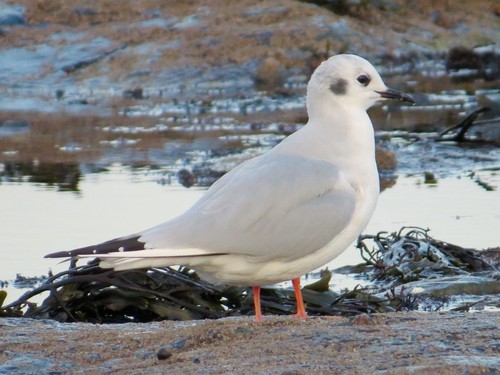
Bonaparte's Gull
28-33 cm (11-13 in) long, 76-84 cm wingspan
Brown Pelican
106-137 cm (42-54 in) long, 200-230 cm wingspan
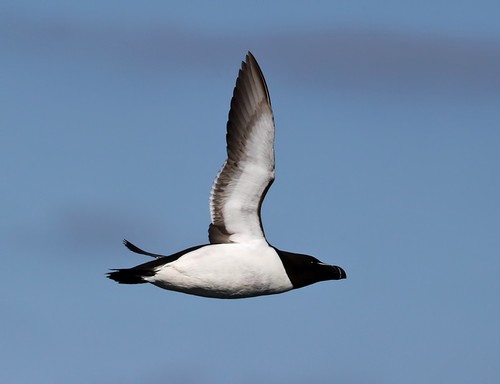
Razorbill
37-39 cm (15-15.5 in) long, 63-68 cm wingspan
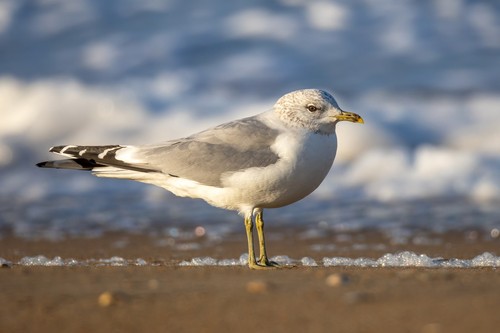
Common Gull
40-46 cm (16-18 in) long, 110-130 cm wingspan
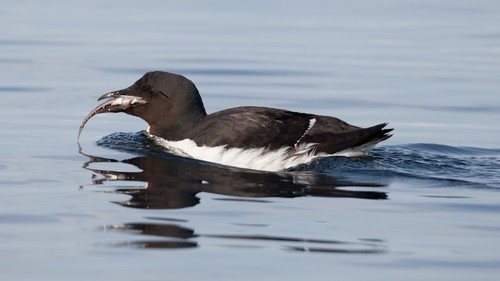
Thick-billed Murre
40-48 cm (16-19 in) long, 65-75 cm wingspan
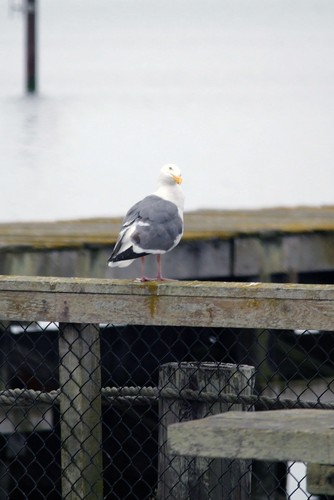
Western Gull
55-68 cm (22-27 in) long, 130-144 cm wingspan
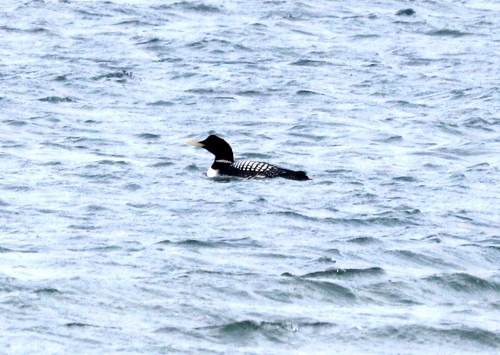
Yellow-billed Loon
76-97 cm (30-38 in) long, 135-152 cm wingspan
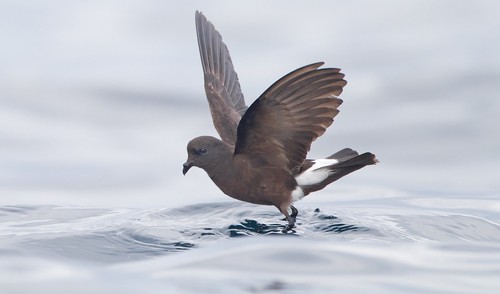
Wilson's Storm-Petrel
15-19 cm (6-7.5 in) long, wingspan 38-42 cm (15-16.5 in)
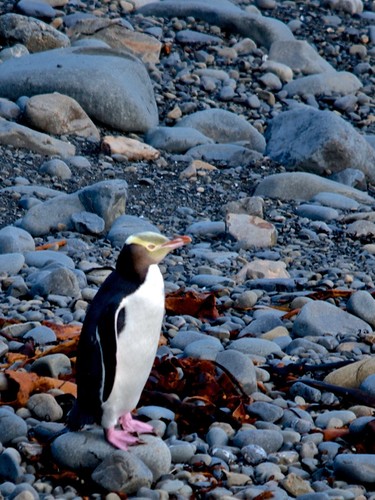
Yellow-eyed Penguin
62-79 cm (24-31 in) tall, 3-8.5 kg (6.6-18.7 lb)
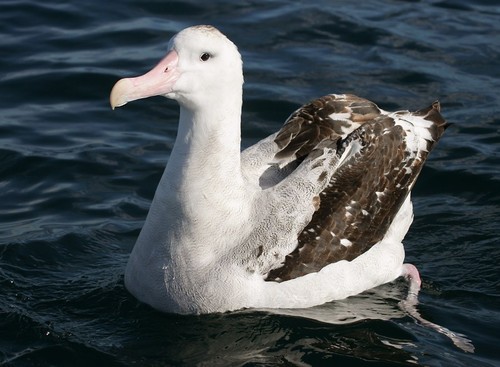
Wandering Albatross
107-135 cm (42-53 in) long, wingspan up to 3.5 m (11.5 ft)
Tufted Puffin
35-41 cm (14-16 in) long, about 63-70 cm wingspan