
Galapagos Penguin Identification Guide
The world's only penguin found at the equator, the Galapagos Penguin is a tiny, endemic black-and-white seabird identified by its thin chest band and pink facial patches.
Read the full Galapagos Penguin encyclopedia entry →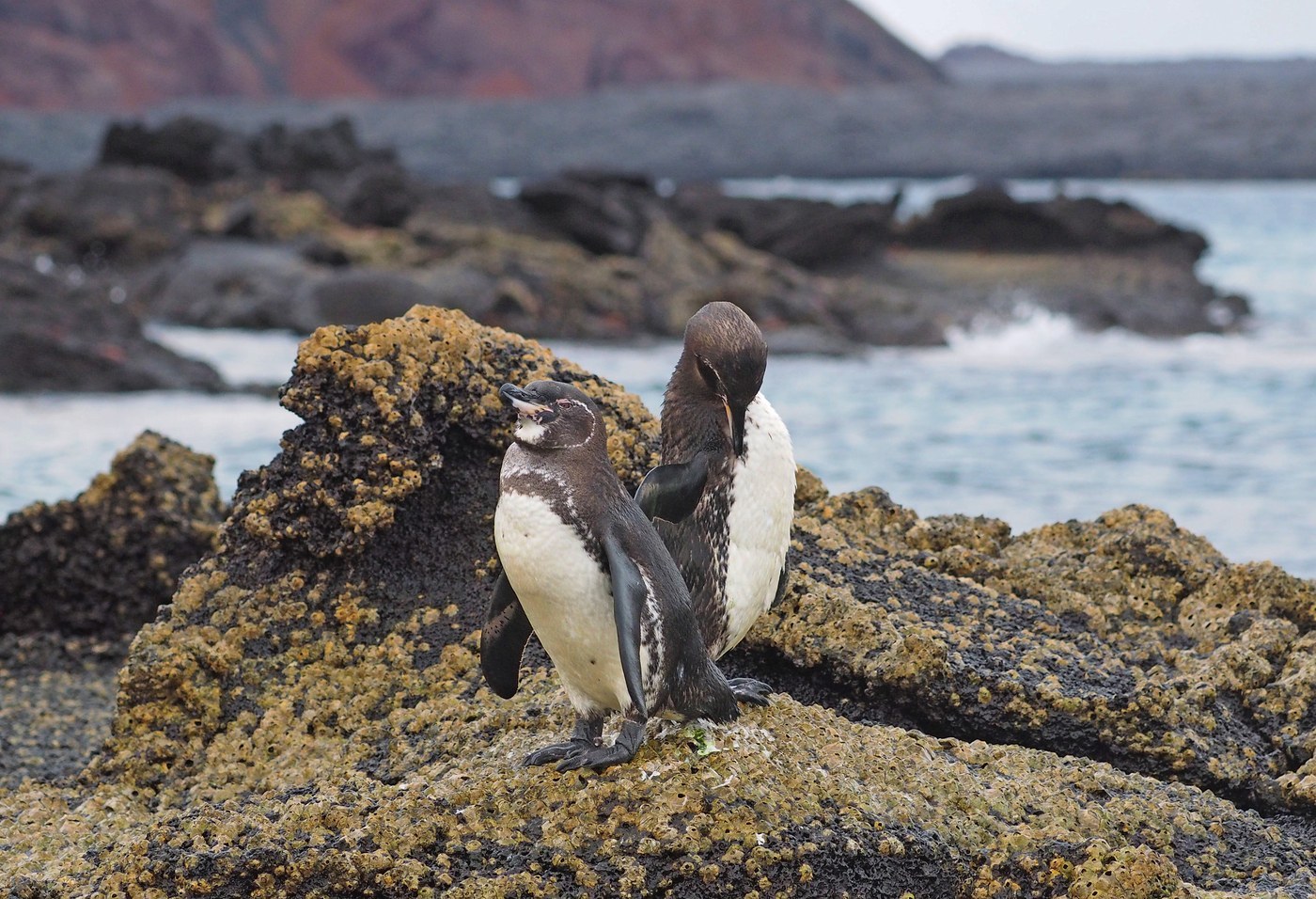
Key Field Marks
- Size: The smallest penguin in the Northern Hemisphere's latitude range and one of the smallest penguins overall, standing about 49 cm (19 in) tall.
- Plumage: Black upperparts and white underparts in classic penguin fashion. A single narrow black band curves across the upper chest and down along the flanks toward the thigh — thinner and less complete than the double band of related banded penguins.
- Head pattern: A white line runs from behind the eye down the side of the neck to the breast, framing the black crown and face.
- Bare skin: Pink patches of bare skin at the base of the bill and around the eyes are used to dump excess body heat in the tropical sun — a feature not shared by cold-climate penguins.
- Bill: Slender, black, and slightly downcurved.
Separating It From Similar Species
- Galapagos Penguin is the only penguin species resident in the Galapagos Islands, so within its range there is no confusion species.
- It is closely related to the Humboldt Penguin of coastal Peru and Chile, but the two do not overlap geographically. The Humboldt Penguin is larger with a bolder, more complete black chest band; the Galapagos Penguin is noticeably smaller and its band is thinner and less defined.
- Its small size, pink facial skin, and equatorial range make it unmistakable once seen well.
Where and When to Find It
- Range: Endemic to the Galapagos Islands, with the vast majority of the population concentrated around Fernandina and western/northern Isabela Island, where the cold, nutrient-rich Cromwell Current upwells.
- Habitat: Rocky, lava-strewn shorelines with crevices and caves for nesting and shade; forages in cool, fish-rich coastal waters close to shore.
- Season: Present year-round; it does not migrate. Breeding can occur opportunistically whenever food is abundant, rather than on a fixed seasonal schedule, though it typically peaks after cooler upwelling periods.
- Population size fluctuates sharply with El Niño events, which reduce food availability and can cause breeding failure.
Voice
- Gives a loud, braying, donkey-like call typical of banded penguins, used at colonies and when pairs greet each other at the nest.
- Also produces shorter grunts and hisses when disturbed.
Frequently asked questions
Is the Galapagos Penguin the only penguin near the equator?
Yes. It is the only penguin species whose range crosses the equator, thanks to the cold Cromwell Current that keeps Galapagos waters cool enough to support it.
How can I tell a Galapagos Penguin from a Humboldt Penguin?
The two never naturally overlap, but if compared, the Galapagos Penguin is smaller with a thinner, less complete chest band, while the Humboldt Penguin is larger with a bolder black band.
Do Galapagos Penguins migrate?
No, they are non-migratory and stay near their breeding islands year-round, mainly around Fernandina and Isabela.
Why does the Galapagos Penguin have pink patches on its face?
The bare pink skin around the eyes and bill base helps the bird radiate excess heat, an adaptation for living in a tropical climate unlike most other penguin species.