
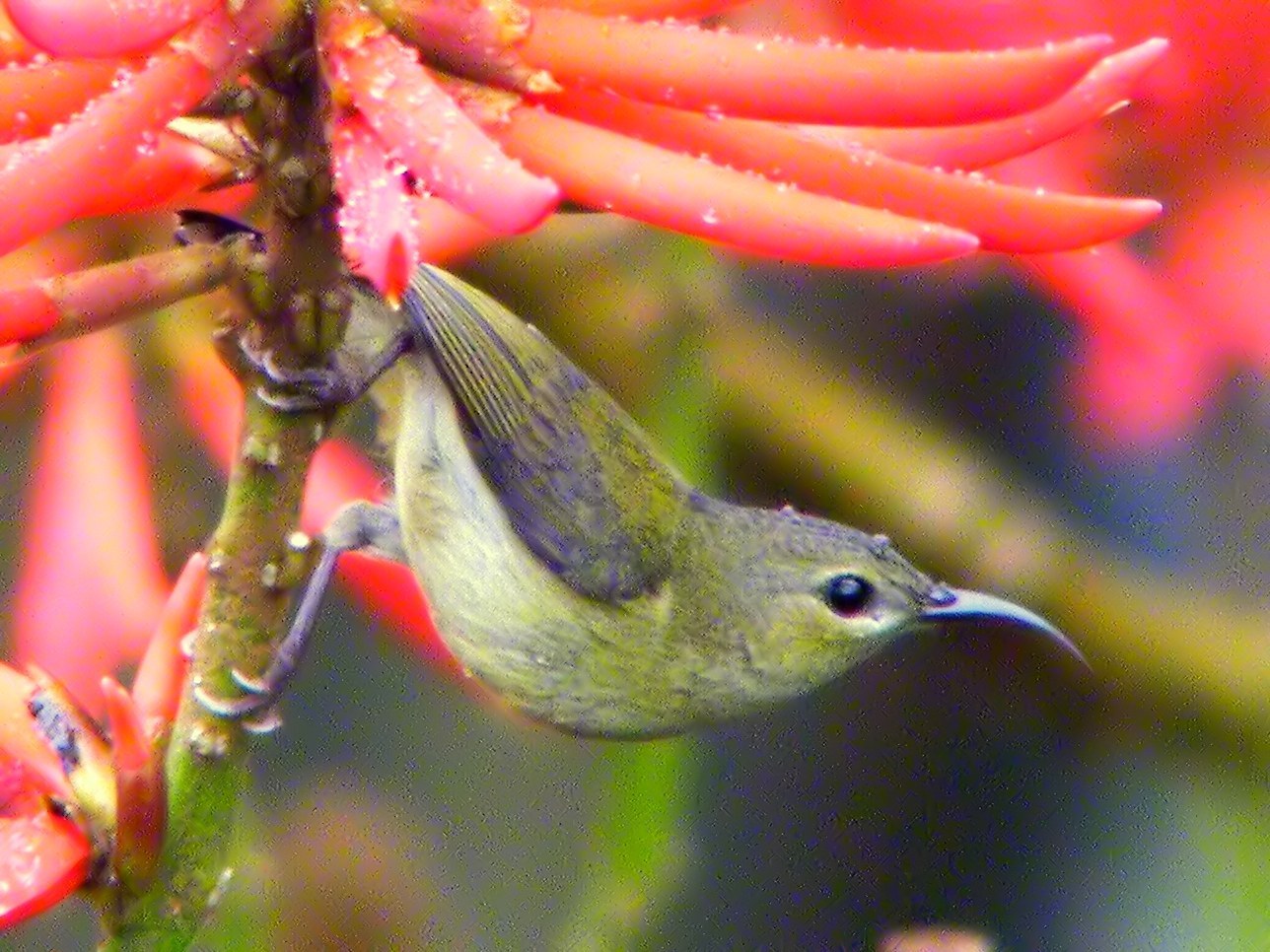
Fork-tailed Sunbird
Aethopyga christinae
A tiny, iridescent sunbird of southern China and Vietnam, named for the male's elongated, forked tail streamers.
- Size
- About 9-10 cm long; males appear longer due to elongated central tail feathers
- Habitat
- Subtropical forest edge, scrub, and gardens in southern China, Hainan, and northern Vietnam
- Type
- songbird
Spotted a bird like this?
Identify any bird from a photo, free.
Overview
The Fork-tailed Sunbird is a diminutive, brilliantly colored bird found in the subtropical hills of southern China and adjacent parts of Vietnam. It is a classic Old World sunbird, feeding on nectar with a slender curved bill and flashing metallic colors as it moves.
Males have a glittering metallic green crown and shoulder patch, a scarlet throat and upper breast, olive-yellow underparts, and elongated central tail feathers that give the species its name. Females are much plainer, olive-green above and paler yellowish below, lacking the male's iridescent colors and tail streamers.
Although tiny, its combination of jewel-like colors and a forked tail makes the male one of the most striking small birds within its range.
How to identify it
Key field marks
- Male: metallic green crown and shoulder patch, red throat and breast, olive-yellow belly
- Elongated, forked central tail feathers in the male
- Female: plain olive-green above, dull yellowish below, short tail
- Slender, downcurved bill typical of sunbirds
- Fast, darting flight between flowers
Similar species
- Mrs. Gould's Sunbird: larger and more extensively colorful with a violet-blue tail and more extensive red on the underparts; ranges can overlap in parts of southern China and Vietnam.
- Crimson Sunbird: more extensively crimson on the underparts and lacks the forked tail streamers, with a different, more southerly range.
- Female sunbirds of other species: often very similar plain olive/yellow females; best distinguished by range, precise bill shape, and any accompanying male.
Habitat & range
Habitat
Fork-tailed Sunbirds occupy subtropical evergreen forest edges, secondary growth, scrub, bamboo, and gardens, typically at low to middle elevations in hilly terrain.
Range
Found in southern China (including Hainan Island), Hong Kong, and northern Vietnam, where it is often one of the more common small sunbirds in suitable habitat.
Migration
Generally resident, though some populations may make short elevational movements outside the breeding season in response to flower availability.
Behavior & voice
Behavior
Fork-tailed Sunbirds are active, restless feeders, moving quickly between flowering shrubs and trees, often hovering briefly or clinging to flowers while probing for nectar.
Voice
The song is a thin, high-pitched, rapid series of tinkling and buzzy notes; calls include sharp, high chips given in flight or while perched.
Feeding
They feed chiefly on nectar taken from a variety of flowering plants using their curved bill and tubular tongue, supplementing this with small insects and spiders, especially when raising young.
Nesting and breeding
The female builds a small, hanging, pear-shaped nest suspended from a thin branch or vine, often incorporating spider silk. She typically performs most of the incubation and early chick care, with the male sometimes assisting in feeding the young.
Frequently asked questions
Why is it called the Fork-tailed Sunbird?
Breeding males have elongated central tail feathers that create a distinctly forked tail shape.
Where does the Fork-tailed Sunbird live?
It is found in southern China, including Hainan Island, Hong Kong, and northern Vietnam, in subtropical forest edge and scrub habitats.
How do male and female Fork-tailed Sunbirds differ?
Males are brightly colored with a metallic green crown, red throat, and forked tail, while females are plain olive-green with a short tail.
What does the Fork-tailed Sunbird eat?
Mainly flower nectar, supplemented with small insects and spiders.
What kind of nest does the Fork-tailed Sunbird build?
A small, hanging, pear-shaped nest suspended from a thin branch, built mainly by the female.
Fork-tailed Sunbird guides
In-depth guides for identifying, finding, and understanding Fork-tailed Sunbird.
Other birds you may enjoy

Black Redstart
13-14.5 cm (5.1-5.7 in) long, 23-26 cm wingspan

Black-throated Sparrow
12-14 cm (4.7-5.5 in) long, about 19-20 cm (7.5-8 in) wingspan

Greater Bird-of-paradise
Body about 43 cm; males with additional flank plumes up to 50 cm and long tail wires

Blue Tit
11-12 cm (4.3-4.7 in) long, 17-20 cm wingspan

Red-billed Quelea
11.5–13 cm long, wingspan about 20–22 cm
White-plumed Antbird
13-14 cm (5-5.5 in) long

Pyrrhuloxia
19-22 cm (7.5-8.7 in) long, 30 cm wingspan

Blue-gray Tanager
16-18 cm (6-7 in) long

Blackburnian Warbler
11-13 cm (4.3-5.1 in) long, 20-22 cm wingspan

Bluethroat
13-14 cm (5.1-5.5 in) long, 20-22 cm wingspan

Eurasian Nuthatch
12-14.5 cm (4.7-5.7 in) long, 22.5-27 cm wingspan

Wood Thrush
19-21 cm (7.5-8.3 in) long, about 33 cm (13 in) wingspan