
Fork-tailed Sunbird Identification Guide
A tiny, iridescent East Asian sunbird with a curved bill and, in breeding males, elongated central tail feathers forming a shallow fork, best found probing flowers in subtropical hillside gardens and forest edge.
Read the full Fork-tailed Sunbird encyclopedia entry →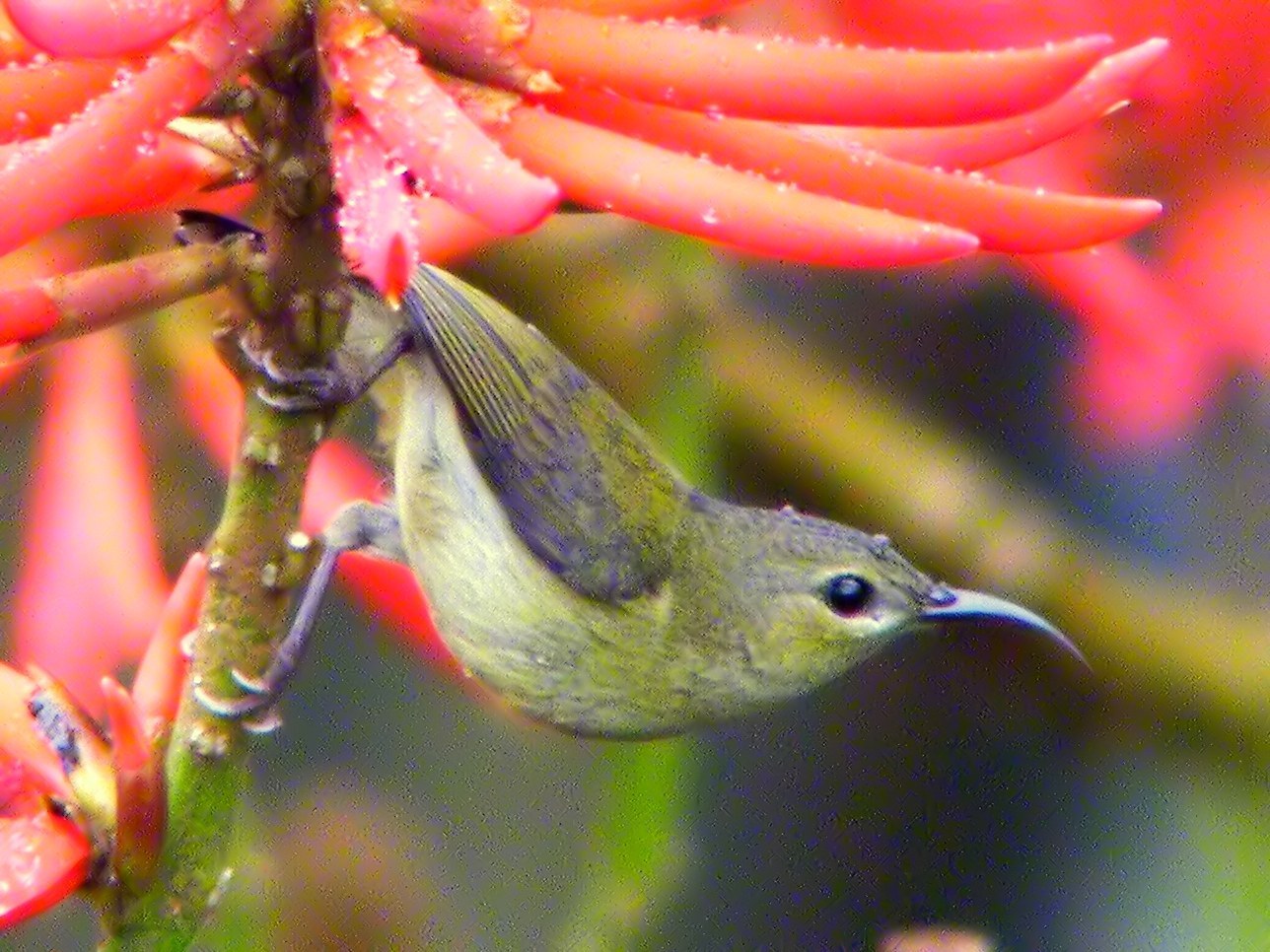
Key Field Marks
- Size & shape: Very small, around 8-10 cm (excluding tail streamers), with a slim body and a distinctly decurved, needle-like bill adapted for nectar feeding.
- Male plumage: Iridescent metallic green crown and throat contrasting with a maroon or dark red back and breast band in many populations; central tail feathers are elongated, giving the tail a forked appearance in breeding condition.
- Female plumage: Much duller olive-green above and grayish-yellow below, lacking iridescence and the elongated tail feathers — far less distinctive and best identified by range, bill shape, and association with a male.
- Bill: Thin, black, strongly downcurved, used to probe tubular flowers for nectar; also gleans small insects.
- Behavior: Constantly active, flitting between flowering shrubs and trees, often hovering briefly at blossoms; frequently joins mixed-species foraging flocks at forest edge.
Similar Species
- Other regional sunbirds (e.g., Mrs. Gould's Sunbird, Green-tailed Sunbird) can show similar iridescent coloring, but the combination of maroon back/breast and forked tail in breeding males is distinctive; females require careful attention to range and subtle plumage tone differences.
- Fire-tailed Sunbird has a much more extensively red body and longer, brighter tail streamers, occurring at higher elevations.
- Non-breeding males lose the elongated tail feathers and resemble females more closely, so seasonal timing matters for confident identification.
Where & When to See It
- Range: Found across southern China, Taiwan, and parts of Southeast Asia, in subtropical and tropical lowland to mid-elevation habitats.
- Habitat: Forest edge, scrubby hillsides, parks, and gardens with flowering plants; adaptable to human-modified landscapes including tea plantations and urban parks with nectar sources.
- Season: Resident year-round across most of its range, though breeding plumage (and the namesake forked tail) in males is most pronounced during the breeding season.
Voice & Behavior Cues
- Song is a thin, high-pitched, rapid series of sharp notes, typical of small sunbirds, often given from an exposed perch near flowering shrubs.
- Calls include sharp "chip" or "tsit" notes used in contact and alarm; listen for these while scanning flowering trees, a good way to locate an otherwise inconspicuous bird.
Frequently asked questions
What gives the Fork-tailed Sunbird its name?
Breeding males grow elongated central tail feathers that create a shallow forked appearance, though this feature is much less obvious or absent in females and non-breeding males.
How do I identify a female Fork-tailed Sunbird?
Females are dull olive-green above and grayish-yellow below without iridescence; they are best identified by the decurved bill, small size, range, and often by association with a male.
Where is the best habitat to find this species?
Look in forest edges, scrubby hillsides, gardens, and parks with flowering plants across southern China, Taiwan, and parts of Southeast Asia.
Is the forked tail present year-round?
No, the elongated tail feathers in males are most developed during the breeding season and are reduced or absent outside of it.