
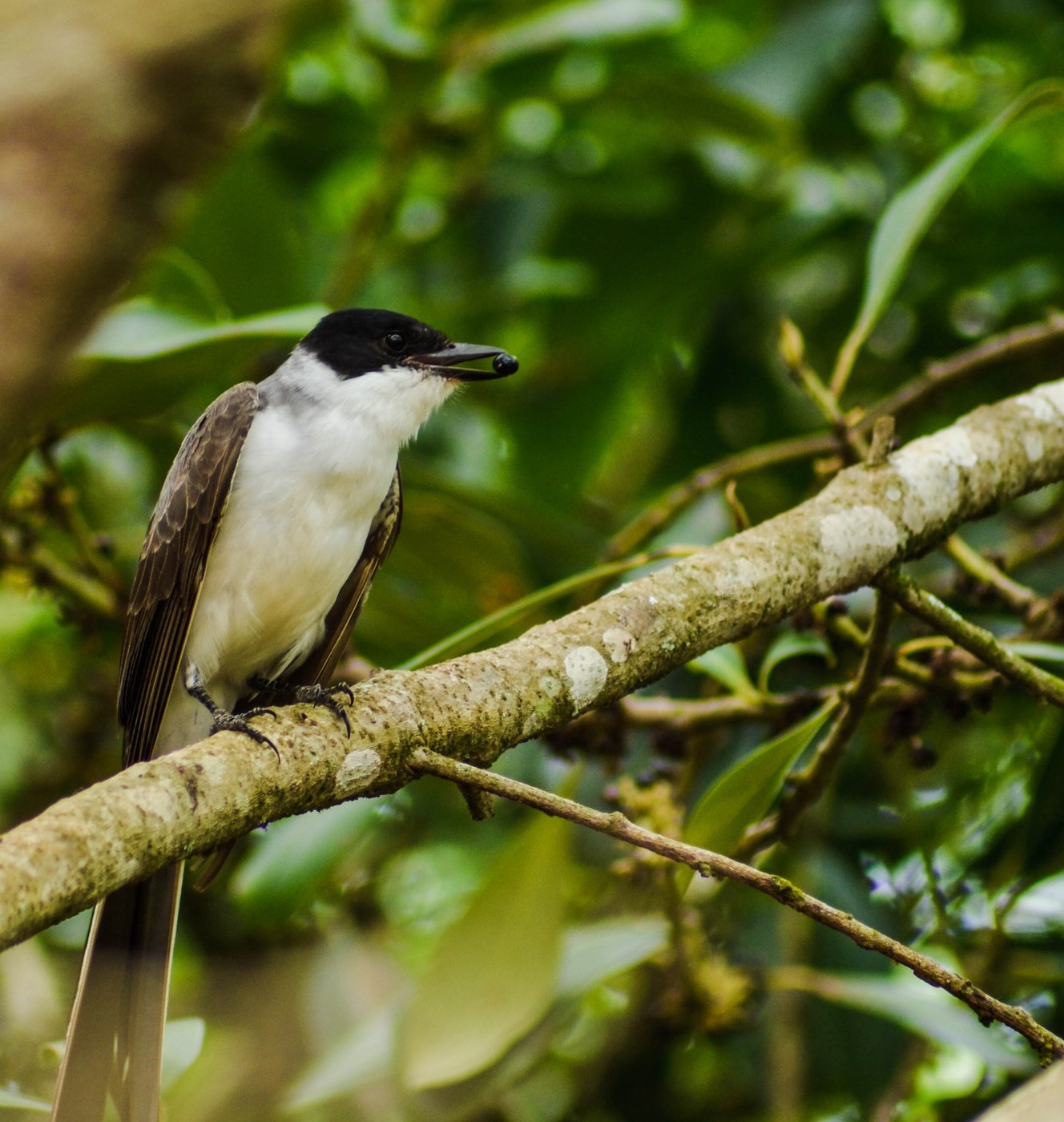
Fork-tailed Flycatcher
Tyrannus savana
An elegant open-country flycatcher with a black cap, pale gray back, and an extremely long, deeply forked black tail trailing behind it in flight.
- Size
- body about 19 cm (7.5 in); tail adds up to 15-25 cm more, males reaching a total length near 38 cm (15 in)
- Habitat
- open country, grassland, savanna, and agricultural land
- Type
- songbird
Spotted a bird like this?
Identify any bird from a photo, free.
Overview
The Fork-tailed Flycatcher is one of the most elegant and easily recognized birds of open country in the Americas, instantly identifiable by its dramatically long, deeply forked tail, especially striking in adult males, which can trail well behind the bird in flight. The head shows a black cap, often with a partly concealed yellow or orange crown patch, above a pale gray back and clean white underparts.
Wings are dark, contrasting with the pale body, and the tail, black and scissor-like, is by far the bird's most distinctive feature, streaming out behind it as it flies buoyantly over open fields. Females and immatures have shorter tails than adult males but share the same basic black-cap-and-pale-body pattern.
A member of the kingbird genus Tyrannus, this flycatcher is a conspicuous and often abundant sight perched on wires, fence posts, and low shrubs across open grassland and agricultural landscapes.
How to identify it
Key field marks
- Black cap contrasting with a pale gray back
- Clean white underparts
- Extremely long, deeply forked black tail, longest in adult males
- Buoyant, graceful flight with the tail streaming behind
Similar species
Scissor-tailed Flycatcher is similar in shape but has extensive salmon-pink underwing and flank coloring and a paler overall body; Fork-tailed Flycatcher lacks the pink tones and has cleaner white underparts. Immature or short-tailed individuals can resemble kingbirds but the tail shape, even when shorter, retains a forked profile.
Habitat & range
Habitat
This species favors open habitats including grassland, savanna, agricultural fields, pastures, and marshy edges, generally avoiding forested areas.
Range
It breeds widely across South America, from Colombia and Venezuela south through Brazil to Argentina, with some Central American and Mexican populations as well; many southern populations are strongly migratory.
Migration
Southern breeding populations undertake substantial migrations northward into the Amazon basin and parts of Central America outside the breeding season, making this one of the more migratory tyrant flycatchers in the Americas.
Behavior & voice
Behavior
Fork-tailed Flycatchers are often seen perched conspicuously on wires, fences, or low shrubs in open country, sallying out to catch insects and sometimes gathering in large flocks, especially during migration or in the non-breeding season.
Voice
Its calls include sharp, twittering, and buzzy notes, generally simple and not especially musical compared to some songbirds, given while perched or in flight.
Feeding
It feeds almost entirely on flying insects, caught in aerial sallies from an exposed perch, occasionally supplemented with some fruit.
Nesting and breeding
The species builds an open cup nest in a shrub or low tree, often in an exposed location, where the female incubates the eggs while both parents defend the nest vigorously, sometimes attacking much larger birds that approach.
Frequently asked questions
What is most distinctive about the Fork-tailed Flycatcher?
Its extremely long, deeply forked black tail, most pronounced in adult males, trailing well behind the bird in flight.
How is it different from the Scissor-tailed Flycatcher?
The Fork-tailed Flycatcher lacks the salmon-pink underwing and flank coloring of the Scissor-tailed Flycatcher and has cleaner white underparts.
Does the Fork-tailed Flycatcher migrate?
Yes, many southern South American breeding populations migrate north into the Amazon basin and parts of Central America outside the breeding season.
What does the Fork-tailed Flycatcher eat?
Mainly flying insects caught in aerial sallies from an exposed perch.
Where does the Fork-tailed Flycatcher live?
In open grassland, savanna, and agricultural land across much of South America, with some Central American populations too.
Fork-tailed Flycatcher guides
In-depth guides for identifying, finding, and understanding Fork-tailed Flycatcher.
Other birds you may enjoy

Black Redstart
13-14.5 cm (5.1-5.7 in) long, 23-26 cm wingspan

Black-throated Sparrow
12-14 cm (4.7-5.5 in) long, about 19-20 cm (7.5-8 in) wingspan

Greater Bird-of-paradise
Body about 43 cm; males with additional flank plumes up to 50 cm and long tail wires

Blue Tit
11-12 cm (4.3-4.7 in) long, 17-20 cm wingspan

Red-billed Quelea
11.5–13 cm long, wingspan about 20–22 cm
White-plumed Antbird
13-14 cm (5-5.5 in) long

Pyrrhuloxia
19-22 cm (7.5-8.7 in) long, 30 cm wingspan

Blue-gray Tanager
16-18 cm (6-7 in) long

Blackburnian Warbler
11-13 cm (4.3-5.1 in) long, 20-22 cm wingspan

Bluethroat
13-14 cm (5.1-5.5 in) long, 20-22 cm wingspan

Eurasian Nuthatch
12-14.5 cm (4.7-5.7 in) long, 22.5-27 cm wingspan

Wood Thrush
19-21 cm (7.5-8.3 in) long, about 33 cm (13 in) wingspan