
Fork-tailed Flycatcher Identification Guide
A striking neotropical flycatcher with an extremely long, scissor-like black tail, black cap, and pale gray body, unmistakable when seen well and a notable vagrant far north of its normal range.
Read the full Fork-tailed Flycatcher encyclopedia entry →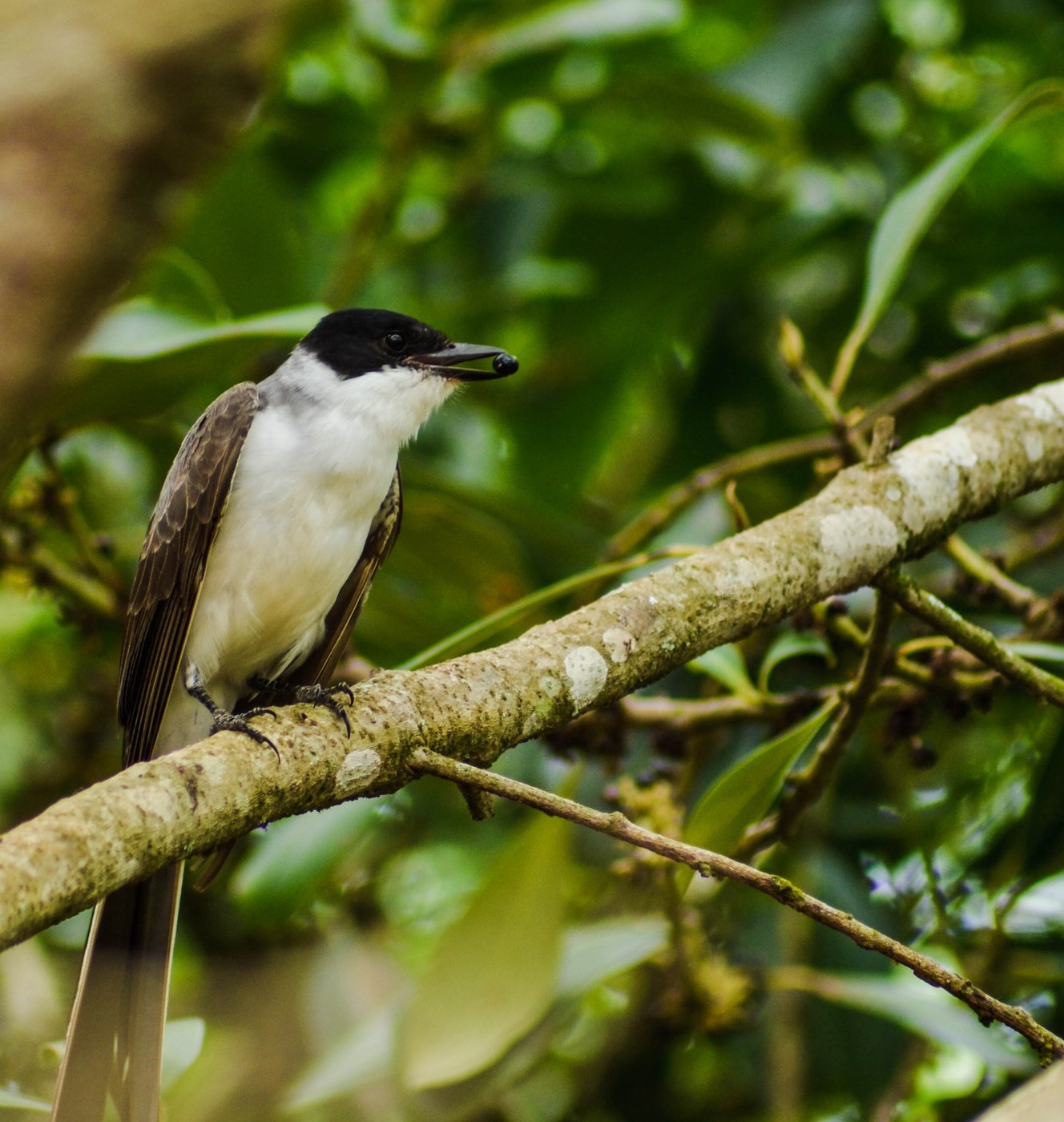
Key Field Marks
- Size & shape: Body is about robin-sized, but the tail more than doubles the bird's total length in adults, streaming out in two long black feathers that can reach 10+ inches.
- Plumage: Clean pale gray back, whitish underparts, and a jet-black cap that extends down through the eye like a mask; wings are blackish.
- Tail: The extremely long, deeply forked black tail is diagnostic and visible even at a distance or in flight, often held closed in a single streamer-like line or slightly open in a scissor shape.
- Bill: Short, black, and flattened — typical flycatcher bill shape for catching insects on the wing.
- Behavior: Perches upright on fence wires, shrubs, or low trees in open country, sallying out to catch insects and returning to the same perch; the tail trails dramatically in flight.
Similar Species
- Scissor-tailed Flycatcher (North America) has salmon-pink flanks and underwing linings and a paler gray back overall, plus a less solidly black cap; ranges barely overlap and the two are easily separated by the pink wash and cap extent.
- Juvenile/first-year Fork-tailed Flycatchers have shorter tails and can superficially resemble kingbirds, but the blackish cap and thin bill still distinguish them.
- No other regularly occurring flycatcher shares this combination of gray back, black cap, and extravagantly long forked tail.
Where & When to See It
- Range: Breeds from Mexico south through Central America and much of South America to Argentina; southern populations are long-distance migrants.
- Habitat: Open country, savanna, agricultural land, and areas with scattered trees or fence lines for perching.
- Season: A regular but rare vagrant to the United States and Canada, especially in fall, when wandering individuals (often first-year birds with shorter tails) turn up well outside the normal range — always a notable sighting for birders.
Voice & Behavior Cues
- Calls are sharp, twittering "tik" or "kip" notes, often given in a rapid chatter during interactions or flight.
- Watch for the exaggerated tail movements during display flights, where the tail is fanned and twisted, a behavior unique among regularly encountered New World flycatchers.
Frequently asked questions
How do I tell a Fork-tailed Flycatcher from a Scissor-tailed Flycatcher?
Fork-tailed Flycatchers lack the salmon-pink flanks and underwings of Scissor-tailed Flycatchers and have a more solidly black cap extending through the eye.
Why might I see a Fork-tailed Flycatcher far outside South America?
It is a well-documented vagrant, with wandering individuals — often young birds with shorter tails — occasionally reaching the United States and Canada, mainly in fall.
What is the most obvious field mark of this species?
The extremely long, deeply forked black tail combined with a black cap and pale gray back makes it essentially unmistakable when seen clearly.
Does the tail length differ between adults and young birds?
Yes, juveniles and first-year birds have noticeably shorter tails than full adults, which can make them trickier to identify at a glance.