
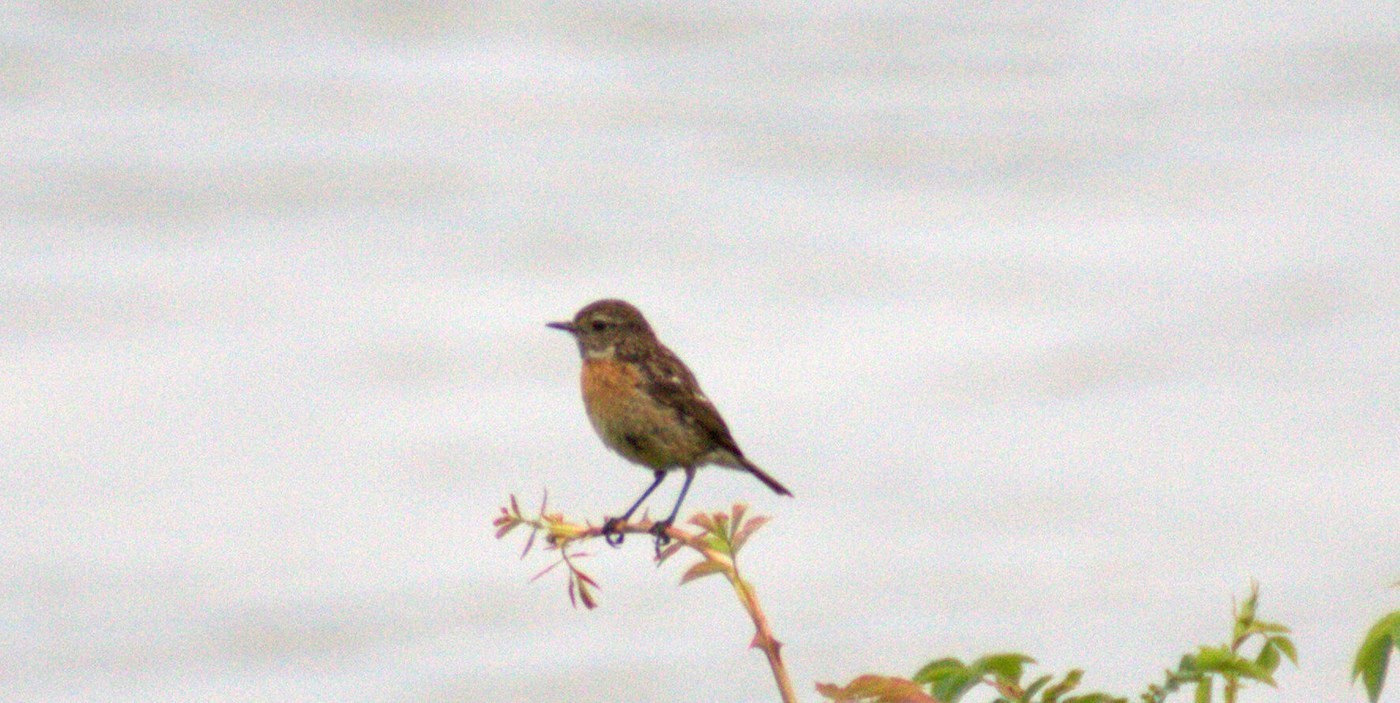
European Stonechat
Saxicola rubicola
A small, perky chat of gorse-covered heathland, the male showing a black head, white collar patches, and a bright orange breast, with a call like clicking stones.
- Size
- 11.5-13 cm (4.5-5.1 in) long, 18-21 cm wingspan
- Habitat
- heathland, gorse scrub, rough grassland, and coastal habitats
- Type
- songbird
Spotted a bird like this?
Identify any bird from a photo, free.
Overview
The European Stonechat is a small, energetic chat closely tied to open, scrubby habitats such as heathland and gorse-covered commons, where it perches conspicuously on the tops of low bushes, flicking its wings and tail almost constantly.
Appearance
Breeding males are striking, with a black head, a bold white half-collar on the neck sides, a white wing patch, and a rich orange-red breast fading to paler underparts. Females and non-breeding males are considerably duller, streaky brown overall, but retain a hint of the orange breast wash and a paler throat patch.
How to identify it
Key Field Marks
- Male: black head, white neck-side patches, orange-red breast, white wing patch
- Female: streaky brown overall with a paler throat and a muted orange breast tint
- Small, plump build with an upright posture on exposed perches
- Constant wing- and tail-flicking
- Call resembling two stones being tapped together
Similar Species
Whinchat has a bold white supercilium (eyebrow stripe) that the Stonechat lacks, along with white patches at the base of the tail; male Stonechats have an all-dark head without any pale eyebrow. Female Stonechats can be trickier, but lack the strong facial striping pattern typical of the Whinchat.
Habitat & range
Habitat
Stonechats favor open, scrubby country with scattered low bushes for perching — classic gorse heathland, rough coastal grassland, and low scrub — habitats that provide both good visibility for hunting insects and cover for nesting.
Range and Migration
The species is found across western and southern Europe, North Africa, and parts of the Middle East. Many populations, especially in milder western and coastal areas, are resident year-round, while birds breeding in colder or more continental parts of the range move south for the winter.
Behavior & voice
Behavior
Stonechats are active and conspicuous, frequently perching on the very top of a gorse bush or fence post, flicking their wings and tail and bobbing while scanning for insect prey, which they typically catch on the ground or in short flycatching sallies.
Voice
The call, from which the species gets its name, is a hard, sharp "tsak-tsak," resembling two pebbles being knocked together. The song is a short, scratchy warble, often delivered from a perch or in a brief song flight.
Nesting and Breeding
The nest is built low, hidden at the base of dense gorse or scrub, a cup of grass and moss lined with hair and feathers. The female lays 5-6 pale blue-green eggs and incubates them for about 13-14 days, with pairs often raising two or three broods per season in favorable habitat.
Frequently asked questions
Why is it called a Stonechat?
Its hard, sharp call note resembles the sound of two stones being knocked together, giving the species its common name.
How can I tell a Stonechat from a Whinchat?
Stonechats lack the bold pale supercilium (eyebrow stripe) that Whinchats show clearly; male Stonechats have an entirely black head, while Whinchats have a distinctly striped face pattern.
Where do Stonechats like to perch?
They favor the very tops of low bushes, especially gorse, and fence posts or wires, from which they scan for insects and flick their wings and tail.
Are Stonechats present year-round?
In milder western and coastal parts of their range they are largely resident, while populations in colder, more continental areas migrate south for the winter.
European Stonechat guides
In-depth guides for identifying, finding, and understanding European Stonechat.
Other birds you may enjoy

Black Redstart
13-14.5 cm (5.1-5.7 in) long, 23-26 cm wingspan

Black-throated Sparrow
12-14 cm (4.7-5.5 in) long, about 19-20 cm (7.5-8 in) wingspan

Greater Bird-of-paradise
Body about 43 cm; males with additional flank plumes up to 50 cm and long tail wires

Blue Tit
11-12 cm (4.3-4.7 in) long, 17-20 cm wingspan

Red-billed Quelea
11.5–13 cm long, wingspan about 20–22 cm
White-plumed Antbird
13-14 cm (5-5.5 in) long

Pyrrhuloxia
19-22 cm (7.5-8.7 in) long, 30 cm wingspan

Blue-gray Tanager
16-18 cm (6-7 in) long

Blackburnian Warbler
11-13 cm (4.3-5.1 in) long, 20-22 cm wingspan

Bluethroat
13-14 cm (5.1-5.5 in) long, 20-22 cm wingspan

Eurasian Nuthatch
12-14.5 cm (4.7-5.7 in) long, 22.5-27 cm wingspan

Wood Thrush
19-21 cm (7.5-8.3 in) long, about 33 cm (13 in) wingspan