
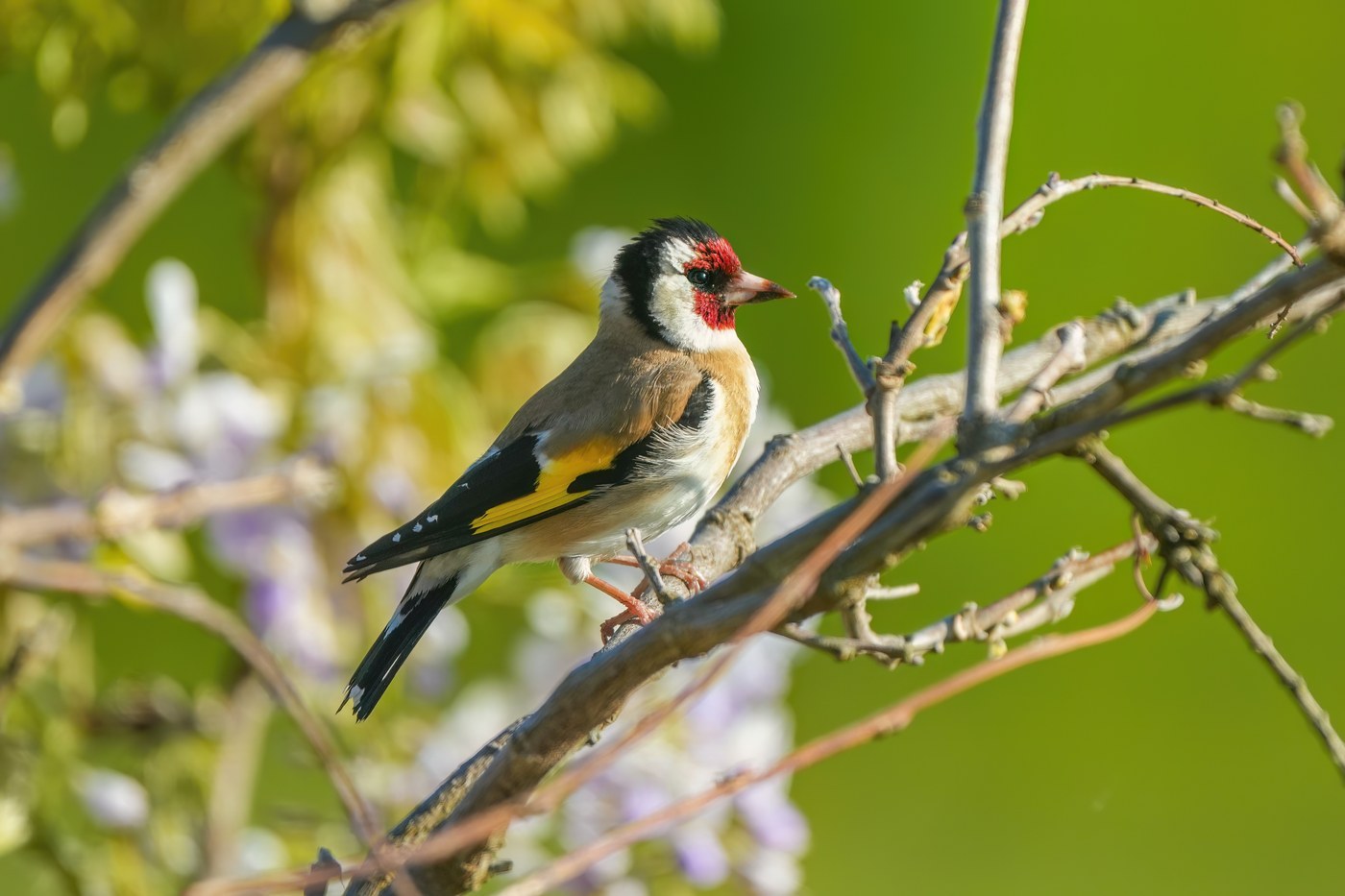
European Goldfinch
Carduelis carduelis
A strikingly colorful European finch with a bright red face, black-and-white head, and golden-yellow wing bars.
- Size
- 12-13 cm (4.7-5.1 in) long, 21-25.5 cm wingspan
- Habitat
- open woodland, orchards, farmland, parks, and gardens
- Type
- songbird
Spotted a bird like this?
Identify any bird from a photo, free.
Overview
The European Goldfinch is one of the most colorful and distinctive finches in Europe, featuring a bright crimson-red face, a bold black-and-white head pattern, warm buff-brown flanks, and striking golden-yellow wing patches that flash conspicuously in flight. Its bill is long, pale, and pointed, well suited to extracting seeds from thistles and other spiky plants.
Often seen in flocks called "charms," Goldfinches are agile and acrobatic feeders, clinging to swaying seed heads to extract food, and are popular garden visitors, especially where nyjer seed feeders are provided.
How to identify it
Key field marks
- Bright red face patch bordered by black and white head markings
- Golden-yellow wing bar, bold black-and-white wingtips
- Buff-brown back and flanks, white belly
- Long, slender, pale pointed bill
Similar species
- European Greenfinch lacks the red face, showing an olive-green body with yellow wing panels rather than golden bars.
- Juveniles lack the red-and-black head pattern, appearing streaky brown, but still show the golden wing bar.
Habitat & range
Habitat
Favors open woodland edges, orchards, farmland with hedgerows, weedy fields, parks, and gardens.
Range
Widespread across Europe, North Africa, and western Asia; introduced populations occur in Australia and New Zealand.
Migration
Partially migratory; northern populations move south in winter, while many western and southern European birds are resident.
Behavior & voice
Behavior
Highly social outside the breeding season, forming flocks ("charms") that move together between feeding areas; agile at clinging to thistle and teasel heads to extract seeds.
Voice
A liquid, tinkling, twittering song and a distinctive "tswitt-witt-it" flight call.
Feeding
Specializes on small seeds, particularly thistle, teasel, and dandelion, using its fine pointed bill to extract seeds from tight seed heads; also eats insects, especially when feeding young.
Nesting
Builds a neat, compact cup nest of moss, lichen, and roots, often placed high in the outer branches of a tree; lays 4-6 pale blue-white eggs with fine reddish speckling.
Frequently asked questions
How do you identify a European Goldfinch?
Look for a bright red face, black-and-white head pattern, and golden-yellow wing bars that flash in flight, combined with a long pale pointed bill.
What do Goldfinches eat?
They specialize in small seeds, especially thistle, teasel, and dandelion, using their fine pointed bill to extract seeds from tight seed heads.
Why is a group of Goldfinches called a charm?
It's a traditional English collective noun likely inspired by their musical, tinkling flock calls and attractive appearance.
Do young Goldfinches look like adults?
No, juveniles lack the red, black, and white head pattern, appearing streaky brown-headed, though they retain the golden wing bar.
European Goldfinch guides
In-depth guides for identifying, finding, and understanding European Goldfinch.
Other birds you may enjoy

Black Redstart
13-14.5 cm (5.1-5.7 in) long, 23-26 cm wingspan

Black-throated Sparrow
12-14 cm (4.7-5.5 in) long, about 19-20 cm (7.5-8 in) wingspan

Greater Bird-of-paradise
Body about 43 cm; males with additional flank plumes up to 50 cm and long tail wires

Blue Tit
11-12 cm (4.3-4.7 in) long, 17-20 cm wingspan

Red-billed Quelea
11.5–13 cm long, wingspan about 20–22 cm
White-plumed Antbird
13-14 cm (5-5.5 in) long

Pyrrhuloxia
19-22 cm (7.5-8.7 in) long, 30 cm wingspan

Blue-gray Tanager
16-18 cm (6-7 in) long

Blackburnian Warbler
11-13 cm (4.3-5.1 in) long, 20-22 cm wingspan

Bluethroat
13-14 cm (5.1-5.5 in) long, 20-22 cm wingspan

Eurasian Nuthatch
12-14.5 cm (4.7-5.7 in) long, 22.5-27 cm wingspan

Wood Thrush
19-21 cm (7.5-8.3 in) long, about 33 cm (13 in) wingspan