
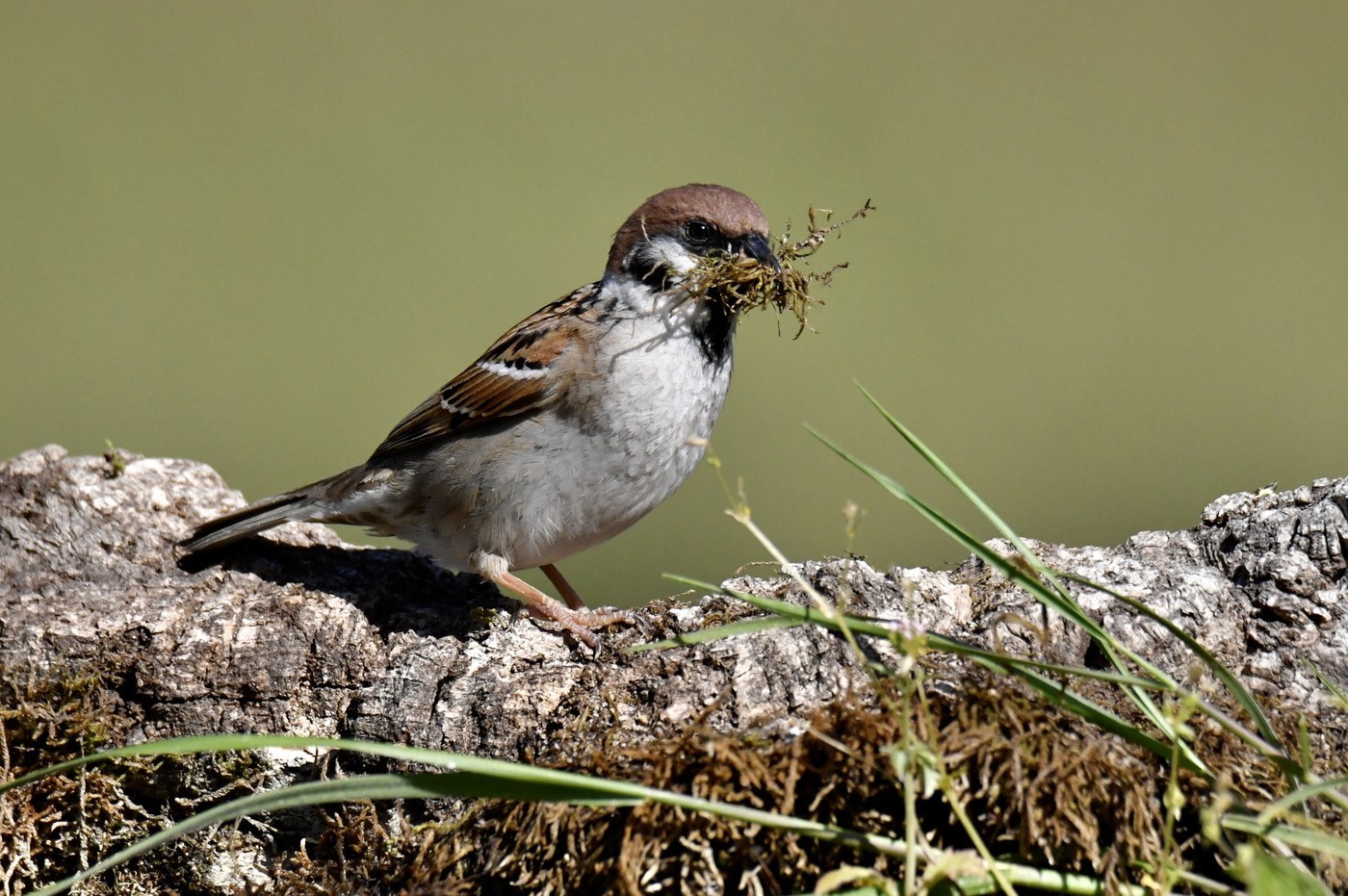
Eurasian Tree Sparrow
Passer montanus
A small, chestnut-capped sparrow with a black cheek patch, smaller and neater than its House Sparrow relative.
- Size
- 12.5-14 cm (5-5.5 in) long, 20-22 cm wingspan
- Habitat
- farmland, hedgerows, open woodland, and villages
- Type
- songbird
Spotted a bird like this?
Identify any bird from a photo, free.
Overview
The Eurasian Tree Sparrow is a compact, active little bird closely related to the House Sparrow but noticeably smaller and neater in pattern. Both sexes look alike, unlike House Sparrows, sporting a rich chestnut-brown crown and nape, a black bib, and a distinctive black spot on an otherwise clean white cheek.
The upperparts are streaked brown and black, and the bird shows a narrow white collar around the neck. Overall it appears trimmer and more delicately marked than the bulkier, more urban House Sparrow.
How to identify it
Key field marks
- Chestnut-brown crown and nape (both sexes alike, unlike House Sparrow's sexually dimorphic plumage)
- Clean white cheeks with a bold black spot
- Small black bib, smaller and neater than the House Sparrow's
- White collar around the hindneck
Similar species
The House Sparrow has a grey crown (not chestnut) and lacks the black cheek spot; male and female House Sparrows differ markedly while Tree Sparrow sexes look alike. Tree Sparrows are also slightly smaller and more active.
Habitat & range
Range
Breeds across most of Europe and temperate Asia, from Ireland east to Japan and Southeast Asia; introduced and locally established in parts of North America and Australia.
Habitat
Favors farmland, hedgerows, orchards, open woodland edges, and villages; in much of Asia it is the common sparrow of towns and cities, filling the urban niche occupied by House Sparrows elsewhere.
Migration
Mostly resident or a short-distance migrant, with northern and eastern populations moving south in the harshest winters.
Behavior & voice
Behavior
Gregarious outside the breeding season, forming flocks that often mix with House Sparrows, finches, and buntings at feeding sites. Feeds mainly on the ground and forages actively among stubble and hedgerows.
Voice
Calls include a sharp, hard "tek-tek" and a distinctive hard "teck teck" flight call, higher-pitched and more staccato than the House Sparrow's chirp; the song is a simple repetition of chirping notes.
Feeding
Eats mainly seeds and grain, switching to insects and other invertebrates when feeding nestlings.
Nesting and breeding
Nests in cavities such as tree holes, cliffs, and building crevices, sometimes in loose colonies. Lays 4-6 eggs, and pairs may raise two or three broods per season.
Frequently asked questions
How do you tell a Eurasian Tree Sparrow from a House Sparrow?
Tree Sparrows have a chestnut (not grey) crown and a distinct black spot on the white cheek; unlike House Sparrows, males and females look alike.
Is the Eurasian Tree Sparrow the common sparrow of Asian cities?
Yes, in much of East and Southeast Asia it fills the urban niche that the House Sparrow occupies in Europe and North America.
What does the Eurasian Tree Sparrow eat?
Mainly seeds and grain, supplemented with insects, which are especially important when feeding nestlings.
Where do Eurasian Tree Sparrows nest?
In cavities such as tree holes, cliff crevices, and gaps in buildings, sometimes forming loose nesting colonies.
Eurasian Tree Sparrow guides
In-depth guides for identifying, finding, and understanding Eurasian Tree Sparrow.
Other birds you may enjoy

Black Redstart
13-14.5 cm (5.1-5.7 in) long, 23-26 cm wingspan

Black-throated Sparrow
12-14 cm (4.7-5.5 in) long, about 19-20 cm (7.5-8 in) wingspan

Greater Bird-of-paradise
Body about 43 cm; males with additional flank plumes up to 50 cm and long tail wires

Blue Tit
11-12 cm (4.3-4.7 in) long, 17-20 cm wingspan

Red-billed Quelea
11.5–13 cm long, wingspan about 20–22 cm
White-plumed Antbird
13-14 cm (5-5.5 in) long

Pyrrhuloxia
19-22 cm (7.5-8.7 in) long, 30 cm wingspan

Blue-gray Tanager
16-18 cm (6-7 in) long

Blackburnian Warbler
11-13 cm (4.3-5.1 in) long, 20-22 cm wingspan

Bluethroat
13-14 cm (5.1-5.5 in) long, 20-22 cm wingspan

Eurasian Nuthatch
12-14.5 cm (4.7-5.7 in) long, 22.5-27 cm wingspan

Wood Thrush
19-21 cm (7.5-8.3 in) long, about 33 cm (13 in) wingspan