
Eurasian Tree Sparrow Identification Guide
A small, active sparrow told from the House Sparrow by its chestnut crown, black cheek spot, and smaller, neater build, favoring farmland and open woodland edges.
Read the full Eurasian Tree Sparrow encyclopedia entry →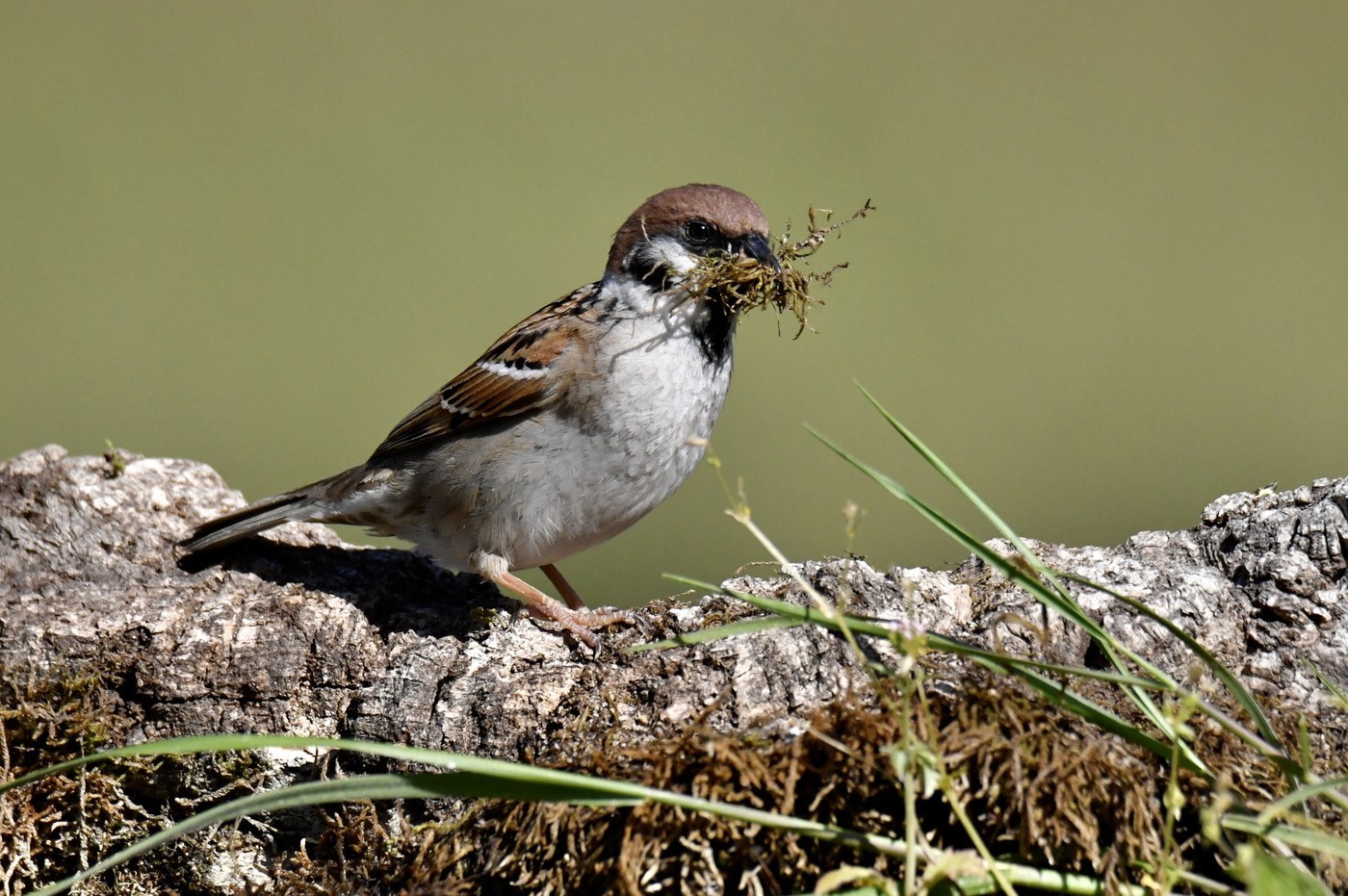
Key Field Marks
- Size & shape: A small, compact sparrow about 12.5-14 cm long, slightly smaller and neater-looking than House Sparrow, with a proportionally smaller head and bill.
- Plumage: Both sexes look alike (unlike House Sparrow) — a rich chestnut-brown crown and nape (not gray as in male House Sparrow), a white face and collar, and a distinctive black spot on each white cheek.
- Throat: Small black bib, notably smaller and neater than the larger black bib of a male House Sparrow.
- Back and wings: Streaked brown and black above with a clean white wing-bar (often two bars visible), giving a crisper, tidier appearance than House Sparrow.
- Bill: Short, conical, black in breeding season, duller horn-brown outside the breeding season.
- Behavior: Gregarious, forming flocks that often mix with House Sparrows and buntings on farmland; feeds on the ground and in low vegetation on seeds and, in summer, insects fed to young; frequently nests in tree holes and nest boxes, unlike the more building-associated House Sparrow.
Separating It From Similar Species
- House Sparrow (male): Male House Sparrow has a gray crown (not chestnut), a larger and more ragged black bib, and lacks the black cheek spot; sexes differ markedly in House Sparrow, whereas Tree Sparrow sexes look identical.
- House Sparrow (female): Female House Sparrow is plain grayish-brown with a pale buff supercilium and no black cheek spot or chestnut crown, quite different from the more patterned, chestnut-capped Tree Sparrow.
- Size and structure: Tree Sparrow is slightly smaller, neater, and more compact overall, with quicker, more active movements than the bulkier, slightly slouchier House Sparrow.
- Habitat cue: Tree Sparrow favors farmland, hedgerows, open woodland, and villages more than dense urban centers, where House Sparrow tends to dominate, though ranges overlap broadly and mixed flocks are common.
Where & When to See It
- Habitat: Farmland with hedgerows and old trees, open woodland edges, orchards, and villages; readily uses nest boxes and tree cavities, and often found around farm buildings and grain stores.
- Range: Breeds across almost all of Europe (though patchily and declining in parts of the west) through temperate Asia to Japan and Southeast Asia; largely resident, though northern and eastern populations show some winter movement, and it has also been introduced and become established in parts of North America and Australia.
- Season: Present year-round in most of its range; in winter often joins mixed flocks of sparrows, finches, and buntings feeding on stubble fields and around farmyards.
Voice & Song Cues
- Calls are similar to House Sparrow's cheeping chatter but tend to be higher-pitched, sharper, and more clipped, often including a distinctive hard "tek" or "chip" note.
- In flight, gives a sharp, hard "tek-tek" contact call, useful for picking out Tree Sparrows within a mixed flock before they are seen well.
- Song is a simple, repetitive series of chirps similar to House Sparrow's but generally considered slightly more musical and varied.
Frequently asked questions
What is the easiest way to tell Eurasian Tree Sparrow from House Sparrow?
Look for a chestnut-brown crown (not gray) and a distinct black spot on an otherwise white cheek — both sexes of Tree Sparrow show this pattern, unlike House Sparrow where only the male has gray on the head and neither sex shows a cheek spot.
Do male and female Eurasian Tree Sparrows look different?
No, unlike House Sparrows, male and female Tree Sparrows look essentially identical, both showing the chestnut cap and black cheek spot.
Where does the Eurasian Tree Sparrow prefer to live?
It favors farmland, hedgerows, orchards, open woodland edges, and villages, nesting in tree holes and nest boxes, rather than the dense urban habitat favored by House Sparrow.
Has the Eurasian Tree Sparrow been introduced outside its native range?
Yes, it has been introduced and established feral populations in parts of North America (notably around St. Louis, Missouri) and Australia.
What call helps identify a Eurasian Tree Sparrow in a mixed flock?
A sharp, hard 'tek-tek' contact call, higher-pitched and more clipped than House Sparrow's chirping, can help pick it out even before it's seen clearly.